


If motivation at work were driven mainly by pay rises, perks, or promotion cycles, employers would have cracked the code by now. PwC’s latest global workforce data points to something far more powerful—and far harder to manufacture.
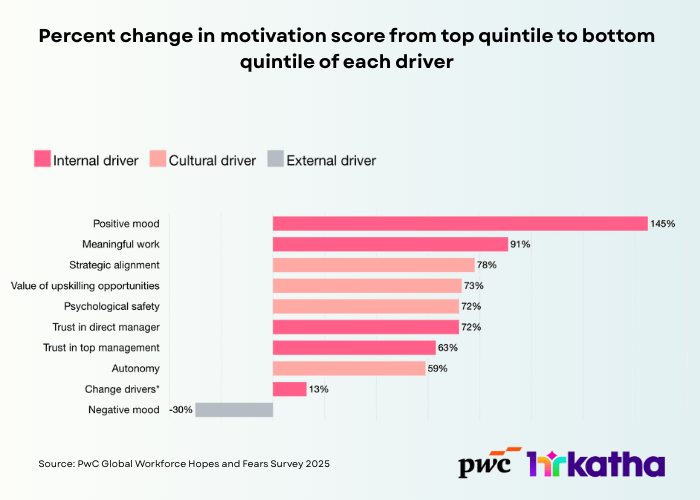
According to PwC’s 2025 Global Workforce Hopes and Fears Survey, a positive mood at work lifts employee motivation by 145 per cent, making it the single strongest driver of motivation across the workforce. It outperforms meaningful work (91 per cent), strategic alignment (78 per cent), access to upskilling (73 per cent), psychological safety (72 per cent), and trust in direct managers (72 per cent). External pressures—such as technological or climate-driven change—barely move the needle by comparison.
The finding is revealing because mood is not an individual trait. It is an organisational outcome. It reflects whether people feel aligned with leadership, safe to speak up, supported by managers, and confident their skills will remain relevant. In that sense, mood is not soft sentiment—it is a proxy for how well the system around employees is working.
Those systems, PwC’s data suggests, are delivering sharply uneven experiences.
Drawing on responses from 49,843 workers across 48 countries and 28 sectors, the survey reveals a workforce divided not by effort or ambition, but by access—to clarity, learning, trust, and increasingly, artificial intelligence.
A 78 per cent motivation gap, driven by alignment rather than pay
One number explains much of the disparity: 78 per cent.
That is the motivation gap between employees who feel highly aligned with their organisation’s goals and those who do not. Trust in one’s direct manager delivers a similar uplift, raising motivation by 72 per cent. Psychological safety produces the same effect.
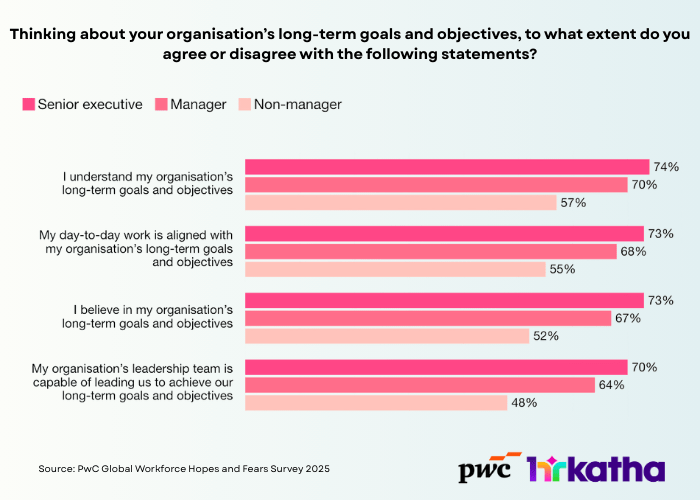
Yet alignment remains uneven. Only 64 per cent of workers say they understand their organisation’s goals. Among non-managers, the figure falls to 43 per cent. Optimism about the future of work follows the same hierarchy: just 53 per cent of workers feel strongly optimistic about their roles, compared with 72 per cent of senior executives and 43 per cent of non-managers.
The implication is uncomfortable. Motivation is not lacking; it is being rationed. Where clarity and trust exist, engagement follows. Where they do not, even generous rewards struggle to compensate.
An AI productivity divide: 92 per cent for daily users, 58 per cent for the rest
Nowhere is this unevenness more visible than in the use of generative AI.
Among workers who use GenAI tools daily, 92 per cent report productivity gains over the past year. For infrequent users, the figure drops to 58 per cent. The pattern repeats elsewhere: 58 per cent of daily users report improved job security, compared with 36 per cent of infrequent users; 52 per cent saw salary increases, versus 32 per cent among those who use AI only occasionally.
These are not marginal advantages. They amount to a 34-point productivity gap, a 22-point job-security gap, and a 20-point pay gap—evidence that AI access is already reshaping employment outcomes.
Yet deep adoption remains limited. Only 14 per cent of workers use GenAI daily, up slightly from 12 per cent in 2024. While 54 per cent have used AI at least once in the past year—and around three-quarters say it improves productivity—the benefits are concentrated among a small minority.
Many organisations, it seems, have achieved AI visibility without AI depth.
A widening learning gap between executives and everyone else
Access to learning closely tracks access to AI—and amplifies its effects.
Seventy-two per cent of senior executives say they have the learning and development opportunities they need.
Among managers, the figure is 66 per cent. Among non-managers, it falls to 51 per cent—a 21-point gap between the top and the frontline.
This gap compounds over time. Seventy-five per cent of daily AI users say they have the resources they need for learning and development, compared with 59 per cent of infrequent users. Access enables usage; usage justifies further investment; and investment produces better outcomes. Those without early access fall progressively further behind.
Sectoral data reinforces the point. In technology, 73 per cent of workers understand their organisation’s goals, compared with 64 per cent across the broader workforce. Skill development, clarity, and motivation tend to travel together.
The skills gap, in other words, is not emerging organically. It is being designed through uneven investment.
Gen Z’s contradiction: optimistic about work, impatient with employers
No group captures this tension more clearly than Gen Z.
Workers aged 18–28 are nearly twice as likely as Gen X (45–60) to feel optimistic about the future of their roles—62 per cent versus 35 per cent. Yet 27 per cent of Gen Z respondents say they are likely to change jobs in the next year, compared with 19 per cent of Gen X.
This is not cynicism. It is ambition.
Gen Z is the most likely cohort to ask for raises and promotions, and among the most motivated overall. They are also more curious about AI (47 per cent) and more optimistic about its long-term societal impact (38 per cent) than older workers.
At the same time, nearly one-third of entry-level employees worry significantly about AI’s impact on their own futures. Early-career roles are where automation risk is highest, and Gen Z is acutely aware of it.
The paradox is telling: the most optimistic workers are also the most mobile, because optimism about work does not necessarily translate into confidence in current employers.
Why anxiety and optimism about AI coexist
At first glance, employee attitudes to AI appear contradictory. Twenty-six per cent of workers say they are worried about AI, and 21 per cent say they are confused by it. Yet optimism dominates: roughly three-quarters of
AI users say it improves productivity and work quality.
This is not inconsistency but realism. Workers can see AI’s potential while fearing its consequences.
The divide between users and non-users is stark. Seventy per cent of daily GenAI users expect technology to significantly change their jobs over the next three years. Among non-users, fewer than half expect such disruption, ranking it alongside shifts in regulation or customer preferences.
Those closest to the technology see its impact most clearly. Those furthest from it risk being caught unprepared.
Content at work, but increasingly strained
The survey also captures the emotional texture of modern work.
Seventy per cent of respondents say they feel satisfied with their work at least once a week, including 22 per cent who feel satisfied daily. At the same time, 35 per cent report feeling overwhelmed weekly.
Satisfaction and strain coexist. Work is meaningful, but demanding. Financial pressure sharpens the strain: more than half of workers report financial stress, and nearly as many say they feel fatigued.
In this environment, alignment, trust, and psychological safety are not soft cultural aspirations. They are stabilisers—buffers against burnout in systems that ask more while offering less certainty.
What 49,843 workers are really saying
Taken together, the data delivers a consistent message.
Motivation correlates more strongly with alignment, trust, and psychological safety than with compensation.
Productivity is driven less by intent than by AI access and depth of use. Skill confidence depends not on sector, but on whether organisations invest evenly across levels.
The disparities are structural: a 21-point learning gap between executives and non-managers; a 34-point productivity gap between daily and infrequent AI users; and a workforce where 73 per cent of non-managers have never used GenAI, while nearly half of senior leaders use AI agents weekly or daily.
These gaps are not accidental. They are the outcome of selective enablement.
Workers, however, appear ready. Fifty-four per cent have already used AI. Most believe it improves work quality. Gen Z remains optimistic despite tight labour markets and rapid change. What is missing is not willingness, but inclusion.
A PwC survey of 49,843 workers shows a workforce divided by access and alignment; in India, that divide is increasingly created inside organisations, not by the talent market.
