


Employee engagement has plummeted 24 percentage points in a single year—from 88 per cent in 2025 to just 64 per cent in 2026. This isn’t gradual erosion. It’s a collapse. According to DHR Global’s Workforce Trends Report 2026, surveying 1,500 corporate professionals across North America, Europe, and Asia, the decline is consistent across regions: Asia at 59 per cent, North America at 67 per cent, Europe at 68 per cent.
Yet burnout rates remain virtually unchanged—83 per cent in 2026 versus 82 per cent in 2025. The one-point stability in burnout paired with a 24-point engagement drop reveals something crucial: it’s not that more workers are burning out, but that burnout’s impact on those who remain has intensified dramatically. Fifty-two per cent now say burnout reduces engagement, up from 34 per cent—an 18-percentage-point surge in just 12 months.
The recognition crisis: from 17% to 32%
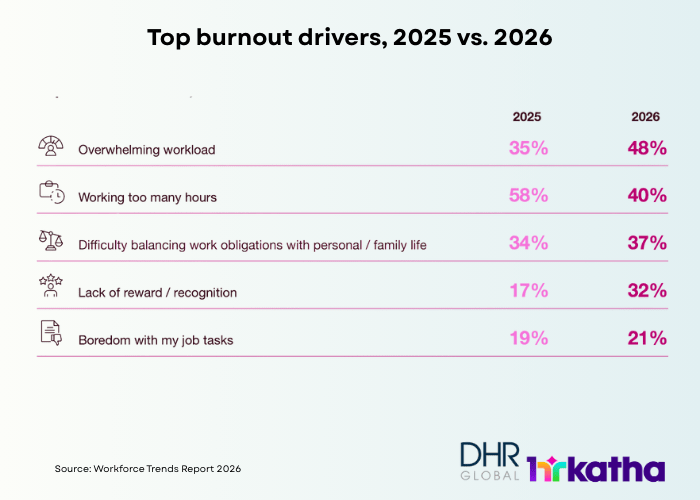
The most striking shift in burnout drivers: lack of reward or recognition jumped from 17 per cent to 32 per cent—nearly doubling in one year. This dwarfs other changes. Overwhelming workload rose from 35 per cent to 48 per cent (13 points). Work-life balance difficulty climbed from 34 per cent to 37 per cent (three points). Boredom inched from 19 per cent to 21 per cent (two points).
Recognition failure surged 15 percentage points, becoming the third-leading burnout driver after workload (48 per cent) and excessive hours (40 per cent). When employees were asked what would most improve workplace culture, 34 per cent cited “recognition and reward systems that reflect our company mission and values”—tied for the top response alongside flexibility.
When 91 per cent of respondents say high-performing colleagues’ exits impact the organisation, yet recognition failures are doubling, organisations are losing their best people, burning out those who remain, and failing to recognise either group’s efforts.
The culture disconnect: 77% of executives, 37% of entry-level
Whilst 77 per cent of C-suite leaders say culture is “very important,” only 37 per cent of entry-level employees agree. Executives are 2.5 times more likely than entry-level staff to view company culture as well-defined. Only 36 per cent of all workers feel their company culture is well-defined and drives performance, with 46 per cent describing it as reactive and inconsistent.
This perception gap materialises in engagement disparities. Associates (62 per cent) and entry-level employees (61 per cent) are most likely to report reduced engagement due to burnout, compared to just 38 per cent of C-suite leaders. The people with least power to shape culture bear its heaviest burden.
Regional patterns converge around similar needs. North Americans want recognition (40 per cent) and clearer communication (38 per cent). Europeans want recognition (37 per cent) and manageable workloads (37 per cent). Asians want flexibility (38 per cent) and manageable workloads (38 per cent). Different entry points, same underlying needs: visibility, clarity, autonomy.
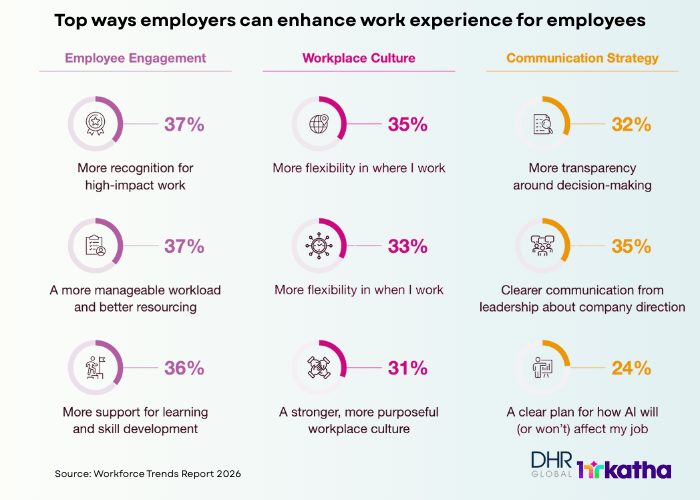
When asked specifically about top improvements, employees reveal consistent priorities across three domains. For employee engagement: 37 per cent want more recognition for high-impact work, 37 per cent seek manageable workloads and better resourcing, and 36 per cent request more support for learning and skill development.
For workplace culture: 35 per cent want flexibility in where they work, 33 per cent seek flexibility in when they work, and 31 per cent desire a stronger, more purposeful culture. For communication strategy: 35 per cent want clearer communication from leadership about company direction, 32 per cent seek more transparency around decision-making, and 24 per cent want a clear plan for how AI will affect their jobs.
The pattern reveals a hierarchy: recognition and workload management top the list, followed by location flexibility and leadership clarity, whilst AI communication—despite the 57-point executive-employee gap—ranks lower in stated priorities even as it creates significant anxiety.
The AI communication chasm: 69% of C-suite, 12% of entry-level
Whilst 69 per cent of C-suite leaders say their organisation has communicated “very clearly” about AI’s impact on jobs and skills, only 12 per cent of entry-level staff and 22 per cent of associates agree. This 57-percentage-point gap between what executives believe they’ve communicated and what frontline workers have heard creates extraordinary risk.
The engagement consequences are direct. Seventy-four per cent of C-suite leaders report higher engagement from generative AI tools, compared to just 27 per cent of entry-level employees—a 47-point differential.
Technology sector provides contrast. Fifty-two per cent of tech employees say their companies have been very clear about AI’s impact—the highest of any sector. Tech employees are also most likely to report significant engagement boosts from generative AI (37 per cent, versus 14-23 per cent in other sectors). Seventy-eight per cent of tech workers report being highly engaged overall, and 48 per cent say their workplace culture is well-defined.
The fading novelty: AI and flexibility lose their edge
Thirty-nine per cent of employees reported noticeable productivity gains from AI tools, highest in Asia (44 per cent), followed by Europe (40 per cent) and North America (33 per cent). Yet AI’s positive impact on engagement is waning. In 2025, 70 per cent said generative AI tools increased engagement. In 2026, just 55 per cent say the same—a 15-point drop.
Remote and hybrid work shows similar erosion: from 75 per cent positive impact in 2025 to 63 per cent in 2026 (12-point decline). Job insecurity concerns have doubled—from 16 per cent to 34 per cent. Tighter job markets now drag engagement for 19 per cent, up from nine per cent.
Early enthusiasm for flexibility and AI is collapsing into anxiety about relevance and security. When one in five organisations (20 per cent) has seen job reductions due to automation, and 20 per cent have encountered misinformation from AI tools, scepticism is rational.
The return-to-office resistance: 38% impacted, 34% supportive
Thirty-eight per cent of employees have been directly impacted by return-to-office (RTO) mandates, yet only 34 per cent fully support their organisation’s approach. Twenty-three per cent somewhat or strongly oppose it.
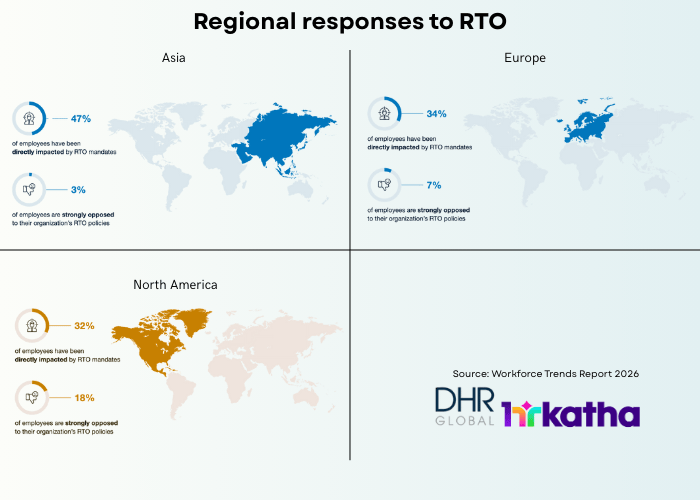
Regional patterns diverge. Forty-seven per cent of Asian employees have been impacted by RTO, compared to 34 per cent in Europe and 32 per cent in North America. Yet strong opposition is highest in North America (18 per cent) and much lower in Europe (seven per cent) and Asia (three per cent).
Job level predicts support. Sixty-one per cent of C-suite leaders fully support RTO policies, but this drops to 30 per cent of entry-level staff and 19 per cent of associates.
What would make in-office days manageable? Forty-two per cent want ability to choose which days to come in. Forty-one per cent want better perks. Thirty-nine per cent want clearer reasoning behind mandates. Employees aren’t rejecting offices—they’re rejecting arbitrariness.
The sector paradox: tech’s engagement, retail’s burnout
Technology leads all sectors in engagement at 78 per cent—14 points above the 64 per cent average. Nearly half of tech workers (48 per cent) say their workplace culture is well-defined, suggesting strong culture sustains engagement despite pressures.
Yet retail shows the highest burnout at 62 per cent, followed by healthcare (61 per cent) and technology (58 per cent). The tech paradox: highest engagement, third-highest burnout. Strong culture and clear AI communication apparently buffer burnout’s engagement impact even when burnout rates are elevated.
The turnover cascade: 91% feel high-performer exits
Ninety-one per cent say high-performing colleagues’ exits impact the organisation. Top consequences: increased pressure on remaining team members (43 per cent), knowledge gaps (34 per cent), and lower motivation (32 per cent).
This creates a doom loop. High performers leave due to burnout or lack of recognition. Remaining workers shoulder abandoned responsibilities (43 per cent). Work suffers from knowledge loss (34 per cent). Survivors feel less motivated (32 per cent), increasing their likelihood of burning out or leaving. The cycle accelerates.
What the 24-point collapse reveals
The DHR Global data captures organisations at an inflection point. Burnout rates are stable, but burnout’s impact has nearly doubled. Recognition failures have doubled. Job security concerns have doubled. AI and flexibility benefits are eroding whilst anxieties intensify.
The 24-point engagement collapse represents the largest single-year drop documented in recent workforce research. It’s not a blip. It’s a rupture.
Three interventions emerge as potentially decisive. First, double down on recognition. When recognition failures jump from 17 per cent to 32 per cent whilst 91 per cent say high-performer exits matter, make contribution visible or watch contributors leave.
Second, close the AI communication chasm. When 69 per cent of executives think they’ve communicated clearly whilst 12 per cent of entry-level staff agree, the 57-point gap isn’t perception—it’s reality. Tech’s example (52 per cent clear communication, 78 per cent engagement) shows what’s possible.
Third, grant autonomy over RTO. When 42 per cent want choice over which days to come in and only 34 per cent support current policies, flexibility earns buy-in whilst mandates don’t.
The question facing organisations in 2026 isn’t whether to act, but whether they’ll act before the 64 per cent engagement rate drops further and the doom loop becomes irreversible. The 24-point collapse in one year suggests the window is closing fast.