


Close Menu
    Facebook X (Twitter) Instagram
    • Our Story
    • Partner with us
    • Reach Us
    • Career
    Subscribe Newsletter
    HR KathaHR Katha
    • Exclusive
      • Exclusive Features
      • Perspectives
      • Friday Features
      • herSTORY
      • Case-In-Point
      • Point Of View
      • Research
      • HR Pops
      • Dialogue
      • Movement
      • Profile
      • Beyond Work
      • Rising Star
      • By Invitation
    • News
      • Global HR News
      • Compensation & Benefits
      • Diversity
      • Events
      • Gen Y
      • Hiring & Firing
      • HR & Labour Laws
      • Learning & Development
      • Merger & Acquisition
      • Performance Management & Productivity
      • Talent Management
      • Tools & Technology
      • Work-Life Balance
    • Special
      • HR Forecast 2026
      • Cover Story
      • Editorial
      • HR Forecast 2024
      • HR Forecast 2023
      • HR Forecast 2022
      • HR Forecast 2021
      • HR Forecast 2020
      • HR Forecast 2019
      • New Age Learning
      • Coaching and Training
      • Learn-Engage-Transform
    • Magazine
    • Reports
      • Whitepaper
        • HR Forecast 2024 e-mag
        • Future-proofing Manufacturing Through Digital Transformation
        • Employee Healthcare & Wellness Benefits: A Guide for Indian MSMEs
        • Build a Future Ready Organisation For The Road Ahead
        • Employee Experience Strategy
        • HRKatha 2019 Forecast
        • Decoding and Driving Employee Engagement
        • One Platform, Infinite Possibilities
      • Survey Reports
        • Happiness at Work
        • Upskilling for Jobs of the Future
        • The Labour Code 2020
    • Conferences
      • Leadership Summit 2025
      • Rising Star Leadership Awards
      • HRKatha Futurecast
      • Automation.NXT
      • The Great HR Debate
    • HR Jobs
    WhatsApp LinkedIn X (Twitter) Facebook Instagram
    HR KathaHR Katha
    zoha
    Home»Exclusive Features»Contextual intelligence: Reading the room, shaping the response
    Exclusive Features

    Contextual intelligence: Reading the room, shaping the response

    Why the ability to interpret context and act on it is becoming the defining skill of effective HR leaders
    mmBy Liji Narayan | HRKathaApril 7, 2026Updated:April 7, 20263 Mins Read6534 Views
    Share LinkedIn Twitter Facebook WhatsApp
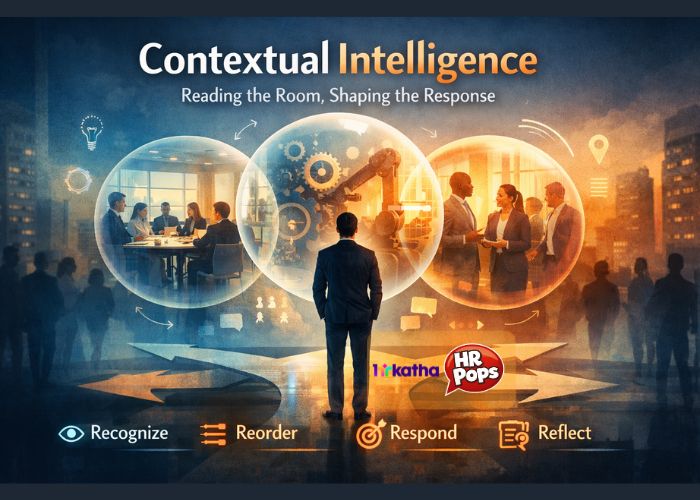
    Contextual intelligence (HR Pops)
    Share
    LinkedIn Twitter Facebook WhatsApp

    What does ‘contextual intelligence’ mean?

    Contextual intelligence is the ability to understand the environment around you, interpret its dynamics, and adapt your actions accordingly.

    It goes beyond technical knowledge or emotional awareness. It is about reading the room, recognising what truly matters in a given situation, and responding in a way that fits the context.

    zoha

    Unlike technical intelligence, which is knowing what to do, or emotional intelligence, which is understanding how people feel, contextual intelligence is about knowing what will work, where, and why.

    It is often explained through a simple framework of four steps: recognise the situation and its complexities, reorder priorities based on context, respond with appropriate action, and reflect to improve future decisions. Together, these form the “4R” model of contextual decision-making.

    Where did the idea come from?

    The concept emerged from leadership studies in the late 20th century, as scholars began to observe that effective leaders did more than apply standard frameworks.

    They adapted.

    Early thinking linked contextual intelligence to ideas such as tacit knowledge, timing, and non-linear thinking. Over time, it became clear that leaders who could interpret context and adjust their approach consistently outperformed those who relied on rigid models.

    As organisations became more global, complex, and technology-driven, contextual intelligence evolved into a distinct leadership capability. It is particularly valuable in uncertain and rapidly changing environments.

    zoha

    Why is it relevant for HR?

    HR operates at the intersection of people, culture, and business strategy. In all these areas, context matters.

    Contextual intelligence shapes several core HR functions:

    • Employee engagement: What works in one team or geography may fail in another. Context-aware strategies outperform standardised programmes
    • Talent decisions: Hiring and development require understanding not just skills, but cultural fit, market conditions, and organisational needs
    • Change management: Timing, communication style, and stakeholder alignment often determine success more than the change itself
    • Leadership development: Future leaders must be equipped to adapt, not just execute predefined competencies
    • Global workforce management: Balancing global consistency with local relevance requires constant contextual judgement

    In an era shaped by AI, hybrid work, and diverse workforces, the ability to interpret context has become central to effective HR leadership.

    The gap between knowing and applying

    Here lies the challenge. Contextual intelligence is widely claimed, but rarely demonstrated.

    Many HR professionals believe they “read the room”. Yet engagement initiatives fail, change programmes face resistance, and inclusion efforts feel disconnected from reality.

    The problem is often a misunderstanding of what contextual intelligence requires.

    It is not instinct alone. Intuition can be biased.

    It is not experience alone. Experience can become outdated.

    True contextual intelligence demands deliberate effort. It requires seeking diverse perspectives, questioning assumptions, and adjusting based on feedback.

    The final step, reflection, is often overlooked. Without assessing what worked and what did not, learning remains incomplete.

    At the same time, over-adapting carries its own risk. When policies shift too frequently or messages change across audiences, organisations lose consistency and trust.

    Contextual intelligence is therefore not about reacting to everything. It is about adapting with coherence.

    The takeaway

    Contextual intelligence is less about rules and more about judgement.

    For HR, it ensures that policies, practices and decisions are not one-size-fits-all, but aligned with the realities of the organisation and its people.

    As workplaces become more complex and less predictable, this capability is emerging as a key differentiator. It separates those who manage processes from those who shape outcomes.

    The question is not whether context matters.

    It is whether you are interpreting it well enough to act on it.

    ability to adapt your actions according to the environment around you ability to understand the environment around you Contextual intelligence Contextual intelligence shapes several core HR functions: Employee employer HR HR Pop HR Pops HRPops Human Resources interpret context and act on it LEAD non-linear thinking relevant for HR Tacit knowledge timing widely claimed but rarely demonstrated Workforce
    Share. LinkedIn Twitter Facebook WhatsApp
    mm
    Liji Narayan | HRKatha

    HRKatha prides itself in being a good journalistic product and Liji deserves all the credit for it. Thanks to her, our readers get clean copies to read every morning while our writers are kept on their toes.

    Leave A Reply Cancel Reply

    Related Posts

    Microsoft employees feel more energised at work; but seek greater growth opportunities

    June 5, 2026

    Teradata freezes salary hikes for 2026 to boost AI investments

    June 5, 2026

    Google cuts jobs in cloud and cybersecurity teams amid AI push

    June 5, 2026

    T-Mobile to hire 1,000 professionals in Hyderabad

    June 5, 2026
    Editorial

    The knowledge that retires before the person does

    The logic behind retirement at 60 once made sense. India was younger. Jobs were scarce.…

    The new power map inside HR

    The org chart did not predict this shift. Business urgency did. Corporate HR structures still…

    EDITOR'S PICKS

    The workplace fears people are finally starting to lose

    June 5, 2026

    Case-in-Point: Capability vs credibility

    June 4, 2026

    herSTORY: Sonali De Sarker, SVP-HR, Epsilon India

    June 4, 2026

    HR Perspectives by Raj Narayan: “Leadership commitment is the starting point to both meritocracy and inclusion”

    June 3, 2026
    Latest Post

    Microsoft employees feel more energised at work; but seek greater growth opportunities

    News June 5, 2026

    Employees at Microsoft are feeling more engaged and empowered at work, according to the company’s…

    Teradata freezes salary hikes for 2026 to boost AI investments

    News June 5, 2026

    Cloud analytics and software company Teradata has decided to suspend annual salary increases for its…

    Google cuts jobs in cloud and cybersecurity teams amid AI push

    News June 5, 2026

    Google has reportedly reduced headcount across parts of its Cloud business, including teams within its…

    T-Mobile to hire 1,000 professionals in Hyderabad

    News June 5, 2026

    US telecom major T-Mobile has strengthened its presence in India with the launch of a…

    Asia's No.1 HR Platform

    Facebook X (Twitter) Instagram LinkedIn WhatsApp Bluesky
    • Our Story
    • Partner with us
    • Career
    • Reach Us
    • Exclusive Features
    • Cover Story
    • Editorial
    • Dive into the Future of Work: Download HRForecast 2024 Now!
    © 2026 HRKatha.com
    • Disclaimer
    • Refunds & Cancellation Policy
    • Terms of Service

    Type above and press Enter to search. Press Esc to cancel.