


Close Menu
    Facebook X (Twitter) Instagram
    • Our Story
    • Partner with us
    • Reach Us
    • Career
    Subscribe Newsletter
    HR KathaHR Katha
    • Exclusive
      • Exclusive Features
      • Perspectives
      • Friday Features
      • herSTORY
      • Case-In-Point
      • Point Of View
      • Research
      • HR Pops
      • Dialogue
      • Movement
      • Profile
      • Beyond Work
      • Rising Star
      • By Invitation
    • News
      • Global HR News
      • Compensation & Benefits
      • Diversity
      • Events
      • Gen Y
      • Hiring & Firing
      • HR & Labour Laws
      • Learning & Development
      • Merger & Acquisition
      • Performance Management & Productivity
      • Talent Management
      • Tools & Technology
      • Work-Life Balance
    • Special
      • HR Forecast 2026
      • Cover Story
      • Editorial
      • HR Forecast 2024
      • HR Forecast 2023
      • HR Forecast 2022
      • HR Forecast 2021
      • HR Forecast 2020
      • HR Forecast 2019
      • New Age Learning
      • Coaching and Training
      • Learn-Engage-Transform
    • Magazine
    • Reports
      • Whitepaper
        • HR Forecast 2024 e-mag
        • Future-proofing Manufacturing Through Digital Transformation
        • Employee Healthcare & Wellness Benefits: A Guide for Indian MSMEs
        • Build a Future Ready Organisation For The Road Ahead
        • Employee Experience Strategy
        • HRKatha 2019 Forecast
        • Decoding and Driving Employee Engagement
        • One Platform, Infinite Possibilities
      • Survey Reports
        • Happiness at Work
        • Upskilling for Jobs of the Future
        • The Labour Code 2020
    • Conferences
      • Leadership Summit 2025
      • Rising Star Leadership Awards
      • HRKatha Futurecast
      • Automation.NXT
      • The Great HR Debate
    • HR Jobs
    WhatsApp LinkedIn X (Twitter) Facebook Instagram
    HR KathaHR Katha
    zoha
    Home»Exclusive Features»HR Pops»Navigating the grey: When the rulebook runs out
    HR Pops

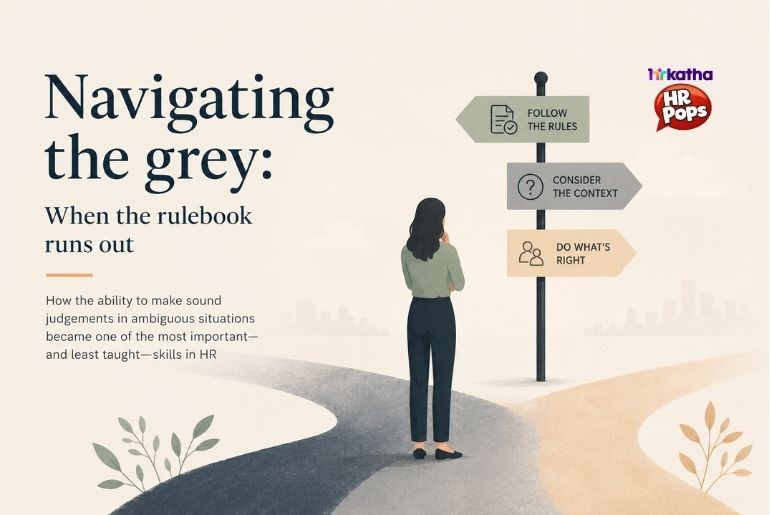
    Navigating the grey: When the rulebook runs out

    How the ability to make sound judgements in ambiguous situations became one of the most important, and least taught, skills in HR
    mmBy Liji Narayan | HRKathaJune 16, 20264 Mins Read432 Views
    Share LinkedIn Twitter Facebook WhatsApp
    HR Pops: Navigating the Grey
    Share
    LinkedIn Twitter Facebook WhatsApp

    What does ‘navigating the grey’ mean?

    Navigating the grey refers to the ability to manage uncertainty, balance competing priorities, and make fair judgements when rules or precedents offer no clear answer.

    It is the opposite of black-and-white thinking. Workplaces rarely present problems with obvious solutions. Decisions involving people, culture, performance, ethics, or conduct often sit in territory where context matters as much as policy. A decision can be procedurally correct and still feel fundamentally unfair. Equally, a compassionate exception can create unintended consequences elsewhere.

    zoha

    For HR professionals, navigating the grey means knowing when strict adherence to policy serves the organisation and when judgement should take precedence. It involves balancing employee rights with business realities, resolving conflicts where both sides have legitimate claims, and recognising that fairness is not always the same as consistency.

    Where did the idea come from?

    The phrase emerged from broader discussions around leadership, ethics, and decision-making that gained prominence towards the end of the twentieth century.

    For much of the industrial era, organisations relied heavily on rules, hierarchies, and standardised processes. The assumption was simple: if enough procedures existed, most situations could be managed predictably. As workplaces became more diverse, global, and knowledge-driven, leaders discovered that many challenges did not fit neatly into established frameworks.

    Management thinkers increasingly emphasised judgement, adaptability, and situational leadership. Corporate scandals, globalisation, remote work, and technological disruption reinforced the idea that rulebooks alone could not provide every answer. Organisations needed leaders capable of interpreting context rather than simply enforcing procedure.

    Why is it relevant for HR?

    Few functions encounter ambiguity as frequently as HR.

    Employee relations issues often involve incomplete information, conflicting accounts, and emotionally charged situations. A grievance may contain elements of truth on both sides. A misconduct case may require balancing intent against impact. A workplace dispute may involve policy violations, personality clashes, and broader cultural issues simultaneously.

    zoha

    The challenge extends beyond employee relations. Flexible work arrangements, mental health concerns, diversity initiatives, AI-enabled recruitment, surveillance technologies, and evolving expectations around fairness regularly place HR in situations where precedent offers limited guidance. In such cases, policy provides a starting point, not a complete answer.

    This is where judgement becomes indispensable. Human resource professionals are often required to weigh competing interests, assess context carefully, and make decisions that may satisfy no one completely but remain fair and defensible.

    The risk: when grey becomes an excuse

    The ability to navigate ambiguity is valuable. The danger arises when ambiguity becomes a convenient refuge.

    In many organisations, genuinely difficult decisions are labelled “complex” not because they lack clarity but because acting on them would be uncomfortable.

    Investigations drag on in the name of nuance. Obvious misconduct becomes a matter requiring further consideration. Accountability is delayed because someone influential is involved.

    The pattern is familiar. Junior employees often encounter rigorous policy enforcement. Senior leaders receive contextual interpretation. Behaviour that appears straightforward when committed by one employee suddenly becomes complicated when committed by another.

    Not every difficult decision is ambiguous. Some situations are uncomfortable but clear. Treating them as grey areas does not demonstrate sophistication. It simply postpones accountability.

    The real challenge for HR is distinguishing between situations that genuinely require judgement and those where the right course of action is already evident but politically inconvenient.

    The takeaway

    Navigating the grey has become one of the defining capabilities of modern HR because organisations increasingly operate in environments where certainty is scarce and competing interests are unavoidable.

    Yet the value of the skill depends entirely on how it is applied. Used well, it allows HR to bring humanity, context, and sound judgement to situations where rigid rules would fail. Used poorly, it becomes a justification for inconsistency, avoidance, and unequal treatment.

    The distinction matters. Rules can be written into policies. Judgement cannot.

    And in the moments when the rulebook runs out, the quality of that judgement becomes the real test of HR leadership.

    Ambiguity ambiguity in HR function ambiguous situations Employee employer grey areas HR HR Pops HRKatha pops HRPops Human Resources making fair judgements amidst unclear rules navigating the grey navigating the grey in HR navigating uncertainty when grey becomes an excuse when precedent offers limited guidance Workforce
    Share. LinkedIn Twitter Facebook WhatsApp
    mm
    Liji Narayan | HRKatha

    HRKatha prides itself in being a good journalistic product and Liji deserves all the credit for it. Thanks to her, our readers get clean copies to read every morning while our writers are kept on their toes.

    Leave A Reply Cancel Reply

    Related Posts

    Women make up 23% of Vedanta workforce; 13% representation across core ops

    June 16, 2026

    SBI gears up for major HR overhaul to tackle burnout

    June 16, 2026

    How PDS operates across 24 countries without imposing one culture

    June 16, 2026

    Banijay Asia appoints Bhagyashree Zope as head of talent acquisition

    June 16, 2026
    Editorial

    The two cultures inside the same multinational

    Someone I know works with one of the world’s largest technology and consulting firms. Based…

    Why HR becomes conservative when hiring HR

    Hire for potential, not just pedigree. Look beyond industry boundaries. Avoid groupthink. Value transferable capability.…

    EDITOR'S PICKS

    How PDS operates across 24 countries without imposing one culture

    June 16, 2026

    Navigating the grey: When the rulebook runs out

    June 16, 2026

    POV: Is employee retention really a manager issue?

    June 15, 2026

    The two cultures inside the same multinational

    June 13, 2026
    Latest Post

    Women make up 23% of Vedanta workforce; 13% representation across core ops

    Diversity Equity & Inclusion June 16, 2026

    Vedanta continues to progress towards its target of 35 per cent women’s representation, and how!…

    SBI gears up for major HR overhaul to tackle burnout

    Employee Benefits & Welfare June 16, 2026

    State Bank of India is planning a sweeping revamp of its human resources strategy to…

    How PDS operates across 24 countries without imposing one culture

    Exclusive Features June 16, 2026

    Global organisations face a familiar temptation as they grow: standardise everything. Uniform policies. Consistent behaviours.…

    Navigating the grey: When the rulebook runs out

    HR Pops June 16, 2026

    What does ‘navigating the grey’ mean? Navigating the grey refers to the ability to manage…

    Asia's No.1 HR Platform

    Facebook X (Twitter) Instagram LinkedIn WhatsApp Bluesky
    • Our Story
    • Partner with us
    • Career
    • Reach Us
    • Exclusive Features
    • Cover Story
    • Editorial
    • Dive into the Future of Work: Download HRForecast 2024 Now!
    © 2026 HRKatha.com
    • Disclaimer
    • Refunds & Cancellation Policy
    • Terms of Service

    Type above and press Enter to search. Press Esc to cancel.