

Close Menu
    Facebook X (Twitter) Instagram
    • Our Story
    • Partner with us
    • Reach Us
    • Career
    Subscribe Newsletter
    HR KathaHR Katha
    • Exclusive
      • Exclusive Features
      • Perspectives
      • Friday Features
      • herSTORY
      • Rising Stars
      • Case-In-Point
      • Point Of View
      • Research
      • HR Pops
      • Dialogue
      • Movement
      • Profile
      • Beyond Work
      • By Invitation
    • News
      • Global HR News
      • Compensation & Benefits
      • Diversity
      • Events
      • Gen Y
      • Hiring & Firing
      • HR & Labour Laws
      • Learning & Development
      • Merger & Acquisition
      • Performance Management & Productivity
      • Talent Management
      • Tools & Technology
      • Work-Life Balance
    • Special
      • HR Forecast 2026
      • Cover Story
      • Editorial
      • HR Forecast 2024
      • HR Forecast 2023
      • HR Forecast 2022
      • HR Forecast 2021
      • HR Forecast 2020
      • HR Forecast 2019
      • New Age Learning
      • Coaching and Training
      • Learn-Engage-Transform
    • Magazine
    • Reports
      • Whitepaper
        • HR Forecast 2024 e-mag
        • Future-proofing Manufacturing Through Digital Transformation
        • Employee Healthcare & Wellness Benefits: A Guide for Indian MSMEs
        • Build a Future Ready Organisation For The Road Ahead
        • Employee Experience Strategy
        • HRKatha 2019 Forecast
        • Decoding and Driving Employee Engagement
        • One Platform, Infinite Possibilities
      • Survey Reports
        • Happiness at Work
        • Upskilling for Jobs of the Future
        • The Labour Code 2020
    • Conferences
      • Leadership Summit 2025
      • Rising Star Leadership Awards
      • HRKatha Futurecast
      • Automation.NXT
      • The Great HR Debate
    WhatsApp LinkedIn X (Twitter) Facebook Instagram
    HR KathaHR Katha
    Home»Exclusive Features»HR Pops»Downshifting: Why slowing down is becoming a career strategy
    HR Pops

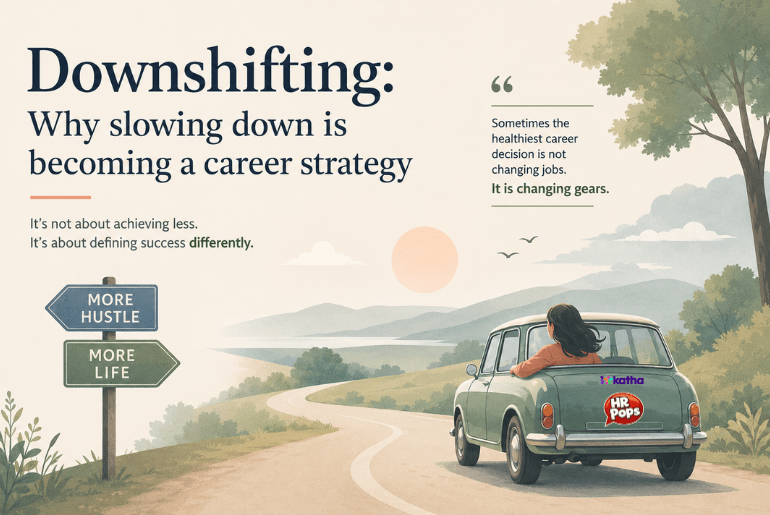
    Downshifting: Why slowing down is becoming a career strategy

    How a motoring term from the 1950s became workplace shorthand for redefining success, and why HR is having to rethink ambition itself
    mmBy Liji Narayan | HRKathaJuly 28, 2026Updated:July 28, 20263 Mins Read8625 Views
    Share LinkedIn Twitter Facebook WhatsApp
    Downshifting: HR Pops: Choosing balance over high position and career goals
    Share
    LinkedIn Twitter Facebook WhatsApp

    What does ‘downshifting’ mean?

    For decades, career success followed a familiar formula: work harder, earn more, get promoted, repeat.

    Downshifting questions that formula.

    The term describes the deliberate decision to step away from a faster, more demanding career path in favour of one that offers greater balance, flexibility, or personal fulfilment. It may involve working fewer hours, declining a promotion, changing careers, or accepting a lower salary in exchange for better quality of life.

    The objective is not to achieve less.

    It is to define success differently.

    For some, that means spending more time with family. For others, it means pursuing meaningful work, protecting mental health, or simply reclaiming time that work has gradually consumed.

    Where did the idea come from?

    The word originated in motoring during the 1950s, where downshifting literally meant moving into a lower gear to reduce speed or gain greater control.

    By the 1990s, the term had acquired a broader social meaning. Lifestyle movements in Britain, Australia and the US began using it to describe people consciously choosing simpler lives over relentless career advancement and consumerism.

    The idea gained momentum as long working hours, burnout and rising stress levels became defining features of modern professional life.

    The pandemic accelerated that shift. Millions of employees reassessed what work meant, not simply where it happened. Questions once considered personal became career decisions:
    How much is enough? What is success actually costing? Is constant acceleration worth it?

    Why is it relevant for HR?

    Downshifting challenges one of the oldest assumptions in talent management: that every employee wants to keep climbing.

    Increasingly, many do not.
    Some want broader experiences rather than bigger titles. Others value flexibility over salary, autonomy over hierarchy, or wellbeing over status. Career progression is becoming less linear and more personal.

    This has significant implications for HR.

    Leadership pipelines, succession planning, reward systems, and performance frameworks have traditionally been designed around upward movement. Organisations now have to accommodate employees who want growth without necessarily wanting promotion.

    Career lattices, internal mobility, flexible work arrangements, sabbaticals, and project-based careers are gradually becoming strategic tools rather than employee benefits.

    The question is shifting from ‘How do we help people move up?’ to ‘How do we help people keep growing?’

    The uncomfortable reality

    Downshifting is not equally available to everyone.

    Employees with financial security can often choose lower-paid or more flexible roles. Others cannot. Rising living costs mean that many professionals continue working at unsustainable intensity because slowing down is simply not affordable.

    There is another challenge.

    Managers sometimes interpret downshifting as declining commitment. Employees who choose balance over promotion risk being overlooked, even when they remain high performers. Career ambition is often measured through visibility and availability rather than contribution.

    Therefore, HR faces a delicate balancing act. It must distinguish between employees who are consciously redefining success and those who are stepping back because burnout, poor management, or limited opportunities have left them disengaged.

    The two may look similar.

    They are not.

    The takeaway

    Downshifting reflects a broader shift in how people think about work.

    Employees are increasingly asking not how quickly they can move forward, but whether the direction still makes sense.

    For HR, the challenge is not encouraging people to slow down or persuading them to speed up.

    It is creating workplaces where success is measured broadly enough to accommodate different definitions of a meaningful career.

    Because sometimes the healthiest career decision is not changing jobs.

    It is simply changing gears!

    balance burnout changing gears choose balance choosing personal fulfilment Consumerism cost of success downshifting Employee employer family time fewer work hours gain control greater balance HR HR Pops HRKatha pops Human Resources LEAD Long Work Hours lower gear lower salary for balance meaning of success meaningful work pops protecting mental health redefining success reduce speed simpler lives stress-free work Workforce Work–life balance
    Share. LinkedIn Twitter Facebook WhatsApp
    mm
    Liji Narayan | HRKatha

    HRKatha prides itself in being a good journalistic product and Liji deserves all the credit for it. Thanks to her, our readers get clean copies to read every morning while our writers are kept on their toes.

    Leave A Reply Cancel Reply

    Related Posts

    Hexaware Technologies elevates Manjunath GM to VP-TA

    September 17, 2026

    Maharashtra employee says former employer sought Rs 1.67 lakh after resignation

    September 16, 2026

    Britain’s workers are buying their own AI to get the job done

    September 16, 2026

    Amazon raises UK frontline pay by up to 5.6%, covering 70,000 employees

    September 16, 2026
    zoha
    Editorial

    AI-native workers are forcing managers to earn their relevance

    They did not arrive announcing themselves. They joined as analysts, engineers, content writers, recruiters and…

    Employees are redesigning work before their companies do

    Nobody announced that work would change this way. There was no strategy document, pilot programme…

    EDITOR'S PICKS

    Rich countries use ChatGPT 36 times more than poor ones. Job exposure explains only part of the gap

    September 16, 2026

    HR Perspectives by Rajita Singh: “Giving internal employees opportunities requires the same kind of thinking as hiring externally”

    September 16, 2026

    Career lattice: When sideways becomes the new forward

    September 15, 2026

    At Akshaya Patra, the HR test is simple: is the kitchen staffed?

    September 15, 2026
    Latest Post

    Hexaware Technologies elevates Manjunath GM to VP-TA

    Movement September 17, 2026

    Hexaware Technologies, the IT services and consulting company, has elevated Manjunath GM to vice president-talent…

    PF wage ceiling raised to Rs 25,000

    Compensation & Benefits September 17, 2026

    The government has raised the wage ceiling for mandatory Employees’ Provident Fund (EPF) and Employees’…

    Maharashtra employee says former employer sought Rs 1.67 lakh after resignation

    News September 16, 2026

    A Maharashtra employee has claimed that a former employer sent a legal notice demanding Rs…

    Britain’s workers are buying their own AI to get the job done

    News September 16, 2026

    British workers are spending nearly £1 billion a year of their own money on AI…

    Asia's No.1 HR Platform

    Facebook X (Twitter) Instagram LinkedIn WhatsApp Bluesky
    • Our Story
    • Partner with us
    • Career
    • Reach Us
    • Exclusive Features
    • Cover Story
    • Editorial
    • Dive into the Future of Work: Download HRForecast 2024 Now!
    © 2026 HRKatha.com
    • Disclaimer
    • Refunds & Cancellation Policy
    • Terms of Service

    Type above and press Enter to search. Press Esc to cancel.