



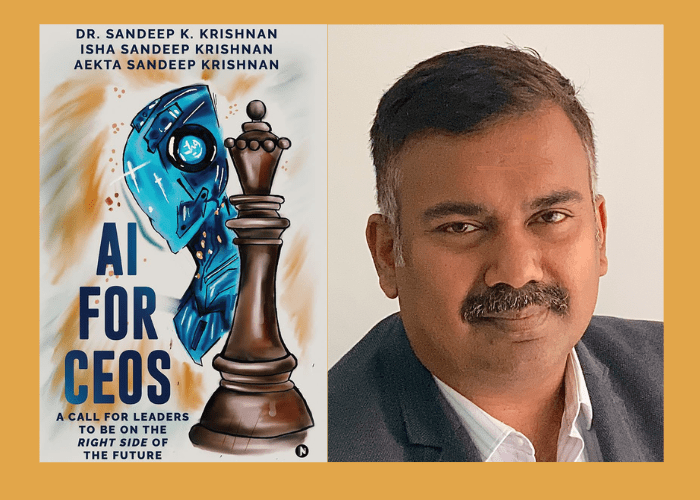
There is a particular kind of business book that arrives not so much to be read as to be seen on the right desks. AI for CEOs: A call for leaders to be on the right side of the future is not quite that book, though it understands the genre well enough to borrow its jacket. What distinguishes it is that, beneath the urgency and exhortation, there is a genuine attempt to be useful to the people it addresses: senior leaders who have sat through enough AI presentations to feel vaguely implicated, but not yet moved.
The book is co-authored by Dr Sandeep Krishnan, who teaches the “Making of a CEO” course at IIM Ahmedabad and brings to the subject both consulting experience and academic rigour — alongside his two daughters, one in fifth grade and the other in tenth. It is an unusual collaboration, and a quietly persuasive one. Whether or not the daughters reshape every chapter is almost beside the point. Their presence reinforces one of the book’s central ideas: the next generation will not “learn” AI the way today’s leaders must. They will simply assume it exists, much as earlier generations assumed the internet or search engines did. The real disruption, then, is not technological but generational, and it is already visible at the breakfast table.
That insight sharpens the book’s larger argument: AI is not an IT initiative but a leadership capability. It belongs as much within the CEO’s remit as capital allocation, strategy, or risk stewardship. The authors make this case with conviction and, for the most part, with evidence. Once machines begin generating options, simulating scenarios, and stress-testing assumptions, leadership itself changes shape. The CEO’s role moves from merely making decisions under uncertainty to orchestrating intelligence by combining human judgment, organisational context, and machine insight into coherent action.
As the foreword by IIM Calcutta’s Dean observes, this may be the first moment in managerial history when machines have entered the cognitive domain of leadership itself.
Across ten chapters, the authors cover strategy, business model disruption, decision-making, governance, tools, talent, and global regulation. The governance section is among the book’s strongest. A cautionary example involving a Big 4 firm penalised for submitting an AI-generated report riddled with hallucinations – while presenting it as original research – lands as it should. The point is clear: AI failures at the leadership level are rarely technology problems alone. They are governance failures.
The talent chapter will resonate particularly with HR leaders. Jobs, the authors argue, will not disappear first – they will disintegrate, fragmenting into capability clusters before they vanish altogether. That distinction matters enormously for how organisations plan, reskill, and lead through the transition. It reframes the CHRO’s role not as a responder to AI disruption but as one of its principal architects.
The practical centrepiece is a 90-Day AI Action Plan: 30 days for clarity, 30 for prioritisation, and 30 for scaling or stopping. It is pragmatic, structured, and immediately usable. Seasoned readers may not find it revolutionary, but then most frameworks that actually get implemented rarely are.
Readers familiar with McKinsey Quarterly or major consulting literature will recognise much of the terrain. The book draws extensively from BCG, PwC, OpenAI, and McKinsey research. Its frameworks, including a CEO Maturity Matrix and a five-tier AI adoption typology, are carefully synthesised rather than presented as wholly original discoveries. To the authors’ credit, the book does not pretend otherwise. Its contribution lies less in breaking new ground than in clearly mapping the terrain for leaders still finding their way into AI.
If the book has a weakness, it is that many of its case studies remain heavily Western and predictably familiar: Amazon, Netflix, Nvidia, McKinsey. That sits somewhat oddly in a book positioned for Indian business leaders navigating a distinctly Indian transformation story. The brief discussion around Reliance hints at what a more India-rooted treatment could have looked like, and one wishes there were more of it.
India’s leadership challenge around AI is not simply about adopting global technology trends. It is unfolding within one of the world’s most unique digital public infrastructures – shaped by Aadhaar, UPI, population scale, cost pressures, and an extraordinarily diverse workforce. These conditions will shape AI adoption differently from the West, and future editions of the book could engage that reality more deeply.
The book’s sense of urgency, admirable in principle, occasionally becomes repetitive. Certain warnings about the cost of CEO inaction appear often enough to feel slightly overemphasised. A tighter edit in parts would have trusted the reader more.
None of this, however, undermines what the book ultimately achieves. For senior leaders who have been circling the AI conversation without quite knowing where to land, AI for CEOs offers a clear, honest, and well-organised entry point. It does not attempt to be a technical manual or an academic treatise. It is a practitioner’s guide written by someone who has spent years in boardrooms watching intelligent people become uncertain in expensive ways, and who has tried, thoughtfully, to make that uncertainty more manageable.
“The right side of the future,” the title promises. On the evidence of this book, getting there may require less genius than curiosity, less technical mastery than strategic clarity. That is a reassuring message. It is also, on the whole, a credible one.
