


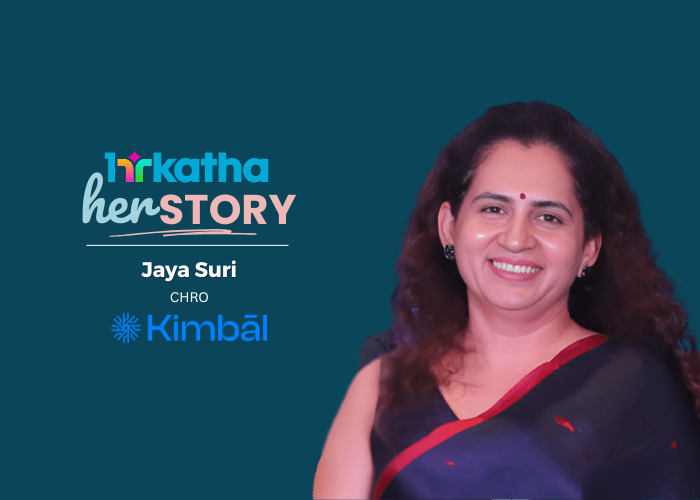
Journey to the core and heart of the organisation
Despite having covered both marketing and HR-related work in her first job at a consulting firm, the attraction of HR was irresistible for Jaya Suri. After all, HR shapes an organisation’s success or failure, and it did not take long for her to realise that HR was the core and heart of any organisation.
While it is possible to replicate strategies, technologies and even business models, it is not possible to copy culture, people and ways of working. And that realisation made her decide to build her career in HR even though she was a Marketing major.
Today, as CHRO at Kimbal, Suri leads with a philosophy forged on factory floors and in boardrooms—one that challenges fundamental assumptions about what HR should be.
The woman who handled blue-collar workers
Having never encountered any gender-based discrimination in school or college, Suri was shocked when she was denied a leadership opportunity during her stint in a plant HR role simply because she was a woman. She was told that a woman would not be able to handle blue-collar workers.
Of course, she went on to prove otherwise. In fact, being a woman turned out to be an advantage rather than a limitation. Not only did people listen better but they behaved with more respect and it became possible to hold more open conversations. She found that negotiation, empathy and one-on-one dialogue—all critical in industrial relations—came naturally to her.
During a particularly difficult strike-related conversation, being a woman worked in her favour and helped de-escalate the situation effectively. That experience reframed her understanding of leadership and reinforced her belief that capability is not defined by gender, but by intent and approach.
“Capability is not defined by gender but by intent and approach.”
Business realities versus emotions
While HR is an emotional function, there are moments when business realities must take precedence over emotions, and those decisions are never easy.
When it comes to redundancy-related decisions, even when they are performance-driven and managed fairly, it is still difficult. The real challenge comes when redundancy is driven by business necessity—especially when strong performers are impacted.
Another complex area, Suri says, is fairness. While equality is an important value, she has learnt that fairness does not always mean treating everyone the same. Context, contribution and organisational impact matter. It is up to HR to take decisions with the long-term sustainability of the organisation at the centre.
This does not mean ignoring individuals; rather, it means recognising that if the organisation is not healthy, many more people ultimately suffer.
“It is HR’s role to balance empathy with responsibility—thinking not just about individuals, but about the larger collective that depends on the organisation’s success.”
Reducing interferences, not controlling
“Human beings are not machines to be managed,” asserts Suri. That is why she does not agree with the term ‘human resource management’. She believes: “In trying to manage people like processes or assets, we lose sight of what actually drives performance.”
The real role of HR is to work with the business and with people to unlock productivity and potential. This happens not by controlling people, but by reducing interferences—anything that prevents individuals from doing their best work. These interferences could be personal, professional, or organisational. It is HR’s role to remove or reduce whatever blocks someone from reaching their full potential.
Culture and business cannot be separated. People decisions cannot be made from a classroom or behind a desk. They can only be made when HR understands the business at least as well as the people running it. Only then can HR truly enable performance, rather than attempt to manage it.
No playbooks, just agility and speed
With her organisation operating in a highly disruptive space—the electricity and energy-transition sector—Suri finds “transformation” an understatement. There are no established playbooks, and very little certainty about what the future will look like.
Agility and speed become critical. These are the two capabilities that can truly differentiate organisations, because everyone is working towards similar goals, but not everyone can move fast or adapt quickly. That is where Suri and her team focus—building an organisation that can respond, pivot and execute at pace.
Of course, HR plays a central role in enabling this. “Agility is one of our core values, and we consciously translate values into everyday behaviours, not just statements,” Suri explains. Value-based training programmes and leadership interventions reinforce how the organisation works, how decisions are made, and how employees collaborate. The intent is simple: to create an organisation where culture actively supports growth, rather than slowing it down.
Quick Fire Round
Best career advice you’ve received?
Never limit yourself to your role. Do more than what’s expected, and success follows naturally.
One thing you wish people understood about being a woman in HR leadership?
HR is not about keeping people happy. It’s about unlocking potential, driving performance, and improving productivity. It’s a business role—not just an emotional one.
Morning ritual that sets you up for success?
5–10 minutes planning the day before checking emails. That clarity makes a big difference.
If not HR, what career would you have pursued?
Sales, because I enjoy talking to people and building real connections.
What energises you most about your work?
Challenges. I enjoy difficult situations where my role can create change. Routine doesn’t excite.
Never underestimate yourself
Professionally, learning has come from everywhere—leaders, peers, teams, and lived experiences. From her first manager she learnt out-of-the-box and innovative thinking. Starting her career in a consulting environment taught her to never underestimate herself. “Very often, the biggest limitation we face is the glass ceiling we create for ourselves,” she says.
A team member who was exceptionally punctual and disciplined around time—down to minutes—reinforced the importance of respecting commitments, people, and process. It shaped how she thought about accountability and professionalism.
Every day is a learning opportunity and Suri tries to remain like a sponge—observing, absorbing, and learning from people around her, regardless of role or hierarchy. Even her children have taught her patience, perspective and humility.
One piece of advice she would give to women—across functions and roles—is simple but critical: stop underestimating yourself. Over the years, she has seen capable, talented women hold themselves back by deciding in advance what is “not possible.” That self-doubt, more than any external barrier, limits growth.
Balancing work and home is a reality many women navigate daily. But this is not a disadvantage, feels Suri. Women are natural multitaskers, skilled at managing complexity, priorities, and pressure. What is often seen as a constraint is, in fact, a powerful capability—one that should be owned with confidence.
Believe in yourself, back your abilities, and move forward without apology. When women truly trust their own potential, there is very little that can stand in their way.