

Close Menu
    Facebook X (Twitter) Instagram
    • Our Story
    • Partner with us
    • Reach Us
    • Career
    Subscribe Newsletter
    HR KathaHR Katha
    • Exclusive
      • Exclusive Features
      • Perspectives
      • Friday Features
      • herSTORY
      • Case-In-Point
      • Point Of View
      • Research
      • HR Pops
      • Dialogue
      • Movement
      • Profile
      • Beyond Work
      • Rising Star
      • By Invitation
    • News
      • Global HR News
      • Compensation & Benefits
      • Diversity
      • Events
      • Gen Y
      • Hiring & Firing
      • HR & Labour Laws
      • Learning & Development
      • Merger & Acquisition
      • Performance Management & Productivity
      • Talent Management
      • Tools & Technology
      • Work-Life Balance
    • Special
      • HR Forecast 2026
      • Cover Story
      • Editorial
      • HR Forecast 2024
      • HR Forecast 2023
      • HR Forecast 2022
      • HR Forecast 2021
      • HR Forecast 2020
      • HR Forecast 2019
      • New Age Learning
      • Coaching and Training
      • Learn-Engage-Transform
    • Magazine
    • Reports
      • Whitepaper
        • HR Forecast 2024 e-mag
        • Future-proofing Manufacturing Through Digital Transformation
        • Employee Healthcare & Wellness Benefits: A Guide for Indian MSMEs
        • Build a Future Ready Organisation For The Road Ahead
        • Employee Experience Strategy
        • HRKatha 2019 Forecast
        • Decoding and Driving Employee Engagement
        • One Platform, Infinite Possibilities
      • Survey Reports
        • Happiness at Work
        • Upskilling for Jobs of the Future
        • The Labour Code 2020
    • Conferences
      • Leadership Summit 2025
      • Rising Star Leadership Awards
      • HRKatha Futurecast
      • Automation.NXT
      • The Great HR Debate
    • HR Jobs
    WhatsApp LinkedIn X (Twitter) Facebook Instagram
    HR KathaHR Katha
    zoha
    Home»Exclusive Features»HR Pops»Skills-based architecture: When capabilities matter more than titles
    HR Pops

    Skills-based architecture: When capabilities matter more than titles

    How a modern HR framework born from AI disruption is dismantling rigid hierarchies—and why some organisations are still clinging to job titles for dear life
    mmBy Liji Narayan | HRKathaJanuary 27, 2026Updated:January 27, 20263 Mins Read12186 Views
    Share LinkedIn Twitter Facebook WhatsApp
    Skills-based architecture (SBA)
    Share
    LinkedIn Twitter Facebook WhatsApp

    What is SBA?

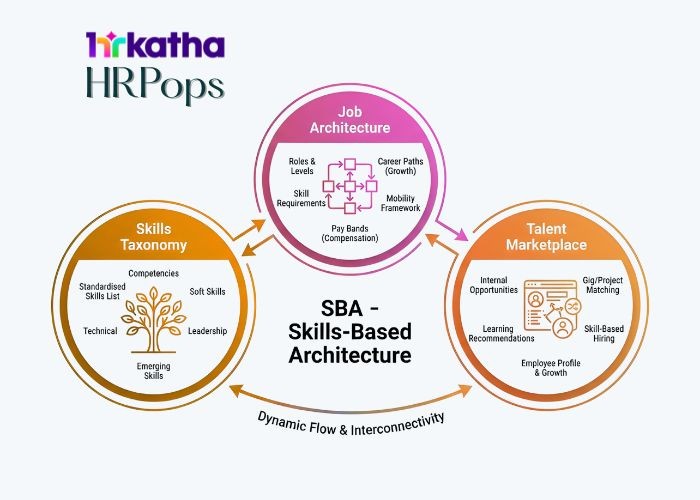
    Skills-based architecture (SBA) is a modern HR framework that organises work around skills rather than static job descriptions. Instead of defining employees by what their business card says, SBA defines them by what they can actually do—their capabilities, expertise, and potential. This allows organisations to redeploy talent quickly, adapt to change, and break free from traditional hierarchies.

    An SBA comprises three elements: a skills taxonomy—a standardised list of organisational skills; a job architecture—a framework linking skills to roles, pay bands, and career paths; and a talent marketplace—platforms where employees match their skills to projects or opportunities.

    zoha

    The benefits are clear: greater workforce agility, transparent career progression, fairer compensation and enhanced employee engagement.

    History

    The job architectures of the 20th century focussed on titles, hierarchies, and duties—designed for stability in industrial settings. Flexibility was limited, causing pay inequity and restricted progression.

    In the 1990s–2000s, globalisation and digital transformation challenged static job models. HR experimented with competency frameworks, but these remained role-centric.

    After 2010, SBA emerged as AI, automation, and gig work required fluid models. Deloitte and other consultancies popularised skills-based organisations, arguing traditional structures were too slow for the pace of change.

    By 2025, 98 per cent of executives planned to adopt skills-based approaches, recognising that millions of jobs would go unfilled without reskilling.

    Why is it relevant for HR?

    Skills-based architecture helps HR identify skill gaps and design targeted learning programmes. It supports workforce planning by aligning skills with business priorities. By tying pay to skills rather than titles, it reduces inequity and promotes fairness.

    zoha

    Employees see clear pathways to growth based on skills acquired, encouraging continuous learning. The architecture enables organisational agility, allowing rapid redeployment of talent—critical in industries facing disruption. It integrates with HR technology platforms like AI-driven talent marketplaces, ensuring frameworks remain current through real-time data.

    The messy reality: Why SBA often fails

    Here’s the uncomfortable truth: most organisations implementing SBA get it wrong. They build elaborate taxonomies, invest in expensive platforms, announce bold transformations—then watch as nothing changes.

    Why? Because culture eats strategy. Employees and managers cling to traditional titles because titles confer status, identity, and power. Stripping them away threatens egos and hierarchies.

    Data accuracy is another problem. Skills inventories become outdated fast. Without continuous updating, SBA becomes another HR system gathering digital dust.

    Implementation is devilishly difficult. SBA requires strong technology, leadership buy-in, and fundamental rethinking of how work is organised. Many organisations lack the infrastructure or courage to see it through—implementing SBA in name only whilst continuing to hire, promote, and pay based on titles.

    There’s also the pay equity paradox. SBA promises fairer compensation by linking pay to skills, but determining the value of skills is just as subjective as valuing titles. Without careful design, SBA can perpetuate the same inequities it claims to solve—just with different labels.

    Making it work

    Skills-based architecture represents a paradigm shift, moving from rigid hierarchies to dynamic, skill-driven ecosystems. Today it is indispensable for HR leaders building resilient, fair, and future-ready organisations.

    But SBA is not a silver bullet. It requires cultural transformation, technological investment, and relentless commitment. Done well, SBA unlocks potential and democratises opportunity. Done poorly, it becomes another failed HR initiative—a beautiful idea that never quite becomes reality.

    The question is: does your organisation have the courage to truly let go of titles? Or will SBA remain what it is in most places—a framework that promised revolution but delivered only new jargon?

    democratise opportunity Employee employer fundamental rethinking hierarchies HR HR framework HR initiative HR network HR Pops HRPops Human Resources job descriptions job titles LEAD redeploy talent SBA skill-driven ecosystems Skills Skills inventories skills taxonomy skills-based architecture Talent Marketplace traditional titles unlock potential Workforce
    Share. LinkedIn Twitter Facebook WhatsApp
    mm
    Liji Narayan | HRKatha

    HRKatha prides itself in being a good journalistic product and Liji deserves all the credit for it. Thanks to her, our readers get clean copies to read every morning while our writers are kept on their toes.

    Leave A Reply Cancel Reply

    Related Posts

    Marriott International elevates Khushboo Sharma to director-HR

    July 2, 2026

    Lupin gets Bijender Vats as SVP & head–HR

    July 2, 2026

    Adani Energy Solutions names Pramath Nath as CPO

    July 2, 2026

    Tech Mahindra reviews alleged religious discrimination during job interview

    July 2, 2026
    Editorial

    Every IPO tells two stories

    Someone I know spent eight and a half years building the research function at a…

    The two cultures inside the same multinational

    Someone I know works with one of the world’s largest technology and consulting firms. Based…

    EDITOR'S PICKS

    Case-in-Point: When managers game the system to protect their teams

    July 2, 2026

    herSTORY: Niyathi Madasu, CHRO, Premier Energies

    July 2, 2026

    Cybersecurity doesn’t have a hiring problem. It has a capability problem!

    July 1, 2026

    HR Perspectives by Preeti Kannan: “ AI is no longer optional, it is the way forward”

    July 1, 2026
    Latest Post

    Marriott International elevates Khushboo Sharma to director-HR

    Movement July 2, 2026

    Marriott International has promoted Khushboo Sharma to director-human resources, marking another milestone in her five-year…

    Lupin gets Bijender Vats as SVP & head–HR

    Movement July 2, 2026

    Lupin has appointed Bijender Vats as senior vice president & head-human resources. In his new…

    Adani Energy Solutions names Pramath Nath as CPO

    Movement July 2, 2026

    Adani Energy Solutions (AESL) has appointed Pramath Nath as its chief people officer (CPO), strengthening…

    Tech Mahindra reviews alleged religious discrimination during job interview

    News July 2, 2026

    Tech Mahindra has launched an internal review after a job applicant alleged that he faced…

    Asia's No.1 HR Platform

    Facebook X (Twitter) Instagram LinkedIn WhatsApp Bluesky
    • Our Story
    • Partner with us
    • Career
    • Reach Us
    • Exclusive Features
    • Cover Story
    • Editorial
    • Dive into the Future of Work: Download HRForecast 2024 Now!
    © 2026 HRKatha.com
    • Disclaimer
    • Refunds & Cancellation Policy
    • Terms of Service

    Type above and press Enter to search. Press Esc to cancel.