



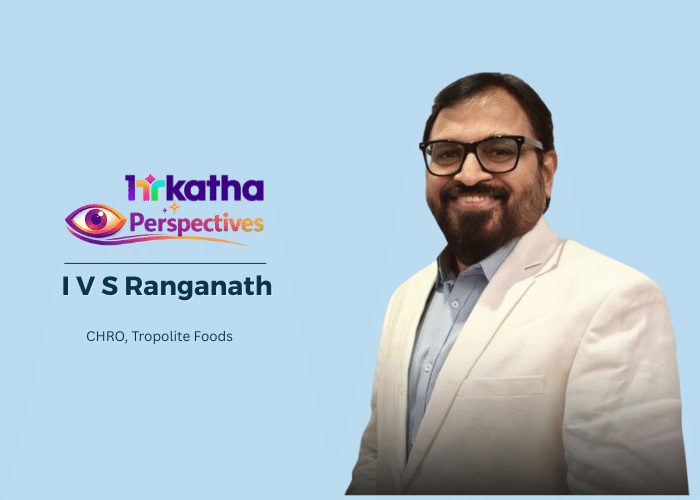
Tropolite Foods is a legacy food-ingredients business built over more than four decades on entrepreneurial energy, deep customer relationships and technical expertise. As it moves from a promoter-led model towards a more professionally driven organisation, the challenge is not simply to introduce more systems and processes. It is to decide what needs to change without dismantling the qualities that allowed the business to grow in the first place.
That is the transition IVS Ranganath came to Gwalior to help navigate. With nearly three decades of experience across Asian Paints, Hindustan Coca-Cola Beverages, Idea Cellular, Aircel, Signode India and Shriram Bioseed Genetics, Ranganath arrived with a strong belief in systems, governance and structured people practices. In conversation with HRKatha, he explains why transformation depends more on clarity than announcements, why institutional knowledge cannot remain trapped in individuals, why retention should be selective rather than emotional, and what an entrepreneurial organisation has taught him about the limits of corporate HR orthodoxy.
Transforming legacy without losing it
You joined Tropolite after nearly three decades across manufacturing, FMCG, telecom, industrial packaging and agritech. What did you discover here that forced you to rethink how transformation should actually happen?
When I joined Tropolite, what immediately stood out was that this was not simply an HR improvement assignment. Tropolite is a legacy organisation moving through a significant transition, from a promoter-led model towards a more professionally driven and institution-led one. That made the mandate both exciting and demanding.
The fundamental question was not how to improve HR. It was how to transform a legacy organisation without losing the strengths, relationships and entrepreneurial spirit that built it, while developing the people, processes and capabilities required for the next phase of growth.
The challenges went deeper than systems or processes. Culture, legacy mindsets, resistance to change, leadership behaviours, accountability and ways of working all needed attention simultaneously.
What surprised me most was that people were not necessarily resistant to change. They were resistant to uncertainty. When employees understand why something needs to change, what it means for them and how they will be supported, resistance reduces significantly.
That realisation shifted my approach from announcing transformation to creating clarity.
The biggest lesson has been that cultural transformation cannot be driven by HR alone. HR can design the architecture. Transformation happens when the leadership team collectively owns the change and demonstrates the desired behaviours every day.
My mandate is not to replace Tropolite’s legacy. It is to transform that legacy into a foundation for the next generation of growth.
“After nearly three decades in HR, I no longer believe that more process means better management.”
One purpose, different experiences
Manufacturing employees, food scientists, salespeople and corporate teams experience Tropolite very differently. How do you create one culture without trying to give everyone an identical employee experience?
The answer is not to create a uniform employee experience. It is to create a common people philosophy.
A person working on a manufacturing line has a completely different daily reality from an R&D scientist, a sales professional travelling across markets or someone in a corporate office. Expecting the same policies and engagement mechanisms to work equally well for everyone would be a mistake.
What I am building at Tropolite is what I would describe as one purpose, different experiences. The commonality comes from our purpose, values, leadership principles and performance expectations, not from making every process identical.
Certain moments, however, should feel consistent regardless of function or location: joining, onboarding, performance conversations, recognition, career opportunities and exit. These are the moments when employees form lasting perceptions of the organisation. Getting them right consistently across every workforce segment is where the common philosophy becomes real.
Culture is ultimately created by leaders, not HR policies. If a manufacturing employee, an R&D scientist and a sales professional experience the same level of respect, transparency, accountability and opportunity, we have created one culture even though their jobs look entirely different.
“The exit interview tells you why someone says they are leaving. It does not tell you why they started thinking about it.”
Knowledge that belongs to the institution
In food ingredients, much of the most valuable knowledge sits in experience and judgement rather than manuals. How do you stop that knowledge from leaving when experienced people do?
In the food-ingredients industry, knowledge does not always sit in a manual. It sits in experience, judgement and relationships. A food technologist who has spent fifteen or twenty years understanding formulations, applications and customer requirements carries enormous institutional knowledge that may never have been formally documented.
The question for me is not simply how to retain these people. The larger question is how to convert individual knowledge into organisational capability.
That requires a deliberate framework: retain critical talent, capture tacit knowledge, transfer it across generations and institutionalise it so that it belongs to the organisation rather than any one individual.
Retention here cannot be limited to compensation. It has to include career opportunities, meaningful roles, learning, autonomy and a genuine sense of belonging to Tropolite’s next chapter.
Alongside retention, we are converting experience into organisational knowledge through documentation, technical repositories, structured knowledge-transfer sessions and deliberate mentor-mentee relationships.
Our experienced professionals are not only measured by what they personally deliver. They are also measured by how effectively they build the next generation of capability. An experienced food technologist who mentors younger R&D professionals creates a multiplier effect rather than simply doing their own job.
That is the cultural shift we are trying to build: from experience as a personal asset to experience as an organisational one.
People will always move. Talent will always evolve. But the knowledge, capability and learning they create should remain with the institution. When that happens, we have built something that outlasts individuals.
“Good to see you, Ranga. Five words. But they create positivity, value and energy every single morning.”
Retain the right people, not every person
The exit interview comes after the decision has effectively been made. What do organisations miss when they wait until resignation to understand retention?
One of the biggest mistakes organisations make is treating retention as a compensation problem.
People in manufacturing, technical, R&D and field roles leave for reasons that are far less visible. They may not see a future for themselves. Their contribution may not be recognised. Leadership may be inconsistent, decision-making autonomy absent or their capabilities underutilised. In technical and manufacturing environments, location, working conditions, shift patterns and the quality of the immediate work environment also matter significantly.
That is why at Tropolite we look at every resignation through a regrettable versus non-regrettable lens.
A regrettable exit is someone we genuinely want to retain because of their performance, potential, critical skills, institutional knowledge or future leadership capability. When such a person resigns, we ask whether the issue is addressable, whether there is a meaningful internal opportunity and whether the work environment contributed to the decision.
A non-regrettable exit is equally important to recognise. There are situations where, after objectively evaluating performance, capability, behaviour and future fit, we conclude that retention is not in the organisation’s interest. Respecting that decision professionally is just as important as trying to retain someone who matters.
The exit interview tells you why someone says they are leaving. It does not tell you why they started thinking about it.
That requires a different approach: stay conversations with critical talent before the resignation letter arrives. The question should be what would make someone want to continue building their career here, not what made them decide to leave.
Retention should be a strategic decision, not an emotional reaction to a resignation letter.
“The mandate was not to improve HR. It was to transform a 50-year legacy organisation without losing what built it.”
What the co-founders taught me
You arrived with nearly three decades of experience in large, structured organisations. What has working directly with the co-founders at Tropolite made you reconsider about how much structure an organisation actually needs?
I came to Tropolite with nearly three decades of corporate HR experience and a strong belief in systems, governance, data and structured people processes. Much of that travels well. Performance management, talent assessment, succession planning, capability-building, HR technology and disciplined people processes are relevant regardless of an organisation’s size or ownership structure.
What does not always travel well is the assumption that more structure automatically means better management.
In a fast-growing entrepreneurial business, you need the discipline of a large organisation alongside the speed, agility and ownership mindset of a smaller one. At Tropolite, I have learnt to ask a different question: what is the simplest process that gives us the right level of governance without slowing us down?
The biggest difference has been at the leadership level. I work directly with the co-founders. Discussions are candid, decisions are made quickly and, once a decision is taken, it is implemented with clarity and ownership. Fewer layers between the problem and the decision-maker change how quickly an organisation can move.
What has impressed me even more is how the co-founders walk the talk. In over a year, I have rarely seen a meeting postponed casually, someone arrive significantly late without reason or a leader leave a meeting midway.
These may seem like small things, but they communicate something powerful: if we expect discipline and commitment from our people, we must demonstrate it ourselves.
And there is something simpler still. Almost every morning, the co-founders greet me with five words: good to see you, Ranga.
Five words. But they create positivity, a sense of value and genuine energy.
Employee experience is not always created through sophisticated HR programmes. Sometimes leadership behaviour creates more engagement than an entire engagement initiative.
I came to Tropolite thinking I would bring structure. I have realised the learning has gone both ways. Tropolite is reminding me that simplicity, humility, speed and walking the talk can sometimes be more powerful than the most sophisticated corporate system.
“One purpose, different experiences. The commonality comes from values and leadership principles, not identical processes.”
What three decades taught me to stop believing
After nearly three decades across very different industries, which beliefs about HR have experience forced you to abandon?
The biggest shift is this: I no longer believe there is one universal formula for good HR.
Earlier in my career, I believed that if you built the right systems, policies and frameworks, organisations would naturally become more professional and high-performing. Today, I believe systems create the foundation, but people and leadership create the outcome.
I no longer believe that more process means better HR. The best HR process is not necessarily the most sophisticated one. It is the one that solves the business problem without creating unnecessary complexity. Sometimes simplicity creates more impact than sophistication.
I no longer believe that retention means retaining everyone. The real responsibility of HR is to identify talent that is critical to the organisation’s future and make a conscious effort to retain the right people. Retention is a strategic decision, not an emotional reaction.
I no longer believe that culture can be created through HR programmes. Culture is created through leadership behaviour. Employees watch what leaders do far more carefully than what HR communicates. Culture is not what we announce. It is what we repeatedly demonstrate.
I no longer believe that engagement is primarily about employee programmes. Sometimes the smallest leadership behaviours create the greatest engagement. A genuine conversation. A leader listening patiently. Recognising someone’s contribution. Saying good to see you. These may look insignificant on paper, but they fundamentally change how an employee feels about an organisation.
And finally, I no longer believe that HR is about HR. After working across so many industries, I am convinced that HR is ultimately about business, through people. Revenue, growth, productivity, customer experience and profitability all have a people dimension. The CHRO cannot operate only as the custodian of policies and employee relations.
If there is one belief that has remained constant while everything else has evolved, it is this: the best HR leaders do not build organisations that depend on HR. They build organisations where leaders, managers and employees collectively own the people agenda.
“We are building the next chapter of a 50-year legacy. My responsibility is not to create an efficient HR function. It is to help build an organisation that can sustain high performance for the future.”