



By 2026, the centre of gravity in human resources will shift decisively. Artificial intelligence (AI) will no longer sit at the edge of HR strategy. It will sit at its core—sometimes as a tool, sometimes as a co-worker, and increasingly as a substitute for human effort.
That shift is already visible in the data. Gartner’s 2026 HR Priorities Survey, based on responses from 426 CHROs across 23 industries and four regions, identifies four forces reshaping the function: AI’s growing role as an alternative to human talent, mounting pressure to balance growth with efficiency, rising uncertainty that demands faster change, and an employment deal that now asks employees to give more while expecting less in return.
Together, these forces are redefining what organisations expect from HR—and from the CHRO.

1. AI changes HR before it changes employees
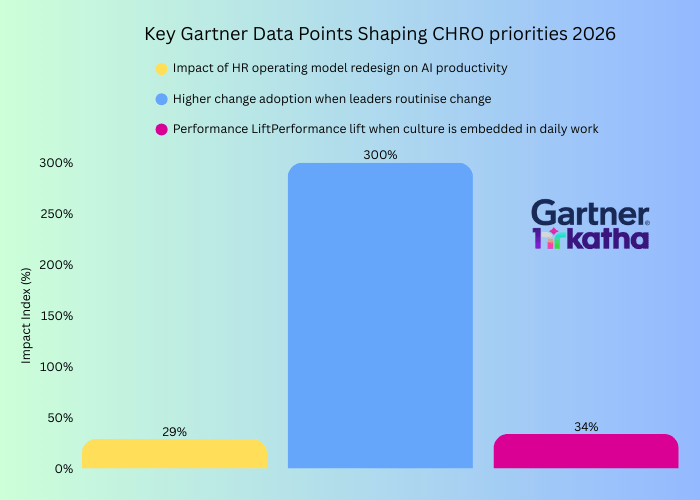
The most important finding in Gartner’s research runs counter to popular wisdom. While companies are investing heavily in AI training and literacy programmes, the data shows that nearly 29 per cent of AI-driven productivity gains come from changing HR’s operating model, not from improving employee AI skills, acceptance, or awareness.
In simple terms, how HR is structured matters more than how fluent employees are in AI tools.
This insight has sharp implications for Indian organisations, many of which have focused on mass upskilling initiatives as a first response to AI. According to Gartner, those investments will deliver only limited returns unless HR itself is redesigned.
High-performing organisations are making four structural moves. They are creating HR innovation command centres—small, empowered teams led by HR strategy and change leaders with the authority to redesign processes, not just recommend them. They are shifting HR business partners away from transactional support towards strategic talent leadership, as AI takes over routine diagnostics such as skills mapping and workforce analytics.
They are also transforming centres of excellence into HR product teams that build personalised onboarding, learning journeys, and career pathways. And they are digitising HR operations end to end, with AI agents handling most Tier 0 and Tier 1 work—policy queries, benefits enrolment, and service requests.
The lesson is clear. Two organisations may deploy the same AI tools, yet see very different outcomes. The difference lies not in technology, but in whether HR has been rebuilt to use it.
2. When AI becomes talent, workforce planning fractures
The second shift is more unsettling. AI is no longer viewed only as a productivity aid. It is increasingly seen as a viable alternative to human talent.
For CHROs, this changes workforce planning fundamentally. Gartner argues that HR leaders must now articulate a “now–next” talent strategy—one that delivers measurable results within 12 months while preparing the organisation for the next one to three years. Without this clarity, HR risks losing relevance in boardroom discussions.
The challenge is that there is no single future of work. Gartner identifies four human–AI scenarios that organisations must manage at the same time.
In one, large numbers of employees use AI to work faster or better, while jobs remain largely unchanged. In another, highly-skilled employees combine with AI to push the boundaries of research, design, or problem-solving.
In a third, AI handles most tasks, leaving fewer humans to focus on judgement-heavy work. In the fourth, AI-first operations run with minimal human intervention.
Indian organisations are already encountering all four. Information technology (IT) services firms are experimenting with AI-first delivery in support functions. Manufacturing companies are redesigning roles around fewer, higher-skilled operators. R&D centres are using AI to accelerate discovery. And shared services are blending humans and machines to drive scale.
Gartner’s advice is pragmatic: stop searching for a single model. Instead, design for coexistence. This requires dual KPIs—one set measuring today’s performance, another tracking future readiness. It also demands a blended workforce strategy where AI is designed into work, not bolted on afterwards.
3. Growth without slack demands a new kind of leader
As organisations push for growth while cutting inefficiencies, leadership expectations are also changing. Here again, Gartner’s data challenges conventional wisdom.
Leaders who routinise change, rather than inspire it, are three times more likely to achieve healthy change adoption. Vision and communication still matter, but they are not decisive. What matters is whether change becomes part of daily work.
Gartner describes this shift through a simple sequence: think, feel, do. Leaders must first acknowledge the reality of change. They must then help employees manage discomfort and emotional responses. Finally, they must train intuition so that people act without waiting for formal instructions.
In practice, this means rewriting leadership performance criteria, redesigning competency models, and giving managers practical tools to handle emotional resistance. It also means identifying a small number of change skills and practising them repeatedly in everyday work.
For Indian organisations, where large workforces and hierarchical structures often slow adoption, this insight is particularly relevant. Change scales not through speeches, but through habits.
4. Culture becomes a hard performance lever
The final shift addresses a long-standing frustration. Culture initiatives are everywhere, yet results are uneven. Gartner’s data explains why.
Organisations that embed culture into daily work see up to a 34 per cent increase in employee performance compared to those that rely on communication campaigns or training alone.
The gap lies in contradiction. Values are promoted, but processes reward different behaviours. Collaboration is praised, yet incentives favour individual output. Long-term thinking is encouraged, but budgets prioritise short-term wins.
Gartner outlines three steps to close this gap. First, define what values mean at different levels of the organisation. Second, translate values into specific, observable behaviours. Third, integrate those behaviours into core systems such as performance reviews, promotions, resource allocation, and decision-making routines.
For Indian companies grappling with engagement fatigue and rising attrition, the message is pointed: culture improves performance only when it is operational, not aspirational.
What the data really says
Taken together, the numbers tell a consistent story. Structural change delivers a 29 per cent impact on AI productivity. Routinised change improves adoption by three times. Embedded culture lifts performance by 34 per cent.
These are not marginal gains. They suggest that many organisations have been focusing on the wrong levers—training instead of redesign, inspiration instead of habit, communication instead of execution.
For CHROs, the mandate is expanding. Human resources is no longer just a support function. It is becoming the architect of how humans and machines work together, how change scales, and how performance is sustained.
The priorities are no longer ambiguous. The data is clear. What remains uncertain is whether organisations will move fast enough to act on it.
