



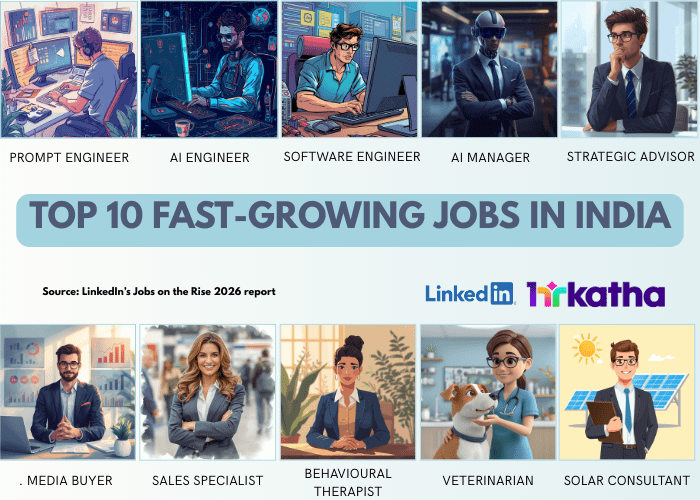
Finding a job is tougher today than ever before, yet roles are multiplying faster than workers can prepare for them. According to LinkedIn’s Jobs on the Rise 2026 report, which tracks positions exhibiting steady growth over three years with substantial hiring volumes, India’s employment landscape is being reshaped by artificial intelligence, renewable energy, and the care economy.
Seventy-two per cent of professionals plan to seek new jobs in 2026, yet 84 per cent feel unprepared for the hunt. This 12-percentage-point gap between intent and readiness defines the paradox: workers know they must move, but don’t know how to position themselves for roles that didn’t exist when they last switched jobs.

Here are the 10 fastest-growing roles and what they reveal about India’s labour market.
1. Prompt engineers: the one-year experience paradox
Prompt engineers design and refine instructions for AI systems.
Required skills: prompt engineering, large language models, prompt design
Median experience: one year
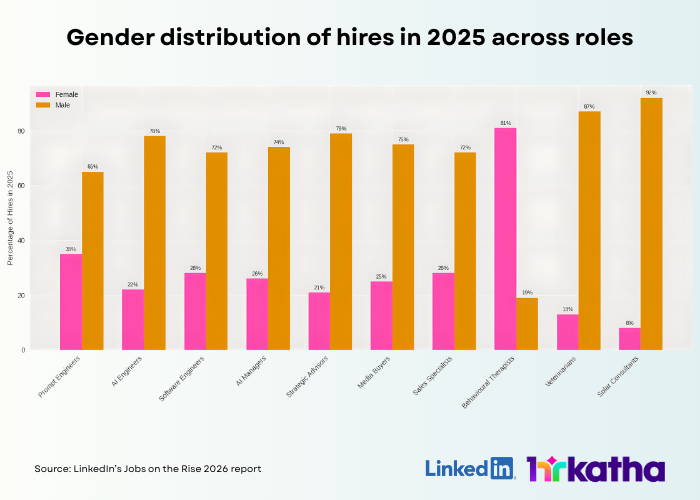
Gender split: 35 per cent women, 65 per cent men
Locations: Bengaluru, Delhi, Hyderabad
Flexibility: 41 per cent remote/hybrid
The paradox: How does one gain a year’s experience in a role that barely existed 18 months ago? The answer lies in adjacent transitions—copywriters, software engineers, and data analysts pivoting by demonstrating competency with generative AI tools. This makes it accessible to non-traditional candidates but also creates the 84 per cent unpreparedness—most workers don’t know which adjacent skills qualify them.
2. AI engineers: two years to master the future
AI engineers design, build, and deploy AI systems.
Required skills: large language models, PyTorch, deep learning
Median experience: two years
Gender split: 22 per cent women, 78 per cent men
Locations: Bengaluru, Hyderabad, Delhi
Flexibility: 50 per cent remote/hybrid
The 22 per cent women representation reveals AI engineering is replicating traditional engineering’s gender imbalance, not disrupting it. Prior roles include software engineers, data scientists, and data analysts—already male-dominated fields. The 50 per cent combined remote/hybrid offering is amongst the highest on the list, yet women’s participation remains lowest.
3. Software engineers: the seven-year premium
Software engineers develop applications.
Required skills: software development life cycles, microservices, Kubernetes
Median experience: seven years—the highest on the list
Gender split: 28 per cent women, 72 per cent men
Locations: Hyderabad, Bengaluru, Chennai
Flexibility: 29 per cent remote/hybrid
The seven-year requirement reflects a mature field with established best practices. Yet it offers less flexibility than AI engineering (50 per cent). Seniority doesn’t guarantee remote work—role type does.
4. AI managers: leadership without flexibility
AI managers oversee AI projects.
Required skills: large language models, retrieval augmented generation, MLOps
Median experience: six years
Gender split: 26 per cent women, 74 per cent men
Locations: Bengaluru, Delhi, Hyderabad
Flexibility: 28 per cent remote/hybrid
Prior roles include data scientists, product managers, and software engineers, indicating internal promotions
rather than external hires. The 26 per cent women representation is marginally better than AI engineers but far
below parity.
5. Strategic advisors: monetising battle scars
Strategic advisors guide organisations in long-term planning.
Required skills: strategic consulting, go-to-market strategy, M&A expertise
Median experience: seven years
Gender split: 21 per cent women, 79 per cent men
Locations: Delhi, Bengaluru, Mumbai
Flexibility: 26 per cent remote/hybrid
Prior roles tell the story: founders, chief operating officers, business analysts. This is the entrepreneurial
class creating second acts—packaging startup experience as advisory services. The seven-year median suggests battle-tested operators monetising accumulated wisdom. The 79 per cent male skew mirrors entrepreneurship’s gender gap.
6. Media buyers: remote work’s outlier
Media buyers plan and purchase advertising across platforms.
Required skills: media buying, media planning, performance marketing
Median experience: two years
Gender split: 25 per cent women, 75 per cent men
Locations: Delhi, Kolkata, Bengaluru
Flexibility: 40 per cent remote/hybrid
The 40 per cent flexibility is amongst the list’s highest—suggesting media buying, unlike strategic advising or AI
management, can be done from anywhere. The concentration in Delhi and Kolkata (unusual—Kolkata rarely appears on these lists) suggests advertising is less Bengaluru-centric than technology.
7. Sales specialists: export focus, limited flexibility
Sales specialists drive business growth.
Required skills: export operations, international sales and marketing, international business strategy
Median experience: three years
Gender split: 28 per cent women, 72 per cent men
Locations: Bengaluru, Mumbai, Delhi
Flexibility: 11 per cent remote/hybrid
The export operations focus differentiates these from generic sales roles. Industries include e-learning, chemical manufacturing, and wholesale import/export. The 11 per cent flexibility is amongst the lowest, reflecting that international sales requires travel and relationship building that remote work can’t replicate.
8. Behavioural therapists: the care economy’s gender inversion
Behavioural therapists support individuals managing emotional and behavioural challenges.
Required skills: applied behaviour analysis, behavioural therapy, autism spectrum disorder expertise
Median experience: one year
Gender split: 81 per cent women, 19 per cent men
Locations: Bengaluru, Hyderabad, Mumbai
Flexibility: 17 per cent hybrid (zero remote)
The 81 per cent women representation is the list’s starkest gender contrast. Prior roles include clinical psychologists, guidance counsellors, and teachers—all female-dominated professions. The zero per cent remote reflects work’s nature: behavioural therapy, especially with children, demands physical presence. This exemplifies labour market segmentation—women cluster in care work whilst men dominate technology and strategy.
9. Veterinarians: the data anomaly
Veterinarians diagnose and treat animal health.
Required skills: veterinary medicine, veterinary surgery, animal health
Median experience: one year
Gender split: 13 per cent women, 87 per cent men
Locations: Bengaluru, Hyderabad, Mumbai
Flexibility: data not provided
The 87 per cent male majority inverts typical care profession patterns. Prior roles include professors, vice presidents of products, and training specialists—none obviously connected to veterinary medicine, which requires specific degrees. This suggests LinkedIn’s algorithm is capturing pharmaceutical/biotech companies hiring veterinary-trained professionals for non-clinical roles. The Bengaluru concentration supports this hypothesis.
10. Solar consultants: energy transition’s gender problem
Solar consultants help organisations adopt renewable energy.
Required skills: solar PV, solar system design, PVSyst
Median experience: three years
Gender split: eight per cent women, 92 per cent men
Locations: Nagpur, Lucknow, Delhi
Flexibility: 13 per cent hybrid (zero remote)
The eight per cent women participation is the list’s lowest—revealing renewable energy is replicating fossil fuel industry patterns. Prior roles: business development managers, sales executives, design engineers. The geographic concentration in Nagpur and Lucknow signals solar adoption moving beyond metros into Tier-2 cities. The 13 per cent hybrid reflects field work requirements.
What the top 10 reveal
Three patterns emerge from the data, none particularly encouraging for inclusive growth.
First, gender segregation is being replicated, not disrupted. Women represent 81 per cent of behavioural therapists but 8-22 per cent of AI roles and solar consulting. The new economy isn’t creating gender-neutral opportunities—it’s transplanting historical disparities into emerging fields.
Second, geographic concentration is extreme. Bengaluru appears in eight of 10 roles’ top-three locations. If you’re not in Bengaluru, Hyderabad, or Delhi, access to these fast-growing roles diminishes sharply.
Third, flexibility is inconsistent. Media buyers (junior roles) get 40 per cent remote/hybrid; AI managers (leadership roles) get 28 per cent. Strategic advisors (seven years’ experience) get 26 per cent; prompt engineers (one year’s experience) get 41 per cent. This suggests organisational conservatism rather than work requirements drives flexibility decisions.
The 84 per cent unpreparedness
The headline statistic—72 per cent plan to job hunt, 84 per cent feel unprepared—captures workers caught between recognising opportunity and being qualified for it. When prompt engineering tops the list but wasn’t taught in any degree programme, when behavioural therapy demands specialised certification, when solar consultants need PVSyst proficiency with no obvious training pathway, the gap between seeing opportunity and accessing it widens.
LinkedIn’s list documents which roles are being created: prompt engineers, AI managers, solar consultants. What it doesn’t document is which roles are shrinking, which workers are being displaced, and whether those losing jobs can access these new roles.
If behavioural therapists are 81 per cent women whilst AI engineers are 22 per cent women, and if jobs being automated tend to be administrative and clerical—roles disproportionately held by women—then new roles emerge in one demographic’s lane whilst old roles disappear in another’s.
India’s labour market is innovating rapidly—the top-10 growth list proves it. Whether it’s innovating inclusively—creating pathways for the displaced, not just opportunities for the positioned—remains unanswered. The 84 per cent feeling unprepared suggests it isn’t.