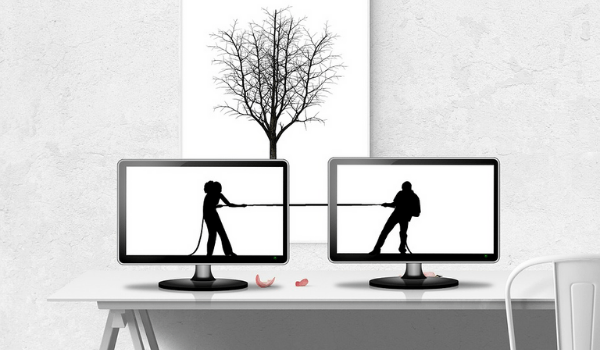
Collaboration and conflict are two sides of the same coin. A significant portion of a regular day in the life of HR is devoted to resolving workplace conflicts. Before COVID-19, they often found themselves in meeting rooms, mediating warring parties. In the new virtual work reality, HR inboxes are clogged with cc-ed mails of heated exchanges.
Stress at an all-time high
Work and personal lives spilling into each other, adapting to new realities all around us, coupled with a year full of uncertainties have led to many knee jerk outbursts that perhaps wouldn’t have happened otherwise. “Conflict has increased primarily due to the lack of a social and psychological infrastructure,” notes Biplob Banerjee, chief people officer, ABD. “Increasing personal and family insecurities, coupled with the lack of visual and physical assurances is creating mistrust, suspicion, imaginary enmity and territorial-supremacy issues,” he adds.
Mansij Majumder, HR head, Manipal Global Education Services, points out that before the pandemic, barely a per cent of conflicts reached a level where HR was fully involved, but now even insignificant disagreements are finding their way directly marked to the CEO. “There’s an increasing tendency to copy senior management on every mail,” he notes. “One thinks the CEO is accessible because now everyone is just an e-mail away.” Majumder attributes the behaviour to the power of anonymity that comes with being remote. “One can write something without the fear of consequence. In a face-to-face interaction, one would think twice before walking up to the person,” explains Majumder.
Rajesh Padmanabhan
“Expectations cannot be left vague in a virtual work environment. The giver has to set clear expectations, while the receiver has to clarify and not assume.”
He said, she said
Remote and virtual work may have reduced inter-personal conflicts between colleagues that resulted from being in each other’s space. However, miscommunication of expectations is one of the most common workplace conflicts that is on the rise across companies. “A primary reason a lot of conflicts arise in virtual work is that expectations are not spelt out very clearly,” says Rajesh Padmanabhan, CEO, Talavvy Business Catalysts.
Comparing interactions to the pre-pandemic world, the senior HR leader explains, “One was able to note changes in tone, reactions and overall body language, and so one intuitively had a feel of what the expectations were. Now we don’t have that.” To overcome this, Padmanabhan stresses the importance of both parties involved. “The giver has to be very clear in the expectation setting and it’s equally important for the receiver to clarify and not assume. Expectations cannot be left vague in a virtual work environment.”
Biplob Banerjee
“Increasing personal and family insecurities, coupled with the lack of visual and physical assurances is creating mistrust, suspicion, imaginary enmity and territorial-supremacy issues.”
Micro-managing menace
It is never pleasant to have a micro-manager for a boss, but it’s an added source of friction when one is working virtually. Manager-subordinate conflicts, wherein the managers are not sure how much their teams are putting in, are being commonly witnessed by HR now. Priyanka Singh, CHRO, Excitel illustrates with an example, from the early stages of the transition to remote work, of a mistrusting micro-manager gone wrong.
“The manager couldn’t physically see how much the person is actually working. Therefore, they put more pressure without regard for what may be happening in the individual’s home space. Eventually, the person reacted and resigned with a long e-mail to HR.” Singh notes that it is important for managers to relinquish control in the new normal, “especially the old school of thought, where one wants to know the status at all times.”
Prachi Ghogle
“We’re not letting it get to a stage where it needs resolving. Managers are being trained by professional counsellors to look out for signals that may indicate something is wrong.”
Hold your e-mails
Majumder believes a lot of it has to do with the nature of written communication. “An e-mail can be interpreted in many ways,” he points out. “It leads to a lot of back and forth. Plus, at times, the issue may be with the task at hand but when one puts it on e-mail, the receiver often interprets it as a personal attack.”
In the new reality, Majumder believes that everyone has to be extra aware of their emotions. “The tendency to lash out and write an e-mail, is okay” he says, “but one should let it stay in the drafts and allow oneself to cool down.” He illustrates with the old adage, ‘Don’t communicate when you’re angry’. After all, “Every e-mail doesn’t need to go immediately,” says Majumder.
Mansij Majumder
“Companies need to invest in professional support.The workforce needs a neutral and unbiased party they can trust and vent to.”
At the same time, Majumder points out the crying need for professional mental health aid in the new work environment. “HR is still an employee. The workforce needs a neutral and unbiased party they can trust and vent to,” he says. “Companies need to invest in professional support.” Besides, he points out that there is also now resistance to warm up to HR, considering HR has been the harbinger of bad news this year. “When we call them now, they first ask, ‘Is everything fine?’, ‘Are you calling to schedule a meeting to fire me?'”
Priyanka Singh
“Managers have to relinquish control in the new normal. The old school of thought, where one wants to know the status at all times, has to be given up.”
Emotionally-intelligent managers
Taking a proactive instead of a reactive approach has proved helpful for SIRO Clinpharm. “We’re not letting it get to a stage where it needs resolving,” says Prachi Ghogle, head – HR, SIRO Clinpharm. The clinical research services company started an employee assistance programme to train managers to better understand their employees’ emotions.
“Managers are being trained by professional counsellors on how to handle an employee’s outburst or reaction and look out for signals that may indicate something is wrong,” informs Ghogle. The training entails sensitising managers to the emotions of employees. “For instance, an angry reaction may not always be a personal grudge. It may just be because the individual is dealing with personal challenges at that moment.”