


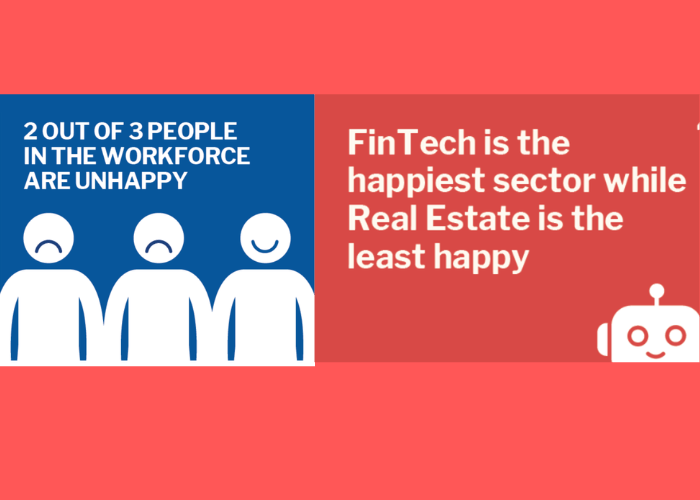
Attention employers! A whopping 70 per cent of the Indian workforce is unhappy at work, according to the Happiness at Work report. That means, at least two out of three members of the workforce are dissatisfied. This is not good news. Why? Well, as the report aptly says, “Individual happiness is the summum bonum of all those palpable and impalpable things which make up a thriving, buoyant enterprise.”
And guess which sector has nailed it or is the closest to doing it? Which sector do you think is able to keep its employees the most happy? The fintech sector! Yes, fintech tops the list of happy employees across sectors, with 40 per cent of the employees in this sector being happy at work.
The second position goes to biotechnology, followed by information and technology (IT), aviation, automobile, hospitality/travel/tourism, consumer electronics, and banking and insurance. Interestingly, consumer electronics, banking and insurance, and financial services are at the same level, with 30 per cent of their employees happy. The list then features FMCG, education and edtech, manufacturing, healthcare and pharmaceuticals, telecom, consulting and management, retail and e-commerce, media, entertainment, and advertising. Last on the list is real estate and construction, where only a mere 20 per cent of the employees are happy.
So, why is there this contrast in employee happiness between the most happy sector and the least happy sector? What is the fintech sector doing differently that so many of its employees are happy at work?
For one, 41 per cent of employees in the fintech space feel they enjoy work-life balance, while only 27 per cent of their counterparts in the real-estate and construction sector share the same sentiment. Secondly, 37 per cent of employees in the fintech sector receive adequate feedback and support on a regular basis, but only 29 per cent of those in the real-estate space enjoy the same support.
A significant 35 per cent of fintech employees feel encouraged to learn and grow, while only 23 per cent in the real-estate sector feel so encouraged. While 38 per cent of fintech employees admit to feeling energetic at work, only 29 per cent of their counterparts in the real-estate and construction space are able to experience the same energy.
When it comes to meaningful work, only 23 per cent of workers in the real-estate and construction sector find their work meaningful, while a lot more (37 per cent) of those working in the fintech space find their work meaningful.
Clearly, employees of the fintech sector enjoy a healthier work-life balance, receive regular feedback and support, and are encouraged to learn and pick up new skills. The employees in this sector find their work more meaningful than their counterparts in the real-estate sector. Why should it be surprising then that the fintech workforce is happier than the real-estate workforce?
Why do 54 per cent of employees intend to leave?
The rising trend of quitting can be attributed to growing dissatisfaction and lack of engagement. The report notes that when employees are able to take time out for their personal interests, there is a 60 per cent reduction in their intention to leave. The urge to quit can be reduced by 62 per cent if employees are regularly appreciated for their work.
The study also reveals that employees who have the ability to maintain their cool and stay calm even in uncertain situations are 63 per cent less likely to leave. Employees who are given freedom in their roles and not micromanaged are 60 per cent less likely to quit.
Why are Millennials the most likely to leave?
The report reveals that a whopping 59 per cent of Millennials intend to leave their jobs, the highest among the generations. This intention is lowest among Baby Boomers (34 per cent). While 42 per cent of the Gen Zers intend to leave, about 48 per cent of the Gen X intend to leave. The younger the employee, the higher is the intention to quit!
Is this a shocker? Not really, because the study discovered that 80 per cent of Millennials are troubled by interpersonal conflicts. That is, they are likely to avoid working with colleagues owing to disagreements.
A good 63 per cent of the Millennials who were part of the study feel their contributions are not appreciated. About 59 per cent are frustrated as they are unable to take time out for their personal interests. Sixty-three per cent find it challenging to remain calm in the face of uncertainty.
Considering that Millennials form a significant part of the workforce today, these issues need to be addressed to control attrition and improve retention in organisations.
How can employee retention be improved?
It is not difficult to make employees stay. All employers need to do is ensure they nurture a sense of belonging in their employees. A whopping 71 per cent of employees feel that a sense of belonging leads to better social connections and acceptance. It also encourages more collaboration and teamwork. Better collaboration results in more effectiveness and a sense of community, which will improve morale and job satisfaction. All of this together results in better productivity and a drop in conflicts.
A good 74 per cent of employees feel it is essential to enjoy working with colleagues. After all, the more the camaraderie, the more the positivity and the better the work environment and employee experience. About 63 per cent of employees hesitate to collaborate with colleagues with whom they are in conflict. Another 62 per cent find it difficult to express their views openly at work. When employees are unable to share their views and opinions freely, the work culture becomes negative and may even become toxic.
Transparency and clarity in communication is important for the happiness of 72 per cent of employees. Lack of clarity is what leads to anxiety, insecurity, and uncertainty. If these are eliminated, the workforce will be more satisfied and more focused on work.
Empathy in communication is important to 73 per cent employees. Clearly, employees value support and mutual respect.
The survey by Happiest Places to Work® in association with the Happiness Research Academy, covered 2,000 employees from across sectors during April to May 2024, with 59 per cent male and 41 per cent female employees.