



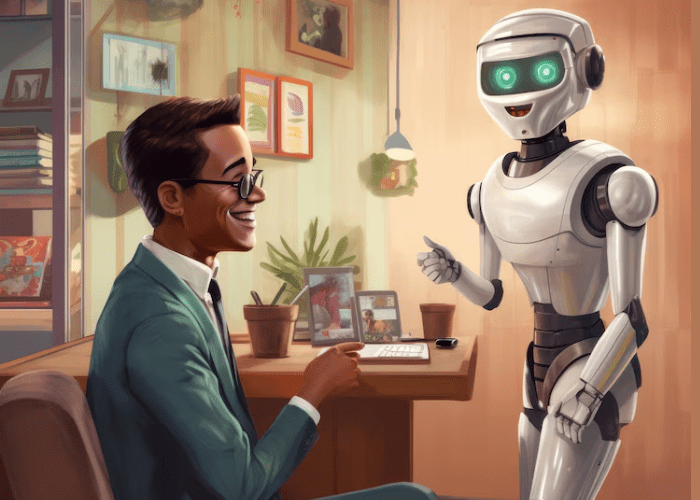
The digital revolution has ushered in a new era of workplace automation, with AI-powered ‘work buddies’ becoming increasingly common. These digital assistants, designed to handle routine tasks, promise to increase productivity and free employees to tackle more complex problems requiring creativity and judgment. However, as AI integration accelerates, a vital question emerges: Can artificial intelligence ever truly replicate the nuanced, empathetic decisions that are inherently human?
Walmart’s ‘My Assistant’ app exemplifies this shift. With over 50,000 employees using it to manage tasks like document summarising, content creation, and scheduling, workers find themselves liberated from routine, able to focus instead on strategic work, talent development, and customer engagement. Microsoft’s Co-Pilot goes further, enhancing meetings by analysing sentiments, highlighting key points, and flagging divergent views.

AI’s efficiency in managing repetitive work has notably improved individual productivity. Praveen Purohit, deputy CHRO, Vedanta Resources, shares how Co-Pilot has transformed his workflow. “For months, Co-Pilot has helped me summarise lengthy documents, draft communications, and create action points. It’s like having a tireless assistant,” he says. Yet, beyond the boost in productivity, a deeper conversation stirs about AI’s impact on critical skills and decision-making.
“For months, Co-Pilot has helped me summarise lengthy documents, draft communications, and create action points. It’s like having a tireless assistant.”
Praveen Purohit, deputy CHRO, Vedanta Resources
Productivity vs problem-solving skills
While AI brings undeniable benefits, corporate leaders remain cautious about its effects on essential skills. Pankaj Lochan, CHRO, Navin Fluorine, warns that excessive AI reliance may hinder independent problem-solving. “AI offers tremendous efficiency, learning from initial cases and easing repetitive tasks,” he says, “but over-reliance on AI could weaken our critical thinking abilities.” He likens it to the decline in navigational skills with the heavy use of GPS: “If we lean on AI for everything, we risk losing our ability to chart our own paths.”
“AI offers tremendous efficiency, learning from initial cases and easing repetitive tasks, but over-reliance on AI could weaken our critical thinking abilities.”
Pankaj Lochan, CHRO, Navin Fluorine
In precision-driven sectors such as manufacturing, AI support has proven invaluable. For Lochan’s team, multi-skilled employees are a game-changer, significantly lowering recruitment costs. “In manufacturing, recruitment costs can make up 75-90 per cent of operational expenses. AI-supported, multi-skilled employees help offset this,” he explains. For companies facing high labour costs, AI-facilitated workforce optimisation is an undeniable advantage.
Balancing automation with empathy and judgement
AI excels at tasks that are procedural, but situations requiring empathy, intuition, and human judgement remain outside its grasp. Ramesh Shankar, a seasoned HR leader, highlights that AI cannot replace nuanced human judgement, especially in areas like handling grievances or assessing special requests. “AI can provide recommendations,” Shankar notes, “but it lacks the emotional intelligence needed in situations that demand empathy.” This balance between automation and human judgement is especially crucial in HR, where AI manages payroll and recruitment but lacks the sensitivity required for delicate conversations or performance evaluations.
High costs also temper AI adoption in some businesses. Purohit notes that while the benefits are substantial, the expense of licensing and implementing AI tools often limits usage to selective or pilot-based scenarios. “The financial hurdle makes selective deployment more practical,” he says, though he believes that wider use could eventually drive down costs, making AI more accessible to businesses across industries.
“AI can provide recommendations, but it lacks the emotional intelligence needed in situations that demand empathy.”
Ramesh Shankar S, senior HR leader
As reliance on AI-powered systems grows, so do concerns about data security and confidentiality. For companies whose competitive advantage depends on innovation, AI’s reliance on vast data networks poses unique risks. Lochan underscores the stakes: “In R&D, where proprietary knowledge is critical, AI’s potential to leak data is a serious concern.” For research-driven sectors that tightly guard intellectual property, data security is a priority in the AI conversation, adding complexity to its adoption.
Human judgement in an AI-enhanced workplace
AI’s role in optimising workflow is undeniable, but human judgement remains irreplaceable for decisions rooted in empathy, creativity, and unpredictability. Take healthcare, for instance: while AI can streamline claims processing, human oversight is essential for evaluating individual cases. “AI can process claims faster,” Shankar observes, “but a human decision-maker understands the nuances of individual needs.”
Leaders are mindful, too, of AI’s influence on strategic decision-making. While data-driven AI can suggest approaches based on historical trends, it cannot match the foresight and adaptability that seasoned leaders bring to evolving challenges. In such scenarios, AI excels at processing vast information, but it is human insight that shapes a team’s direction.
The path forward: A collaborative future
As AI-powered work buddies continue to redefine the workplace, the companies that excel will be those that master the art of human–AI collaboration. “AI is here to support and elevate human potential, not replace it,” says Purohit. “The goal is to use AI to increase productivity and quality, while recognising the irreplaceable value of human intelligence in complex decision-making.”
The future of work lies in blending human insight with AI-driven efficiency. Companies that strike this balance will not only improve operations but will also nurture a workplace where AI complements, rather than competes with, human creativity and intuition. Together, they will build a more dynamic, resilient, and collaborative future, where technology serves as a powerful ally in unlocking human ingenuity.