



Hospitality presents unique talent challenges. Operations run 24/7, 365 days a year. Work-from-home is rarely an option—employees must be present to serve guests. Schedules shift with occupancy, weekly offs often need rescheduling, and the industry’s demands create inherent stress that policies alone cannot eliminate.
Yet some organisations manage to build enduring cultures within these constraints—where leaders spend decades, CXOs are developed internally, and culture evolves without fragmenting.
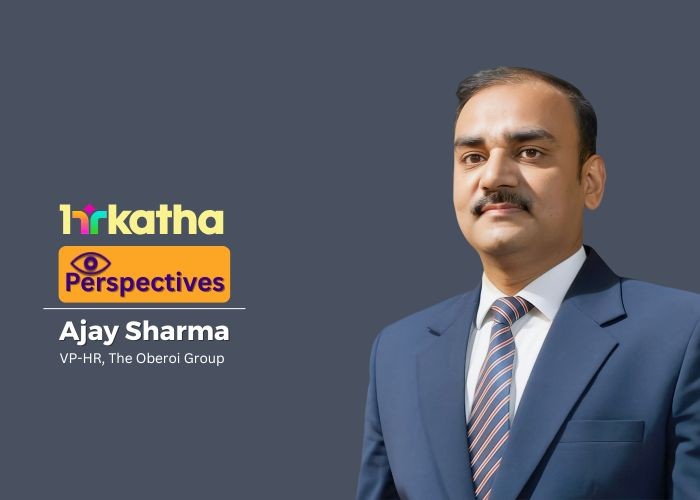
In conversation with HRKatha, Sharma explains why small teams accelerate leadership learning, why 75 per cent of The Oberoi Group’s CXOs have been developed internally, why workplace stress in hospitality often stems from lack of personal time, and why public employee grievances should trigger organisational introspection rather than PR management.
Small teams teach ownership
What experience shaped you most as a people leader?
I began my HR journey with The Oberoi Group in 2005 at The Oberoi Vanyavilas in Sawai Madhopur—a remote location with a young team of about 150 members. The two years I spent there were far more intense than I had imagined.
Managing HR for a small team teaches ownership and accountability very quickly. It also forces you to develop business acumen because you are closely connected with operations. You have to be completely hands-on and disciplined.
That experience refined me both professionally and personally. Living and working alongside the team also meant I could see the impact of people practices almost immediately. Feedback was instant.
If I were advising my 25-year-old self, I would say the same thing: begin your HR career in a smaller location with a smaller team. Hands-on and intense experiences in the early years help build the foundation of professional identity.
“Every public grievance is a signal calling for deeper organisational review.”
One culture across generations
Can one culture serve five generations simultaneously?
I believe it can—provided the culture continues to serve basic human needs: purpose, recognition and growth.
Organisational culture should not be static. It must have the flexibility to evolve with time. When culture evolves while staying anchored to these basic needs, it can continue to unite employees across generations.
“Hands-on experience in the early years builds the foundation for professional identity.”
Build versus buy: 75 per cent internal
Do organisations still have the patience to grow leaders internally?
At The Oberoi Group, about 75 per cent of our CXOs have been developed internally. Most of our senior leaders have spent more than 20 years with the organisation.
We consciously prioritise internal promotions. This approach strengthens long-term engagement and productivity rather than focusing only on short-term performance.
At the same time, relying too heavily on internal pipelines can sometimes reduce exposure to outside perspectives and diversity of thought. Clear development plans and strong success metrics help balance this.
Overall, building leaders from within has helped us preserve culture while sustaining leadership continuity.
“One culture can unite generations if it serves purpose, recognition and growth.”
Redesigning roles after maternity
In what ways do organisations still unintentionally penalise motherhood?
Unconsciously, organisations do impose career penalties on motherhood. Even when supportive policies exist, invisible structural barriers remain.
In many cases, women in operational roles take the biggest career hit.
One structural shift that could help is to make role redesign a formal step when women return from maternity leave. Every returning mother should have the opportunity to redesign her role based on changing priorities and realities. This could even be made a mandatory process and included in organisational audits.
Where possible, flexible work arrangements should also be explored. But ultimately, success depends on leadership commitment and consistent tracking of outcomes.
“Seventy-five per cent of our CXOs have been developed internally.”
Creating “comfortable zones”
How do you address the root causes of workplace stress?
Workplace stress cannot simply be wished away. The answer is not only offering counselling or an EAP helpline but creating an environment that does not burn people out.
In hospitality, work-from-home is rarely possible. Hotels operate 24/7 and 365 days a year, and schedules depend heavily on occupancy. Weekly offs sometimes have to be rescheduled. These realities naturally create stress.
One underlying issue is that employees often do not get enough “me-time”.
To address this, we focus on creating what we call “comfortable zones” within the workplace. Many of our hotels have recreation rooms, small gyms, wifi areas for team members and interest groups that allow employees to engage beyond work.
The aim is to create a sense of community within the workplace so that employees can recharge and connect with colleagues beyond operational responsibilities.
“Small teams teach ownership faster than large organisations”
Linking people practices to business outcomes
What earns HR credibility with business leaders?
I do not believe HR lacks commercial acumen. But HR teams must learn to integrate business priorities more clearly into their people strategies.
Sometimes HR policies become too one-sided, focusing only on people considerations without adequately linking them to business outcomes.
HR credibility improves when people practices are clearly connected to organisational performance. One powerful lever is aligning individual objectives with organisational goals.
When employees see how their work contributes to the larger business outcome, it strengthens intrinsic motivation and improves performance.
“Employees often struggle to find ‘me-time’ in a 24/7 hospitality environment.”
The buck stops with HR
When employees take grievances public on social media, where does HR’s responsibility begin and corporate communications’ end?
It may appear to be a corporate communications issue, but fundamentally it is not. The buck stops with HR.
The first step is to acknowledge the issue with empathy, move the conversation out of the public domain and work towards resolution.
The second step is even more important—identifying the underlying cause and addressing it sincerely. Every public grievance is a signal that calls for broader organisational review.
After resolving the individual issue, organisations must scan their internal processes more deeply. Feedback mechanisms may need strengthening, outdated processes redesigned, and frontline managers sensitised so that similar issues can be prevented in the future.
“HR credibility comes from linking people practices to business outcomes.”