


Life insurance sits at an unusual intersection of trust and urgency. It is a product people know they need but rarely want to think about, sold through relationships built over years and claims that arrive at the most difficult moments of people’s lives. The workforce that delivers this—agents, advisers, operations teams and leadership—spans generations, geographies and expectations in ways few industries match.
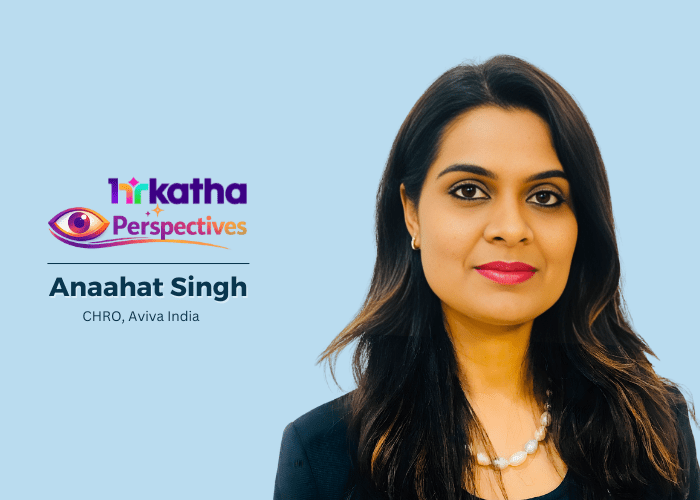
Anaahat Singh navigates these realities as CHRO of Aviva India, a joint venture between Aviva International Holdings and Dabur Invest Corp. In conversation with HRKatha, she explains why hiring for current skills has become a business risk, why diversity in Indian organisations narrows not at entry but over time, and why psychological safety does not require flattening hierarchy—only making it more human.

Comfortable being a beginner again
Are you hiring for skills that exist today, or the capacity to learn what does not yet exist?
The traditional hiring model—checking boxes against a skills list—is no longer just inefficient. It is a business risk. In a world where tools, technologies and ways of working evolve faster than hiring cycles, what someone knows on day one matters far less than how they respond when they do not know something.
At Aviva India, we have shifted the lens from “what you know” to “how you grow”. The real question in an interview is not what someone has mastered—it is how they behave in moments of uncertainty. That reveals more about future potential than any résumé.
Future-ready talent, for us, is someone comfortable being a beginner again. Someone who leans into change with curiosity rather than resistance, who works alongside AI rather than around it, and who is willing to let go of practices that no longer serve. Unlearning is as important as learning.
“The CHRO role is not a people role. It is a business role with people at the centre of it.”
A shared core, a personalised experience
Can a single culture genuinely serve five generations simultaneously?
We should not have a fragmented culture. But we must have a personalised experience.
The cultural North Star must remain constant—purpose, psychological safety, respect and care. These are not generational preferences; they are human constants. What should vary is how people experience that culture.
A 24-year-old and a 54-year-old will want to be recognised, developed and heard in different ways. That is not a challenge—it is a design requirement. The organisations that succeed will build a strong shared core while allowing flexibility in how individuals engage with it.
Culture is the glue. Personalisation is the fuel.
“Fear comes from distance. When AI becomes part of how people work, it starts to feel like support.”
Internal development as a strategic moat
Is it still realistic to develop senior leaders internally?
Poaching is a tactical move. Internal development is a strategic moat.
Leaders who grow within an organisation carry something that cannot be hired—context, memory and an understanding of how decisions evolved. That depth is difficult to replace.
At Aviva India, we invest in identifying and developing high-potential talent early, building structured paths that make the pipeline visible. When employees can see a credible route to leadership, retention improves—not just because of the destination, but because of visible investment.
At the same time, external hiring brings fresh thinking. The balance lies in knowing when to build and when to bring in.
“Psychological safety is not about removing hierarchy. It is about humanising it.”
Where diversity actually fails
What is the one systemic barrier to diversity you are trying to dismantle?
Diversity does not fail at the entry level. It narrows over time.
The real challenge lies in the mid-career stage—typically around 8 to 10 years—when professional growth intersects with personal responsibilities. Capability does not decline, but participation does.
The barrier is not primarily policy. It is the social infrastructure around caregiving and deeply embedded expectations that organisations alone cannot fully control.
What is harder to change is mindset—recognising potential that does not look familiar.
Progress in diversity is rarely dramatic. It is slow, deliberate and often invisible until it becomes undeniable.
“Diversity does not fail at the entry level. It quietly narrows as careers progress.”
Humanising hierarchy
Can Indian organisations build cultures where junior employees challenge senior leaders?
Psychological safety is not about removing hierarchy. It is about humanising it.
Respect is deeply embedded in Indian workplaces—and should remain. But respect should not silence voices. The shift is not structural; it is behavioural.
Structured forums help. But the real signal is what happens when someone speaks up. If leaders respond with openness rather than defensiveness, culture shifts through repeated behaviour—not programmes.
Speaking up should be seen as a form of respect, not a breach of it.
“Poaching is a tactical move. Internal development is a strategic moat.”
AI becomes familiar through use
How do you help employees see AI as an enabler rather than a threat?
Fear comes from distance. Familiarity reduces it.
Our approach is to make AI tangible—integrating it into everyday workflows rather than treating it as an abstract concept. People become comfortable with technology by using it, not by being told it is safe.
The hesitation we see most often is around what AI means for roles. That is a valid concern. What we keep returning to is this: work is not disappearing—it is evolving. And organisations have a responsibility to invest in helping people evolve with it, not just say they will.
“Culture is the glue. Personalisation is the fuel.”
Learn the language of business
What shaped you as a people leader? What would you tell your younger self?
Leadership is shaped over time—through decisions, missteps and moments where you have to stay present in uncertainty rather than retreat from it.
If I could tell my younger self one thing, it would be this: learn the language of business as fluently as the language of people.
Early in my career, I viewed HR through the lens of culture and compliance. What I would do differently is spend more time with the business—especially on the front line—understanding how work actually happens. That exposure builds both credibility and judgement. It also makes you a more effective advocate for the workforce, because you understand what you are asking the business to change.
The CHRO role is not a people role. It is a business role with people at the centre of it.
“Future-ready talent is someone who is comfortable being a beginner again.”