



The queue at the top
There is an assumption embedded in most HR careers: experience accumulates, titles grow longer, and rewards follow naturally.
The latest labour-market data suggests otherwise.

AIHR’s HR Career Outlook 2026, based on analysis by Revelio Labs of 3.88 million HR professionals, 162,000 active job postings and 54 HR roles across the United States, finds that the most coveted senior HR positions are also the most crowded. The scarcest talent sits elsewhere.
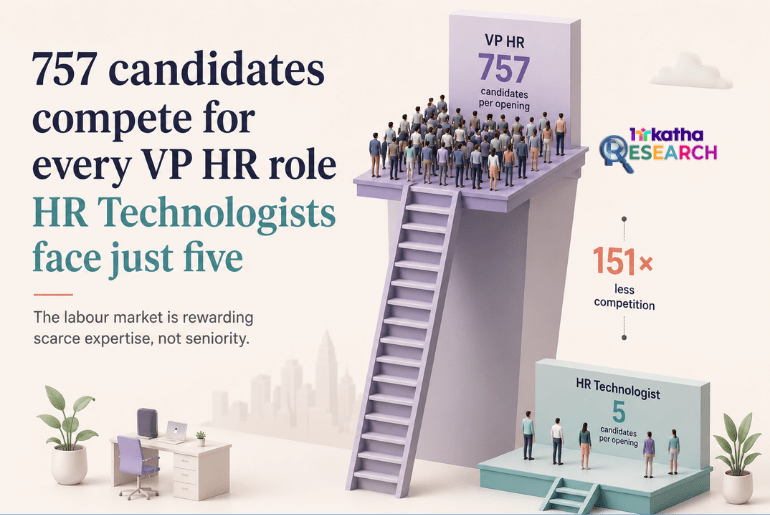
The report’s supply-demand ratio provides the clearest illustration. A VP HR role attracts 757 available candidates for every opening. Senior HR Business Partner roles attract 650. HR Director positions attract 230.
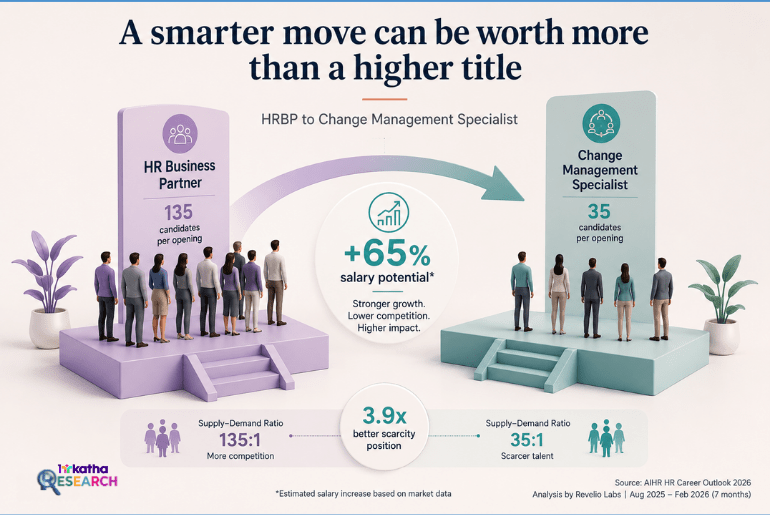
At the other end of the spectrum, HR Technologists face a ratio of just five candidates per vacancy. Heads of People Analytics face 28. Change Management Specialists face 35.
The market is placing a premium on expertise, not hierarchy.
Why specialists are winning
The most revealing finding is not where demand is strongest but where scarcity exists.
Many traditional HR functions remain essential. Yet technology is steadily reducing the value of work centred on coordination, administration and process management. Organisations can automate scheduling, reporting and transactional workflows far more easily than they can automate organisational design, workforce analytics or transformation programmes.
That distinction is now showing up in labour-market demand.
The report identifies Learning and Development as one of the fastest-growing segments within HR. Five of the seven fastest-growing HR roles belong to the function.
As AI reduces the effort required to create content, the value shifts towards capability architecture: identifying future skills, designing learning systems and measuring business outcomes.
Creating a training module is becoming easier. Building organisational capability is not.
The compensation economy
A similar pattern appears in Total Rewards.
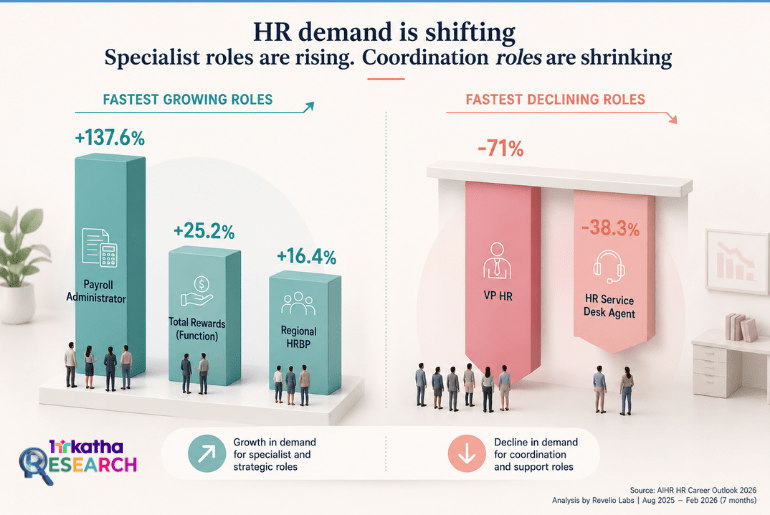
Demand for the function grew 25.2 per cent during the study period. Job-posting demand for Payroll Administrators rose 137.6 per cent, driven partly by growing regulatory complexity and pay-transparency requirements.
Employers are rewarding HR professionals who manage specialised systems carrying direct business risk.
Compensation and Benefits Managers sit in a comparatively favourable position, combining strong pay with relatively limited talent supply. The market increasingly values expertise that organisations cannot easily replace.
The disappearing middle
Perhaps the most uncomfortable finding concerns the traditional HR middle layer.
Job-posting demand for VP HR roles fell 71 per cent during the seven-month study period. HR Service Desk Agent demand declined 38.3 per cent. The roles appear unrelated. In practice, they reflect the same structural shift.
Organisations are steadily removing roles whose primary function is coordination. Technology platforms increasingly handle transactions, while specialists handle judgement-intensive work.
The result is a labour market that favours depth over breadth.
Regional HR Business Partners stand out as a notable exception, with demand rising 16.4 per cent. Proximity to business outcomes still commands value. Generic coordination does not.
What AI is really changing
Artificial intelligence itself appears in fewer than 1 per cent of HR job postings.
That does not mean AI is absent from the labour market. It means employers are changing the work rather than the titles.
Routine tasks are becoming less valuable. Analytical, advisory and systems-oriented work are becoming more valuable. Artificial intelligence is amplifying existing trends rather than creating entirely new occupations.
The HR Technologist’s supply-demand ratio of five candidates per role tells the story more clearly than any AI keyword ever could.
The end of the ladder
The data is American. The logic is not.
Indian HR careers have long been built around the same assumption: climb high enough and scarcity takes care of itself. The AIHR findings suggest that scarcity is no longer created by title. It is created by expertise.
This matters because the Indian HR profession still tends to view seniority as the primary driver of career progression. The destination remains the same in many organisations: HRBP, HR Director, CHRO. Yet the market is increasingly rewarding professionals who move sideways into scarce specialisms before they move upward.
AIHR highlights one example. Moving from HR Business Partner to Change Management Specialist is associated with an estimated 65 per cent salary increase while significantly improving labour-market positioning. The individual has not necessarily become more senior.
They have become harder to replace.
That distinction will define the next decade of HR careers.
For years, experience alone provided a degree of protection. Today, experience without specialisation appears increasingly exposed to competition. The queue for VP HR contains 757 candidates. The queue for HR Technologist contains five.
For decades, HR careers were built around climbing a ladder. Today’s labour market looks more like a network of specialist pathways.
The professionals who prosper may not be those who climb fastest. They may be those who develop expertise that few others possess.
Source: AIHR HR Career Outlook 2026, based on US HR labour market data analysed by Revelio Labs, covering seven months from August 2025 to February 2026.
