


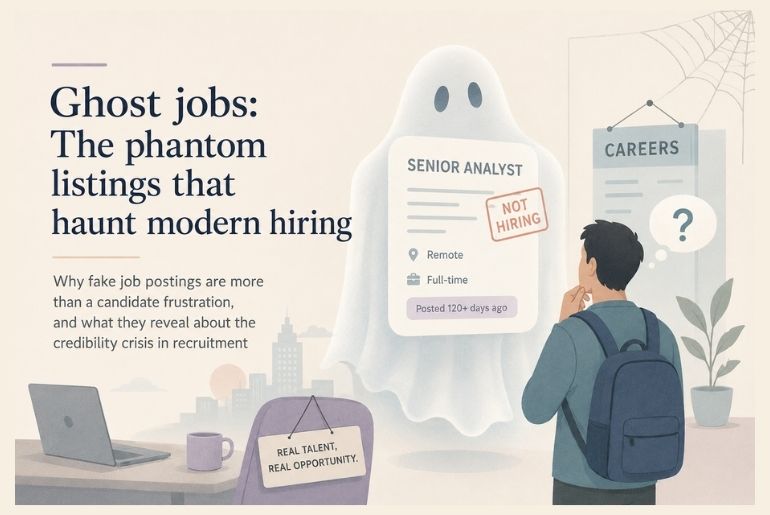
What are ghost jobs?
Ghost jobs are vacancies that appear genuine but are not actively being filled.
They remain on company websites, LinkedIn, and job portals even though hiring has been paused, the position has already been filled, or no approval exists to recruit in the first place.
Some are left online to build talent pipelines. Others simply linger because nobody removes them.
For candidates, ghost jobs waste time and create false hope. For HR, they raise a more uncomfortable question: when does employer branding become misleading?
Where did the idea come from?
The practice predates social media.
In the early 2000s, many organisations kept “evergreen” vacancies open to build candidate pipelines for future hiring. During economic downturns, some companies continued advertising roles to project stability, even when recruitment had slowed.
Digital job platforms made the practice far easier. Posting a vacancy became inexpensive, instant, and visible to millions. Over time, some organisations also began using job advertisements to understand salary expectations, monitor talent availability, or keep recruitment pipelines warm.
The pandemic accelerated the trend. Hiring freezes became common, but many listings remained online long after recruitment had stopped.
Why is it relevant for HR?
Ghost jobs create problems that extend far beyond disappointed candidates.
Recruitment is built on trust. Every job advertisement is effectively a promise that an organisation is looking for talent. When candidates repeatedly apply for roles that never move forward, confidence in that promise begins to erode.
The problem also affects recruiters. Genuine applications become harder to attract when candidates begin assuming vacancies are unlikely to be real. Employer branding suffers, application quality declines, and recruitment teams spend increasing time rebuilding credibility that should never have been lost.
For HR leaders, the issue is no longer simply candidate experience. It is organisational reputation.
The uncomfortable reality
Ghost jobs rarely exist because HR wants to mislead candidates.
More often, they reflect organisational dysfunction.
Hiring managers seek approval before budgets are finalised. Finance delays headcount decisions after vacancies have already been advertised. Recruiters inherit requisitions that quietly disappear without being formally closed. In large organisations, job postings can remain live simply because no one owns the responsibility of taking them down.
Some organisations, however, keep vacancies active deliberately. A long careers page signals growth. A steady flow of applications provides market intelligence on skills, salaries, and talent availability. In an era of AI-driven recruitment, candidate data has become valuable in its own right.
Whatever the reason, the outcome is the same. Candidates invest time in opportunities that never really existed.
Increasingly, they notice. Social media, Glassdoor, and LinkedIn have made recruitment far more transparent than it once was. Candidates compare experiences, track dormant vacancies, and publicly question employers that repeatedly advertise roles without hiring.
The cost is no longer limited to frustrated applicants. It is measured in lost trust.
The takeaway
Ghost jobs reveal something larger than inefficient recruitment.
They expose the gap between signalling and substance.
A careers page should represent genuine hiring intent, not organisational aspiration or market research. If a company is building a talent pipeline, candidates deserve to know. If hiring is paused, transparency is better than silence.
For HR, credibility is becoming one of recruitment’s most valuable assets.
Because every vacancy is more than an advertisement. It is the first conversation between an organisation and a potential employee.
And first impressions are difficult to rebuild once candidates realise the conversation was never meant to happen.