



The debate about AI and employment has spent three years asking the wrong question.
The question is not whether AI will replace workers. It is which workers, doing which tasks, are already being replaced, and what that tells organisations about how careers are changing.
The Stanford University Human-Centred AI Institute’s Artificial Intelligence Index Report 2026, drawing on LinkedIn labour-market data, McKinsey surveys and dozens of peer-reviewed productivity studies, offers perhaps the clearest picture yet of AI’s impact on work.
The picture is more nuanced than either the optimists or the pessimists predicted. AI is not eliminating jobs at scale. It is redesigning how work is organised, concentrating scarce talent in unexpected places, and quietly removing much of the work that traditionally introduced young people to professional life.
The global race for AI talent
The geography of AI capability is changing faster than many expected.
Israel now has the world’s highest concentration of AI professionals, with AI talent accounting for 2.1 per cent of its LinkedIn workforce. Singapore follows at 1.8 per cent and Luxembourg at 1.6 per cent. These are not the world’s largest technology economies. They are relatively small countries that have deliberately designed immigration, education and innovation policies to attract scarce expertise. Luxembourg also recorded the highest net inflow of AI professionals during 2025, attracting 5.23 AI professionals per 10,000 LinkedIn members. The US, still the world’s largest AI employer in absolute terms, managed a net inflow of just 1.2 per 10,000.
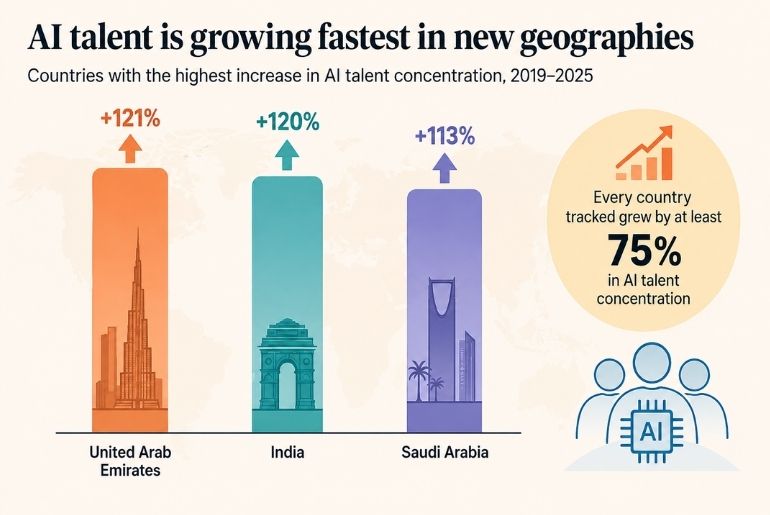
India presents a different story. Between 2019 and 2025, India more than doubled its AI talent concentration, alongside the UAE and Saudi Arabia. The country is producing AI capability faster than almost any major economy. That success brings its own challenge. AI talent is becoming increasingly global, and organisations are no longer competing only with domestic employers but with international markets willing to pay heavily for scarce expertise. Retaining AI professionals may prove as strategically important as recruiting them.
Productivity is improving, but not equally
The evidence that AI improves productivity is becoming difficult to dispute.
Customer-service agents using conversational AI resolved roughly 15 per cent more queries per hour. Software developers working with GitHub Copilot completed 26 per cent more pull requests. Marketing teams using multimodal AI increased output by around 50 per cent. Yet the gains are highly uneven. Across multiple studies, the largest productivity improvements consistently appear among less experienced workers. AI narrows the performance gap between junior and senior employees by giving inexperienced workers access to expertise they previously acquired only through years of practice.
The longer-term risk begins here. Researchers increasingly warn of what Stanford calls learning penalties. Employees complete work faster but spend less time developing the underlying judgement that previously came from solving problems unaided. AI may accelerate performance while slowing expertise. The economy-wide picture is beginning to shift regardless: a study of 12,000 European companies found AI adoption increased labour productivity by 4 per cent, with organisations that invested in employee training seeing stronger outcomes than those that deployed technology alone. US labour productivity grew 2.7 per cent in 2025, nearly double the previous decade’s annual average. Implementation, not technology, is increasingly the limiting factor.
The disappearing first rung
The most significant labour-market shift is occurring at the bottom of the career ladder.
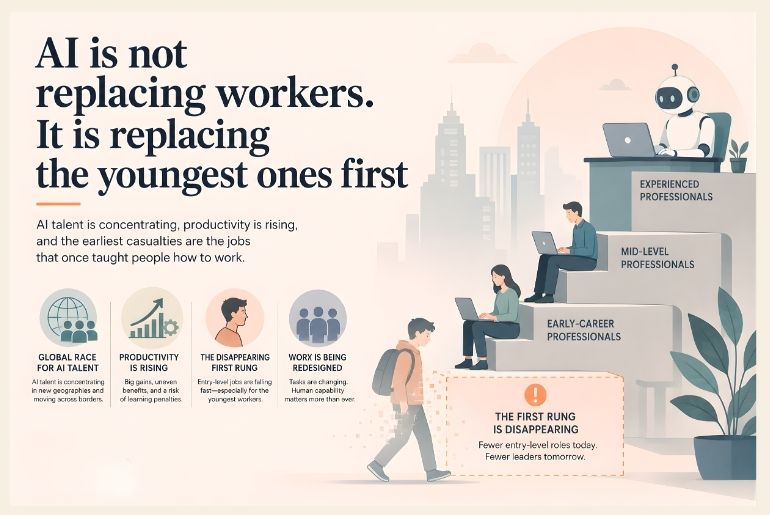
In the US, employment among software developers aged between 22 and 25 has fallen by almost 20 per cent since peaking in 2022. Older developers have seen no comparable decline. This echoes findings from the recent Cognizant-Pearson study, which showed AI already performs roughly one-third of entry-level work globally and 37 per cent in India specifically. Organisations are not replacing experienced employees with AI. They are reducing the number of entry-level opportunities that once produced experienced employees.
That distinction matters enormously. Graduate jobs have never existed simply to complete routine work. They have existed to teach judgement, build organisational understanding and prepare future managers. If AI removes the work before organisations redesign how early-career learning happens, today’s productivity gains could create tomorrow’s leadership shortage. The first rung of the career ladder is disappearing faster than the rest of the ladder.
AI exposure is not the same as unemployment
Another Stanford finding challenges one of AI’s most common assumptions.
Highly AI-exposed occupations did experience rising unemployment between 2022 and early 2025, but the increase was modest, around 0.3 percentage points. Less AI-exposed occupations experienced a larger increase of almost one percentage point. The finding suggests AI itself is not yet the dominant driver of job losses. Economic conditions, sectoral cycles and business investment continue to matter more than automation alone. What AI appears to be changing first is hiring behaviour rather than redundancy decisions. Employers are keeping experienced workers while hiring fewer junior ones.
Business expectations, however, suggest the restructuring is only beginning. One-third of employers in McKinsey’s global survey expect workforce reductions over the coming year, rising to 35 per cent among organisations with revenues exceeding one billion dollars. The functions where reduction expectations are strongest, namely service operations, supply chain, marketing and sales, and software engineering, all combine high volumes of repeatable knowledge work with rapidly improving AI capability. Expected reductions exceed those already experienced across almost every business function.
Organisations are moving slower than the technology
Perhaps the widest gap in the report lies between technical capability and organisational capability.
Workers appear far more ready for AI than employers assume. Nearly half of employees actively want AI to automate repetitive parts of their work. Yet tasks with the highest automation potential account for only around 1.3 per cent of actual AI use. The bottleneck is no longer the technology. It is workflow redesign, management capability and organisational confidence. Deploying AI tools is proving considerably easier than redesigning work around them.
The diversity gap remains stubborn
One pattern has barely shifted despite rapid growth.
Across most major economies, between two-thirds and three-quarters of AI professionals are men. In the US, women account for 34.3 per cent of AI talent. The imbalance has remained largely unchanged since 2016, even as AI hiring accelerated significantly. As AI becomes embedded across business functions, this is no longer simply a representation issue. The workforce building tomorrow’s systems still draws disproportionately from one half of the available talent pool, and that is increasingly a capability risk as much as an equity one.
What this means for HR
The Stanford report ultimately describes four changes happening simultaneously: AI talent is becoming globally mobile; productivity gains are becoming measurable but uneven; entry-level careers are narrowing; and work itself is being reorganised task by task rather than job by job.
For HR leaders, that changes the central question. The challenge is no longer deciding which jobs AI will replace. It is deciding which human capabilities become more valuable once AI performs the routine work. The collapse in junior hiring, the persistence of learning penalties and the widening gap between AI deployment and organisational adoption all point in the same direction: technology is evolving faster than workforce design. AI is not replacing the workforce. It is replacing the conditions under which the next workforce gets built, and that is a quieter disruption than mass redundancy, and quite possibly the more consequential one.