



In IT services and enterprise technology, predictability has quietly disappeared. Client expectations shift rapidly, technologies evolve mid-project, and employees are expected to relearn faster than ever before. As AI-native talent enters the workforce and delivery models span remote, hybrid and on-site environments, HR leaders are being pushed to rethink not just hiring and performance, but the very idea of careers.
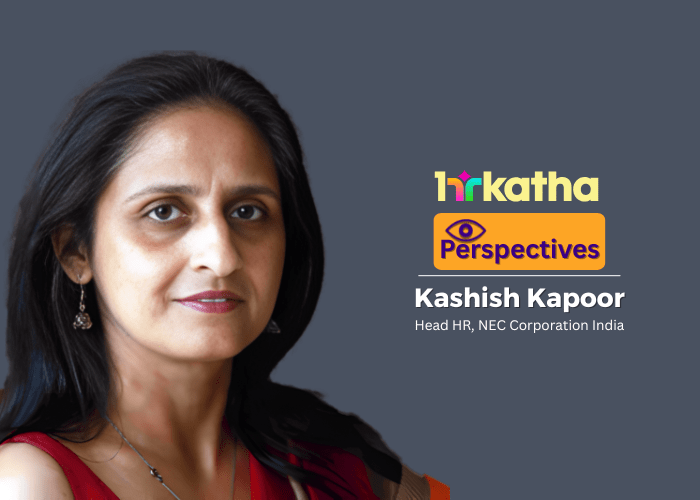
In conversation with HRKatha, Kashish Kapoor, CHRO, NEC India explains why technical skills now have a shelf life measured in months, not years; why performance appraisal must visibly translate into meritocracy; and why inclusion cannot be driven through targets alone.

Six to twelve months, not five years
Are you hiring for current skills or future capability?
The idea that technical skills last five years no longer holds. Today, skills evolve far more rapidly. In many cases, visible shifts happen within six to twelve months.
What is changing is not just the speed, but the nature of skills. The distinction between primary and secondary skills is blurring. Roles now require combinations of capabilities across functions.
At the same time, we are dealing with an AI-native workforce—people who have adopted technology faster than expected. Yet, alongside this, the need for empathy, trust and human connection is becoming more pronounced.
There is a clear tension here. While organisations continue to invest in reskilling and upskilling, they must also focus on bridging generational expectations and strengthening human connections.
AI can answer questions, but it cannot define an individual’s journey or create meaningful development paths. That remains a human responsibility.
“Performance appraisal must translate into meritocracy through transparency and objectivity.”
Meritocracy through transparency
What is working better than traditional performance management systems?
There is no single right model—whether it is bell curves, annual cycles or continuous feedback. What matters is whether performance appraisal actually translates into meritocracy.
For that to happen, three principles are essential: transparency, objectivity and consistency.
Today’s workplace operates across multiple formats—remote, hybrid and on-site. In such environments, performance systems must be designed to account for productivity, collaboration and context.
At NEC India, the focus is on regular, meaningful check-ins rather than episodic reviews. Conversations have become more continuous and developmental.
This goes beyond ratings. It helps identify where to invest in skills and how employees can grow into future roles. That is what creates careers, not just jobs.
“Managers are the frontline of culture and engagement.”
Three-pillar learning architecture
How do you scale development meaningfully?
Our learning architecture is built around three pillars: leadership development, manager effectiveness and functional expertise.
This ensures that every level of the organisation has access to structured learning. It also creates aspiration—employees can see what growth looks like.
Flexibility is equally important. Through skill-sprint programmes and cohort-based learning, employees can choose personalised development paths aligned to business needs.
Manager effectiveness plays a critical role here. Managers shape culture, engagement and employee experience on a daily basis.
High-potential employees are identified early and developed through leadership cohorts and action learning projects, closely linked to succession planning.
“Learning agility is no longer optional—it’s how work gets done.”
Learning agility as a daily discipline
How do you ensure learning agility is real, not just a buzzword?
Learning agility today is embedded in everyday work.
With the pace of change, the ability to learn, adapt and take risks is critical. It shows up in how individuals handle feedback, navigate ambiguity and respond to unfamiliar situations.
Organisations are also unlearning traditional ideas of failure. Failure is increasingly seen as part of the learning process.
In a world where roles evolve faster than skills, past experience alone is no longer a reliable predictor of future success. What matters is potential—and that is driven by learning agility.
Pull quote
“Inclusion must be cultural, not driven by quotas.”
Inclusion, not quotas
Can D&I be driven through targets?
Diversity and Inclusion cannot be sustained through targets alone. It has to be embedded into the organisation’s culture.
If targets alone worked, we wouldn’t still be having this conversation decades later.
At NEC India, the focus is on integrating inclusion into everyday processes—hiring, onboarding, development, rewards and recognition. Policies are designed to be inclusive rather than prescriptive.
The aim is to create an environment where diversity emerges naturally and is sustained through culture, not compulsion.
“Technical skills now have a shelf life of six to twelve months.”
Build first, then hire
How do you approach capability building in areas like AI?
Our first preference is always to build internal capability. That is why we focus on shorter learning cycles—six to twelve months.
External hiring comes into play for niche or leadership roles. We also leverage external ecosystems and internal global expertise to strengthen capability.
This balanced approach allows us to stay agile while continuing to invest in our people.
“Empathy, trust and belief are non-negotiable in HR leadership.”
Empathy, trust, belief
What differentiates a great HR leader?
Three things: empathy, trust and belief.
Everything else can be learned. But these three are fundamental.
Leaders must believe in the organisation, in their people and in themselves. That belief should be visible in every interaction. That is how cultures are built.
“AI cannot define an individual’s journey or development path.”
Symbiotic, not transactional
What is one mindset shift professionals need early in their careers?
Engagement with an organisation should not be transactional. It has to be symbiotic.
“What’s in it for me” is important, but it cannot be the only lens. Growth comes from contributing, learning and creating mutual value.
It is that synergy that ultimately drives long-term success.
“Don’t make your engagement transactional—it has to be symbiotic.”