


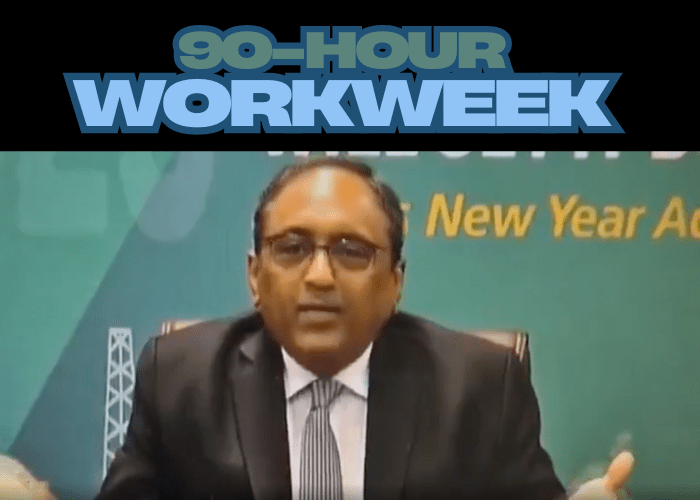
The mask has slipped. These are the moments when corporate leaders inadvertently drop their carefully cultivated public personas and reveal their true colours. SN Subrahmanyan, chairman and managing director of Larsen & Toubro (L&T), has given us precisely such a moment of clarity. In lamenting his inability to force employees to work on Sundays—complete with an astonishingly tone-deaf quip about spouses ‘merely staring at each other’ at home—Subrahmanyan hasn’t just sparked outrage. His endorsement of a 90-hour workweek, which drew criticism even from corporate peers such as RPG Group’s chairman, Harsh Goenka, has provided a masterclass in everything wrong with India Inc’s leadership mindset.
The breathtaking arrogance of advocating a 90-hour workweek in 2025 would be almost comical if it weren’t so dangerous. Let’s put this in perspective: fifteen hours daily for six days, or twelve-plus hours seven days a week. This isn’t just a violation of basic human dignity—it’s brazenly illegal under Indian labour laws. That the head of one of India’s largest conglomerates can so cavalierly dismiss worker protection legislation speaks volumes about the impunity with which corporate India’s aristocracy operates.
Subrahmanyan’s attempt to justify this medieval vision by invoking Chinese work practices is particularly rich. It’s the corporate equivalent of suggesting we solve traffic congestion by making cars longer rather than building better infrastructure. In an era where artificial intelligence and automation are revolutionising productivity, his solution is simply to demand more human hours—a stunning admission of intellectual bankruptcy in strategic thinking.
But perhaps we should be grateful for this moment of unvarnished truth. Subrahmanyan has inadvertently exposed the yawning chasm between India’s corner-office elite and ground reality. While one might charitably assume he intended to champion hard work and dedication, his framing was spectacularly tone-deaf. His remarks about spouses weren’t just sexist; they displayed a stunning ignorance of middle-class reality. For most working professionals, weekends aren’t about idly gazing at their partners—they’re about tackling the mountain of household responsibilities that accumulate during the workweek. Unlike Subrahmanyan, cocooned in his bubble of privilege with domestic staff at his beck and call, the average employee can’t outsource their personal lives.
The timing of this controversy is exquisite. As India positions itself as a global technology and innovation hub, here’s a premier engineering company’s chief essentially advocating sweatshop practices. We’re not in the 1970s anymore, when job scarcity forced employees to endure whatever conditions employers imposed. Today’s workforce, dominated by Gen Z professionals, views work through an entirely different lens—prioritising flexibility, mental health, and work-life balance.
What’s fascinating is how this controversy illuminates the generational warfare brewing in corporate India. The swift and savage social media backlash demonstrates how digital platforms have democratised workplace discourse. The old guard’s pronouncements no longer go unchallenged; their authority no longer absolute. Gen Z workers, armed with options and amplified by technology, are rewriting the employer-employee social contract.
Corporate leaders would do well to study their history. The exploitation of industrial-era workers sparked the rise of labour unions, fundamentally altering workplace dynamics. With unions already gaining ground in India’s IT and BFSI sectors, one wonders if dinosaur-like attitudes such as Subrahmanyan’s might accelerate similar movements across industries.
This moment represents a crucial crossroads for Indian business. Two competing visions of Asian economic development stand in stark contrast: one emphasising raw work hours and intensity, as referenced in Subrahmanyan’s China example, and another prioritising innovation, efficiency, and worker wellbeing. India must choose its path forward.
Perhaps most tellingly, Subrahmanyan’s remarks betray a fundamental misunderstanding of modern productivity. Innovation, creativity, and breakthrough thinking—the very elements needed for corporate success—rarely emerge from exhausted minds working marathon hours. It’s about recognising that productivity and worker wellbeing aren’t competing priorities but complementary forces.
For leaders such as Subrahmanyan, the choice is stark: evolve or become cautionary tales in management textbooks. In this era of democratised discourse and mobile talent, the market will render its verdict swiftly—and it’s increasingly clear which way the wind is blowing. The question isn’t whether such leadership dinosaurs will become extinct, but how much damage they’ll do to their organisations before they go.
2 Comments
Nice article. However, it is astonishing to see an article like this from a person who has been in HR domain. What would you have done if you were the CHRO of L&T at this time. Would you have questioned him? Would you have resigned? No, I don’t think so. You would have just pockected in whatever the payment rise he gives and fired those employees who wouldn’t agree to work 90 hours. Maybe smartly implemented some system to monitor every minute of employee at office. This is what the HR teams are for in Indian industry. Spineless, speechless and inhumane people serving their bosses.
Can you email this article to the current Head of the Company or CEO wherein you worked as HR? May be you can, since you are not working there right now. You can only write an this outside company’s intranet otherwise you would lose your job!