


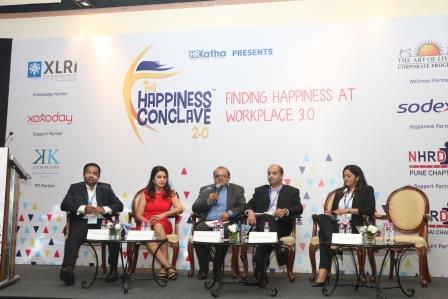
A panel at The Happiness Conclave 2.0 discussed whether technology really helps iron out the inconveniences of employee work-life or is more intrusive.
Technology in the workplace has certainly impacted various aspects of how people network, communicate, interact and perform. Big data, analytics and AI have taken this a step ahead changing the whole meaning of jobs. While organisations look further in terms of digitising workplaces, an eminent panel consisting of CHROs from across industries and a business head, came together at The Happiness Conclave 2.0 to discuss whether technology really helps iron out the inconveniences of employee work–life or is it more intrusive.
The panellists included Sanjeev Parkar, senior director-human capital, PwC; Geethaa Ghaneckar, director-HR, Raymond; Sailesh Menezes, country manager & head-HR India, Hewlett Packard; Mansi Mehta, head of assessment business, Jombay; and the session was moderated by Shreyans Solanki, head-HR BNFS, Syntel.
Solanki kick-started the session by broaching the subject of living in a technology-pervasive world, where there is no escape. He said, “When the country deregulated in the 1990s and the Internet came in, it rapidly and drastically changed how we interact, communicate and work.”“If employee-engagement surveys have a question on what irritates you most in office. I am sure the answer will be technology,”
Sanjeev ParkarPondering on how things changed in the past two decades, he asked his co-panelist, Parkar, to share his experiences on how technology has made life easier at the workplace; what’s working and what’s not.
Parkar responded with a reflection on the huge shift in technology since the 1990s. “Earlier, e-mails were not so popular, but now we send out a mail every other minute expecting immediate replies. The sheer pace at which decisions are made can result in irritations,” he opined.
Parkar opined that most of the employee-engagement surveys have got so many questions, but the one question that really needs to be asked is what irritates one most in office. “My gut feeling is that most people would find technology to be a major irritant,” he quipped.
He is of the belief that people aren’t bothered by career development or related issues; what really annoys them is the fact that an app doesn’t work when it is clicked. Similarly, he finds the use of WhatsApp for formal discussions quite irritating. “During interventions it is important to address what irritates people to the core,” he said.
“The pressure to be constantly online, to constantly know and understand more are the aspects that can cause tremendous stress, and that is something organisations can certainly work towards reducing in a significant way,”
Geethaa Ghaneckar
Solanki wondered if we have become slaves to technology. “From an organisational standpoint, do you think organisations are mature enough to create a framework for happiness in the midst of embracing technology and ensuring profits?” he asked.
Ghaneckar, who has been associated with a 90-year old organisation—Raymond—shared how they had undergone dramatic shifts in the way they work and sell, in the last 10 years and certainly in the last five. “We are one of the early organisations, with a chief digital officer, and we have a full digital team working with her to create a digital organisation,” she stated.
She shared that every aspect of the business is now being looked at in terms of digitising and making it more mobile, as these are two inevitable realities of today and tomorrow. She revealed that almost 60 per cent of the workforce at Raymond is below the age of 30, which is a millennial workforce, and they are all digital natives. “Wifi is like life blood for them. What we may call irritant is a way of life for them. So, while managing a workforce we have to accept this difference. At Raymond, we have five generations working together. It is a balancing act for us and this will continue for the next 20 years at least,” she said.

(L-R: Sanjeev Parkar, Geethaa Ghaneckar, Sailesh Menezes, Mansi Mehta & Shreyans Solanki)
She further elaborated that the population of millennials in the workforce is only going to increase in the coming years, along with the entry of GenZ, who are all digital natives. With that, the expectations from Wi-Fi, apps and social media conversations with colleagues, digital transmission of everything in real time is all going to be a way of life.
Having said that, “The pressure to be constantly online, the pressure to constantly know more and understand more are the aspects that can cause tremendous stress, and that is something organisations can certainly work towards reducing in a significant way,” Ghaneckar added. She shared how at Raymond, the effort is to ensure that people use technology in a responsible way —“We need to draw a line before technology gets very pervasive.”“Previously, the onus of work-life balance was on the employer due to a fixed work hours. However, now the onus is on the employee to figure out a way to balance work and life,”
Sailesh Menezes Taking the discussion ahead, Solanki mentioned that while people in the Scandinavian or western European countries clock 32 to maximum 40 hours a week, on an average, and are now even talking of shutting down physically and digitally after stipulated work hours, we in India work a minimum of 55 hours a week. “That said, do organisations need to reflect on where we stand and do we need to draw a line somewhere?” he asked, passing the baton to Menezes.
Menezes, embarked with the thought that “Happiness is a decision, it’s not a feeling. You cannot feel happy, you have to decide to be happy.” He stated that technology should be an enabler. It should enable one’s life and not become life instead. If it becomes the end state then there’s something wrong with the whole means to the end itself.
“Let’s not try and tag technology as a hero or a villain. It drives us, it allows us to be more organised and more connected. That is why we should have a give and take relationship with technology,”
Mansi Mehta
“On that note, if you look at work–life balance, earlier the onus of creating the same was on the employer as there used to be a fixed timing within which the employee would work in office and post that, was free to do whatever he wished to. However, now the onus is on the employee to figure out a way to balance work and life,” Menezes opined.
Now that most organisations are moving to flexible work schedules allowing employees the opportunity to define how they actually live their lives every day, it is causing even more stress as most employees struggle with this.
On the contrary, Mehta said, “Technology is my lifeline. We live a mobile lifestyle today. Let’s not try and tag technology as a hero or a villain. It drives us, it allows us to be more organised and more connected. That is why we should have a give and take relationship with technology. If it’s giving us the ability to work remotely and at any time, why can’t we allow it to take our accountability or ownership to an extent?”
Regarding work–life balance, she shared that, at Jombay people believe that there is nothing like work–life balance. There is life at work and work at life.
She further shared that while there has been a lot of buzz around IoT lately, she feels that instead of Internet of Things, people should think of ‘Internet of Me’, and find out how that technology is going to help them improve their productivity or reduce stress level. In addition, she believes that individual productivity is very private and confidential and organisations should not have access to an individual’s productivity. Rather, it should be examined at an aggregate level.
“I am totally in support of technology, but somewhere we will need to draw a line, as someone said rightly, technology is a great servant but don’t make it your master,” she concluded. However, Solanki followed it up with a question — “Are we reaching a stage where we can have a bespoke customised approach to policies and hierarchies, welcoming a new generation into the workforce?”
Mehta responded by admitting that she agrees it has to be bespoke and customised, since it has also been already established that happiness is different for each individual and it changes every day. If it’s customised, to not necessarily bands or levels but to one’s functional role, and how they feel as an individual, it will add a lot of value, and in turn, give happiness to people.
Menezes added, “Technology, if used effectively, can be an extremely strong enabler,” as he shared the example of how organisations these days have the concept of hot desks or hot seats and there are sensors that can guide people to the next available seat instead of one having to go around looking for one.
While the panel agreed that technology in the workplace should only be there to an extent or it may get too pervasive, Ghaneckar put it beautifully saying, “It should be like a humming air-conditioner that works in the background and only makes people comfortable. Till that extent it is good but beyond that it can get intrusive.”
At the same time, she shared how technology is being designed to be very addictive; that it is real, and happening; and no more anyone’s choice. For instance, Raymond has already announced the introduction of robotics in the factories. In that respect, Ghaneckar said, “Since that decision may up our RoI, it is going to impact about 2000 employees and my only discussions with the leaders while implementing this is about how we are re-deploying or re-skilling those 2000 people.”
She believes that HR should play the gatekeepers’ role in ensuring technology is used wisely, while the expectations of people are also in control. One cannot expect employees to be online and available all the time, only because technology allows them to do so. People can choose to simply switch off after a point, and organisations and managers need to respect that choice. As the session concluded, the panel unanimously agreed to Ghaneckar’s statement that, “Conscientious use of technology, digitisation and mobility is the way to go and organisations are responsible for this.”