


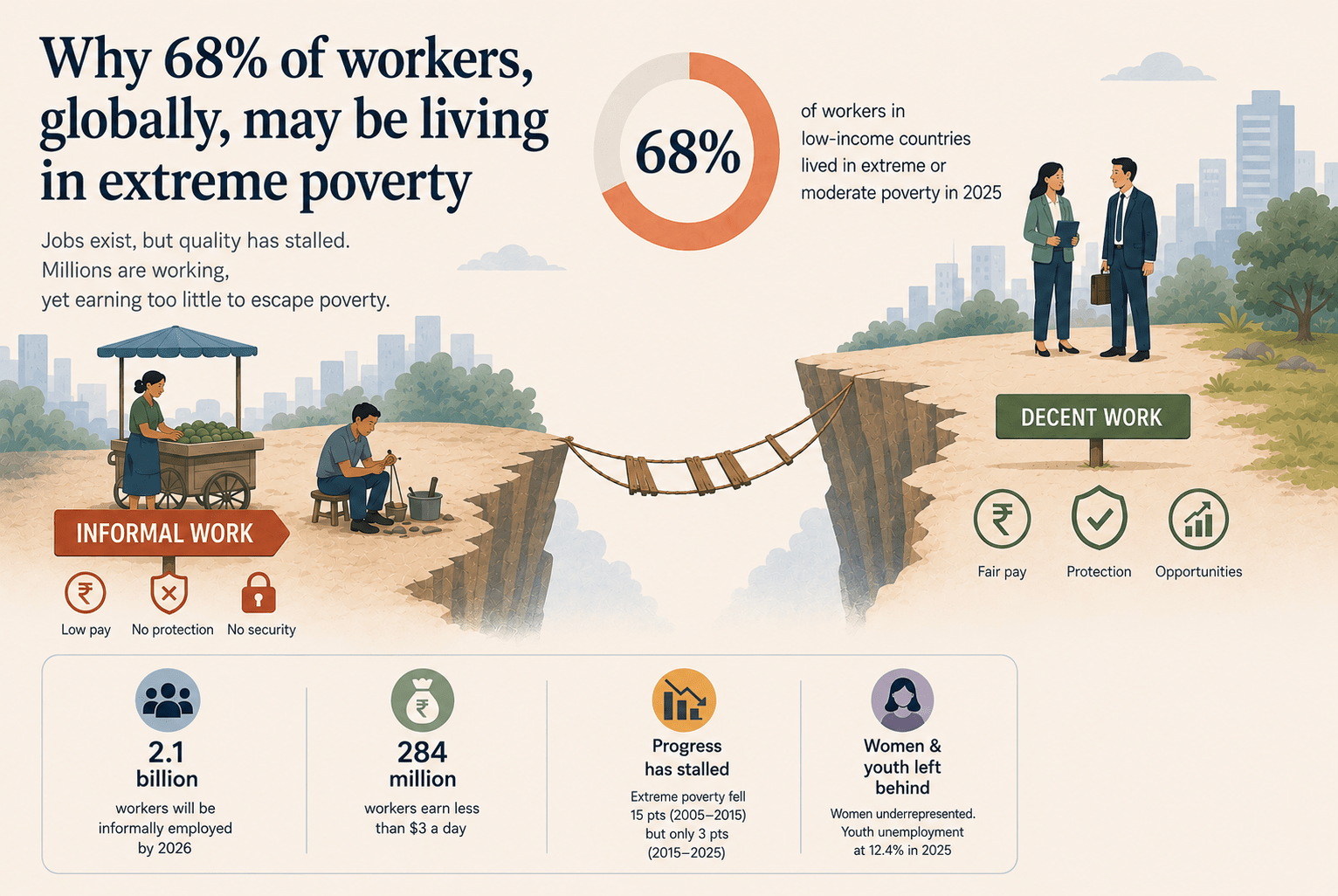
In large parts of the world, employment is not an aspiration. It is a condition of survival. Which makes the International Labour Organisation’s latest finding particularly uncomfortable: in low-income countries, 68 per cent of workers were still living in extreme or moderate poverty in 2025 despite having jobs.
For decades, unemployment has been the headline measure of labour-market health. The ILO’s ‘Employment and Social Trends 2026’ report suggests it has become an incomplete one. The bigger challenge is increasingly not whether people have work, but whether that work provides enough income, security and productivity to lift them out of poverty.
The scale of the problem is striking. By 2026, an estimated 2.1 billion workers worldwide will be in informal employment, typically without social protection, job security or stable earnings. Another 284 million employed workers still survive on less than US$3 a day. The labour market is creating work. It is simply failing to create enough good work.
Progress has slowed dramatically
The direction of change remains positive. The pace does not.
Between 2005 and 2015, the share of workers living in extreme poverty fell by 15 percentage points. During the following decade, the decline slowed to just three percentage points.
The earlier gains were driven by workers moving from low-productivity informal employment into more productive formal jobs. That transition has slowed considerably. Workers are still moving into better employment, but not quickly enough to keep pace with population growth or rising economic expectations.
The same pattern appears in informality itself. After years of gradual decline, the global informal employment rate edged upwards between 2015 and 2025. Much of this increase is concentrated in Africa and South Asia.
Much of this is not entrepreneurial self-employment. It is survival work: people creating livelihoods because formal employment is unavailable, often in low-paid activities with little opportunity for productivity growth or upward mobility.
The labour market’s hidden problem
The global unemployment rate stood at 4.9 per cent in 2025.
On its own, that figure suggests remarkable stability.
The ILO’s broader measure tells a different story.
Its “jobs gap” reached 408 million people in 2025. Unlike unemployment, this measure includes discouraged workers who have stopped searching for jobs, people trapped in involuntary underemployment, and others whose labour remains underutilised despite being technically employed.
It is, in many ways, a more honest measure of how many people today’s labour market is failing.
Regional trends reinforce that point. Latin America continues to reduce unemployment, while North America faces weakening labour-market prospects. High-income countries are grappling with ageing populations and slowing labour-force growth. Low-income economies face the opposite challenge, with rapidly expanding youth populations entering labour markets unable to generate formal employment at sufficient scale.
The same unemployment rate can therefore conceal very different labour-market realities.
Women and young people remain at a disadvantage
Poor-quality employment is distributed unevenly.
Women accounted for only two-fifths of global employment in 2025 and remained 24 percentage points less likely than men to participate in the labour force. Young women were particularly disadvantaged, with substantially higher rates of exclusion from employment, education and training.
Globally, youth unemployment rose to 12.4 per cent in 2025, while 257 million young people
were classified as NEET, that is, neither in employment, education nor training.
The report suggests that demographic pressures continue to shape labour-market inequality long before technological change enters the picture. That context matters because AI adoption may be arriving fastest in precisely the entry-level knowledge roles that educated young workers have historically relied on as a first step into formal employment.
Productivity, not employment, is becoming the constraint
The report repeatedly returns to one underlying issue: productivity.
In many low-income economies, employment continues to expand without corresponding gains in labour productivity. More people are working, but they are not generating enough additional economic value for wages to rise alongside employment.
The consequence is increasingly visible.
Global labour income accounted for 52.6 per cent of GDP in 2025, remaining below its pre-pandemic level. Real wages have struggled to keep pace with inflation across many regions, leaving workers with a shrinking share of the value they help create.
Employment is growing but living standards are not necessarily following.
New pressures threaten to widen the gap
The ILO identifies three structural risks likely to slow progress further.
The first is sovereign debt. Rising debt burdens are reducing governments’ capacity to invest in infrastructure, education and social protection, precisely the investments that support formal employment and productivity growth.
The second is growing uncertainty around global trade. Disruptions to supply chains and export markets disproportionately affect informal and low-income workers, who have limited financial resilience and few social protections.
The third is technological change.
The report notes that AI and automation could create new opportunities while also accelerating disruption in developing economies if informal work disappears faster than formal employment is created. The sequencing matters. When technology arrives before labour markets have expanded formal opportunities, productivity may improve while livelihoods become more fragile.
What the numbers are really saying
The report ultimately measures something more significant than unemployment.
It measures the changing relationship between work and economic progress.
For much of the twentieth century, getting a job was widely understood as the principal route out of poverty. Employment became the foundation on which development policy, labour-market strategy and social mobility were built.
The latest data suggest that assumption is becoming less reliable.
Unemployment remains historically low. Yet the jobs gap still stands at 408 million. Informality is rising again. More than two billion people continue to work without the protections of formal employment. And in the world’s poorest economies, nearly seven in ten workers remain poor despite having jobs.
The labour market is not in crisis in the traditional sense of mass unemployment.
It faces a quieter and potentially more difficult challenge.
Work still exists, it is true. However, for hundreds of millions of people, it simply no longer provides a dependable route out of poverty.
For HR leaders managing operations across emerging markets, that distinction is no longer abstract. The question is not whether organisations are creating jobs. It is whether the jobs they are creating are offering anything beyond employment. Because in a labour market where 68 per cent of workers in low-income countries remain poor despite working, employment on its own has stopped being the answer.