



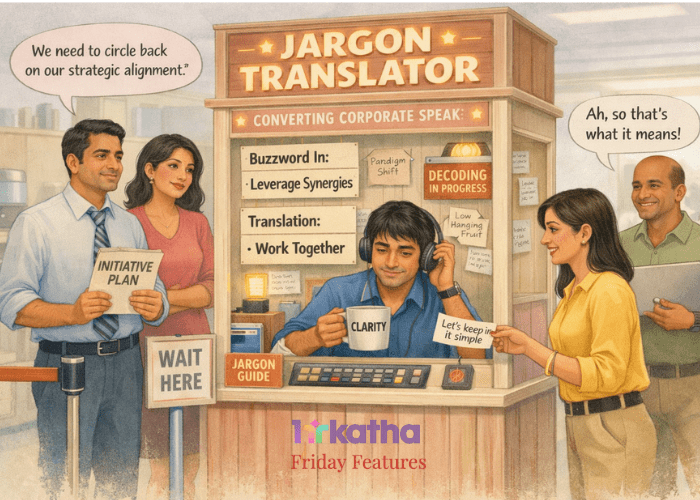
There’s a peculiar theatre that plays out in offices every day. Someone says, “Let’s take this offline and circle back with a more strategic lens,” and everyone nods—not necessarily because it made sense, but because it sounded like it did.
Corporate language has become a performance. Polished, persuasive—and occasionally pointless.

This Friday, we’re stepping away from the jargon jungle and into something far more relatable: what HR leaders quietly roll their eyes at—and what they’d rather hear instead.
Because somewhere along the way, communication stopped being about clarity and started auditioning for a consulting gig.
When ‘strategic’ starts sounding like static
Shaleen Manik, CHRO, Transsion India
For Shaleen Manik, the problem isn’t the existence of buzzwords—it’s the overload.

Complex language is often mistaken for strategic thinking. The more layered the words, the more “impressive” it sounds. But in reality, understanding quietly declines.
“Leadership communication should not require decoding,” is a belief he strongly holds.
One phrase he’d happily retire? “Leveraging synergies.”
What he suggests instead is far simpler: “Let’s work together to avoid duplication.”
It may not sound impressive, but it does something far more useful—it tells people exactly what to do.
Because if people don’t understand what’s being said, execution suffers. And no amount of polished language can compensate for confused action.
If a sentence needs interpretation, it’s probably not communication.
The ‘cool’ factor that isn’t so cool
Mukul Chopra, former CHRO, ConveGenius
Mukul Chopra brings in a different lens—the subtle pressure to sound a certain way.

Buzzwords often creep in because people want to appear relevant, sharp, or in sync with the times. Words like “disruption” once felt exciting, but today they can carry an unintended weight—even anxiety.
His take is simple: communication isn’t about sounding cool. It’s about being understood.
He offers a mental check that’s easy to remember—speak in a way that the last person in the room understands.
Not the most senior. Not the most articulate. The last.
Because if they get it, you’ve done your job right.
From ‘let’s align’ to ‘let’s decide’
Sharad Verma, CHRO, Iris Software
For Sharad Verma, buzzwords are less about vocabulary and more about intent.

He observes that phrases such as “let’s align offline” often create the illusion of progress without actually moving things forward. Conversations feel productive, but decisions remain… pending.
His alternative is one many teams could adopt instantly: instead of “let’s align,” say “let’s meet at 4 p.m. and decide.”
It’s sharper, clearer, and leaves no room for ambiguity.
Because communication isn’t just about sounding right—it’s about enabling action. If a sentence doesn’t tell someone what happens next, it’s probably just filler.
Why simplicity feels so hard
There’s an unspoken hesitation in workplaces—the fear that being simple might come across as simplistic.
That if you don’t use the right buzzwords, you might not sound “leader-like” enough.
But the real challenge isn’t in using complex language—it’s in resisting it.
Simplicity demands clarity of thought. It forces you to know exactly what you mean and say it without hiding behind vocabulary.
And that’s not easy.
The real shift
What’s emerging isn’t a rejection of all corporate language. Some jargon will always have its place.
But there is a visible shift—from trying to sound impressive to trying to be understood. From presentations that look good to conversations that actually land. From saying more… to meaning more.
So the next time you feel tempted to “deep dive into a paradigm shift,” try something simpler.
Say what you mean.
Because the real test of communication isn’t how it sounds in a meeting.
It’s what people actually do after it.
And that only happens when they understand it.
What’s the corporate buzzword you’d happily retire? ‘Synergies’? ‘Circle back’? ‘Deep dive’? Share what you’d say instead in the comments.