


Succession planning success rates in India have nearly doubled in a single year—from 27 per cent to 51 per cent. This should be cause for celebration. More than half of planned leadership transitions now actually happen as intended, compared to barely a quarter just twelve months ago. Yet this apparent triumph masks a troubling reality: whilst Indian organisations have become remarkably good at executing succession plans, they remain surprisingly weak at making those plans strategically relevant.
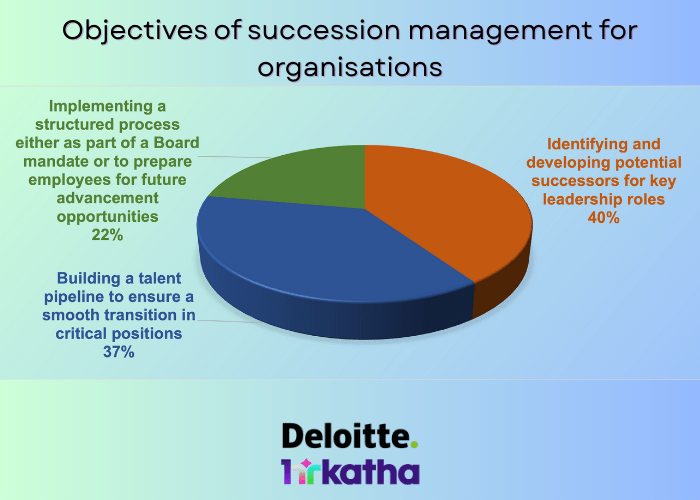
According to Deloitte India’s Talent Readiness Study, 78 per cent of Indian organisations now have formal succession processes—up from 72 per cent a year ago. Development frameworks have reached 87 per cent. Measurement of effectiveness has leapt from 43 per cent to 63 per cent. But here’s what hasn’t kept pace: only 29 per cent benchmark their high-potential programmes against industry best practices. Just 9 per cent have embedded AI into succession planning. And despite widespread formalisation, the fundamental question—what is succession management actually for?—remains surprisingly unclear for many.
India has built the infrastructure of succession planning. It hasn’t yet built the intelligence layer on top.
The success rate surge: what changed?
A near-doubling of success rates doesn’t happen by accident. It signals systematic change. Formalisation itself drives compliance—when succession moves from informal grooming to documented frameworks, accountability increases. Plans get written. Timelines get set. Deviations get noticed.
Measurement creates pressure. When 63 per cent of organisations now track effectiveness (up from 43 per cent), failures become visible. In the previous era, organisations could plan poorly without consequence because outcomes weren’t tracked. Now they show up in reports.
Context matters too: one in two CXOs in India is homegrown. When external hiring for top roles is the exception rather than the rule, succession planning stops being optional. It becomes existential.
Yet 51 per cent, whilst impressive growth, remains modest. It means nearly half of all succession plans still don’t result in the intended elevations. The glass is simultaneously half-full and half-empty.
Sector differences tell a story
Services sector organisations report 84 per cent adoption of formal succession processes, compared to 80 per cent in life sciences and 75 per cent in manufacturing. This isn’t random—it reflects fundamentally different talent dynamics.
Services, particularly IT and consulting, face brutal talent mobility. Without formal succession planning, these firms face continuous vulnerability to key person risk. Life sciences operates under regulatory pressures that demand documented processes. Manufacturing, at 75 per cent, shows the lowest adoption because leadership transitions historically moved more slowly. That’s changing, but manufacturing hasn’t yet fully metabolised the urgency that services learned a decade ago.
The high-potential trap
Seventy-four per cent of organisations run high-potential programmes. Yet only 29 per cent benchmark these against best practices. This disconnect reveals widespread adoption without widespread understanding of what makes it effective.
The problem isn’t lack of programmes—it’s weak communication and poor integration. Hi-Po programmes exist in silos, disconnected from broader talent systems. Organisations consume significant resources—87 per cent offer accelerated advancement, 65 per cent provide individualised planning, 52 per cent offer fast-track opportunities—without knowing if they’re developing actual future leaders or simply rewarding current stars who may never transition to broader roles.
Family business and the young director problem
Nearly half of next-generation leaders in family businesses step directly into director-level roles—often at young ages. The encouraging finding: 72 per cent invest in formal development programmes, recognising that inheriting a seat doesn’t confer competence.
But governance remains the challenge. Without genuine boards willing to provide honest feedback and structures that allow failure and learning, early succession risks producing entitled leaders rather than capable ones.
The AI gap: the ghost of future planning
Only 9 per cent of Indian organisations have embedded AI into succession planning. This is perhaps the study’s most consequential finding.
Globally, succession planning is rapidly moving toward data-driven prediction. Organisations use AI to analyse performance patterns, map skills adjacencies, forecast talent gaps, personalise development plans, and reduce bias. India, at 9 per cent adoption, risks being left behind—not in five years, but now.
The study notes “interest is high, but realisation is lagging.” But succession planning has long cycles. Organisations that delay AI integration won’t just be behind—they’ll be working with fundamentally different, less-capable systems than competitors who started today.
The global comparison
Globally, only 35 per cent of companies have structured succession plans. India, at 78 per cent, dramatically outperforms this benchmark. But scratch beneath and the picture complicates. India’s 51 per cent success rate remains “modest compared to mature multinational corporations, where succession programmes are more deeply embedded into internal mobility and leadership-development strategies.”
What distinguishes mature systems isn’t formalisation—it’s integration. In best-practice organisations, succession planning isn’t separate from performance management, compensation, and strategic planning. Indian organisations, despite high adoption, still largely treat succession as standalone planning.
The study notes India “must advance toward innovation, benchmarking, and digital integration to match global best practices.” Translation: Indian succession planning has become sophisticated at executing traditional processes but hasn’t embraced the experimental, data-driven approaches that define leading practice globally.
What India has actually built
India’s succession management has achieved widespread adoption of formal structures remarkably quickly. The foundation is impressive: 87 per cent development frameworks, 62 per cent assessment frameworks, 74 per cent Hi-Po programmes.
What India hasn’t yet built is the intelligence layer: strategic clarity about objectives, rigorous benchmarking, innovative approaches, and digital integration that turns succession planning from intuition-based to insight-driven.
The contrast is instructive. India has raced ahead on formalisation (78 per cent versus 35 per cent globally) but lags on AI adoption (9 per cent versus rapidly growing global integration). It’s executing traditional succession planning efficiently whilst competitors are rewriting what succession planning means.
The real challenge
The study concludes with a challenge: transform succession planning “from a compliance-driven exercise to a strategic enabler of organisational resilience and growth.”
Indian organisations have proven they can build systems. Now they must prove those systems build leaders. The infrastructure is impressive. But infrastructure without intelligence—without strategic clarity, innovative thinking, and data-driven insight—is just scaffolding around an empty space.
India has built the foundation. The question is whether it will construct something remarkable on top—or settle for having impressive blueprints whilst competitors move into buildings already occupied by the future.