


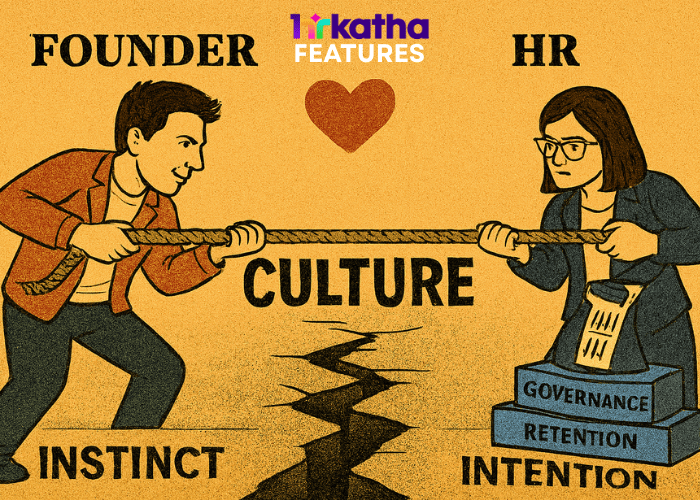
In the age of pitch decks and primetime startup spotlights, culture has become both a badge of honour and a silent fault line. Founders speak of grit and velocity. HR leaders speak of governance and equity. Between instinct and intention lies the difference between companies that scale—and those that unravel.
At inception, culture rarely arrives as a policy document. It flows directly from the founder. Their temperament becomes tone. Their urgency becomes deadline. Their appetite for risk becomes organisational tolerance for ambiguity. In those early months, culture is intensely personal—and deeply powerful.

But what ignites momentum does not automatically sustain longevity.
As scale arrives, so does strain. The question shifts from “What are we building?” to “How are we building it?” And beneath that sits a more uncomfortable tension: who ultimately shapes culture—the founder’s instinct or HR’s discipline?
The novelty trap
“People join a startup because of the novelty of the idea,” observes Emmanuel David, a senior HR leader. “They leave because of a conflict of values.”
Across India’s startup ecosystem, this pattern repeats with unsettling regularity. The brilliance of an idea often eclipses value due diligence. Alignment with the founder’s worldview is assumed rather than tested. For senior hires—CFO, CHRO, CMO—this oversight becomes expensive. Without value congruence from day one, friction is not accidental. It is inevitable.
“People join a startup because of the novelty of the idea. They leave because of a conflict of values.”
Emmanuel David, senior HR leader
In many cases, the exit interview becomes the first honest conversation about culture.
David argues that culture is shaped less by declarations and more by precedents. He recalls stopping a seemingly generous practice of expensive birthday celebrations after discovering that a junior employee had taken a salary advance to reciprocate the gesture. “We were setting a precedent,” he reflects. “Culture lives in those nuances.”
Founder instinct creates energy. HR foresight prevents inequity. Early-stage chaos may feel dynamic, even romantic. But unexamined habits quietly harden into norms—and norms calcify into culture.
The hustle imperative
For Praveer Priyadarshi, another seasoned HR leader, the early startup phase is defined by existential urgency.
“When a founder starts building an organisation, it begins with hustle,” he explains. “Rapid prototyping. Quick thinking. Quick turnaround. At that point, structure can feel like a barrier.”
Speed is not cosmetic. It is survival.
“When a founder starts building an organisation, it begins with hustle. Rapid prototyping. Quick thinking. Quick turnaround. At that point, structure can feel like a barrier.”
“The most important priority for a founder is ensuring the organisation stands on its feet. If systems and processes come into play too early, they can hinder that speed. And speed is the essence.”
Praveer Priyadarshi, senior HR leader
Founders remain hands-on by necessity. They conceptualise, visualise, push, persuade. Bureaucracy is the last thing on their mind—and often something they have escaped from. Many resist structure because they have experienced what happens when organisations slow under their own weight.
The model works brilliantly in the sprint phase. It becomes fragile in the marathon.
The maturity threshold
“For an organisation to become sustainable and evergreen,” Priyadarshi emphasises, “maturity stages must come into play.”
This is where HR’s role evolves—from operator to architect.
In the beginning, HR may focus on hiring velocity and compliance basics. As scale builds, the mandate shifts to formalising vision: documenting values, reinforcing behaviours, building governance frameworks, ensuring equity of experience.
Founder energy can ignite a company. It cannot, by itself, govern one.
Culture may originate in instinct. But if it is not institutionalised, it remains dependent on personality. And personality does not scale.
“If the founder becomes a sponsor of structured initiatives, the organisation becomes strong and robust,” Priyadarshi explains. “But if the founder continues to run it in permanent startup mode, governance issues will surface. Compliance issues will surface. And challenges will become harder to manage.”
The transition from charismatic momentum to institutional maturity is the most delicate phase in a startup’s lifecycle. Many promising companies stumble here—not because they lacked vision, but because they resisted evolution.
Conflict and common ground
As organisations grow, value clashes are inevitable.
David recounts advising a senior professional who felt pressured by a founder to take a questionable action. The immediate instinct was resignation.
Instead, David encouraged engagement. “We tend to choose flight when values conflict. But as professionals, can we create options? Can we understand what’s driving the founder’s reaction rather than only seeing the behaviour?”
The executive stayed. Dialogue followed. The issue was resolved.
In startups, tension often feels personal. Loyalty feels emotional. Disagreement can feel like betrayal. But not every clash signals moral collapse. Some signal immaturity, misalignment, or speed outrunning reflection.
HR’s role here is both strategic and ethical. Non-negotiables—harassment, bullying, ethical breaches—must be confronted unequivocally. But many conflicts arise not from malice, but from mismanaged momentum.
Priyadarshi offers a crucial distinction: “Founders are not anti-process. They are anti-impediment. If HR can demonstrate that systems enable growth rather than slow it down, alignment becomes easier.”
The battle is rarely ego versus enforcement. It is speed versus sustainability—and whether both can coexist without suffocating each other.
Adaptive, not extinct
David offers a metaphor from zoology. Insects are among Earth’s most adaptable species—agile, resilient, capable of thriving across terrains. Dinosaurs, despite their size, became extinct because they could not adapt quickly enough.
Startups that survive are not necessarily the largest or loudest. They are the most adaptable.
Agility without ethical and operational guardrails invites volatility. Excessive structure breeds stagnation. One extreme creates chaos. The other creates inertia.
Healthy cultures find rhythm between them.
Founder instinct brings clarity of vision, emotional intensity, and decisive action. HR discipline brings equity, sustainability, and institutional memory. One fuels growth. The other protects it.
The partnership paradox
Is culture stronger when it grows organically—or when it is deliberately designed? The binary is misleading.
Culture, in reality, emerges through partnership—often tense, sometimes uncomfortable, but necessary.
Founder instinct provides momentum. HR discipline provides continuity. One sparks the fire. The other ensures it does not burn the house down.
The most enduring startup cultures are neither chaotic nor bureaucratic. They are adaptive yet principled, fast yet fair. They recognise that speed cannot outrun integrity indefinitely.
People may join for novelty and founder charisma. They stay for shared values, predictable fairness, and confidence that ambition will not override ethics.
As India’s startup ecosystem matures, this balance becomes less optional and more existential. The companies that scale sustainably will not be those where founders dictate culture unilaterally, nor those where HR imposes rigidity in the name of control.
They will be organisations where instinct and discipline remain in productive tension—long enough to turn raw momentum into maturity.
Because the real question is not whether culture should come from the founder or from HR.
It is whether both are willing to evolve—before growth outpaces governance.