



Company: Sterling Industries (fictitious), a Rs 1,200 crore manufacturing conglomerate with operations across automotive components and industrial machinery.
Background

Three years ago, Vikram Desai, then a Finance Manager at Sterling, blew the whistle on financial irregularities. He discovered that the CFO and two senior executives were inflating inventory valuations to show healthier margins to investors. Vikram reported it internally to the Audit Committee.
An investigation followed. The CFO and two executives were terminated. The company narrowly avoided a regulatory scandal. Vikram was quietly praised by the Board—and quietly sidelined by everyone else.
Within six months, Vikram resigned.
“I couldn’t stay,” he told HR during his exit interview. “People stopped talking to me. I was excluded from meetings. My manager said I ‘broke trust’ by going over his head. I did the right thing, but it cost me my career here.”
The situation
Now, three years later, Vikram has applied to return. He has been working at a smaller firm, but he misses Sterling’s scale and culture. His application lands on the desk of the new CHRO, who wasn’t there during the whistleblowing incident.
Leadership is divided.
The CEO, who came in after the scandal, sees the symbolic value:
“Bringing Vikram back sends a strong message—that we protect people who speak up, that integrity matters.”
But the COO, who witnessed the fallout, is uncomfortable:
“Vikram was right, but he caused massive disruption. People still remember. If we bring him back, it reopens old wounds. And frankly, some very good people here still resent him.”
Several employees, when informally asked, echo the concern:
“He did the right thing, but he also exposed colleagues. It’s complicated.”
HR now faces a difficult choice.
The dilemma
Should HR rehire Vikram—rewarding integrity and signalling that whistleblowers are protected, even welcomed back?
Or decline—acknowledging that whilst he was right, the cultural scars remain, and his return would create more tension than healing?
What’s really at stake
This is a test of whether organisations genuinely value ethics over comfort. If Sterling doesn’t rehire Vikram, the message is clear: speak up, but don’t expect a way back.
If they do rehire him, they risk reopening divisions and making current employees uncomfortable.
And it raises an uncomfortable truth: doing the right thing sometimes costs you more than doing the wrong thing.
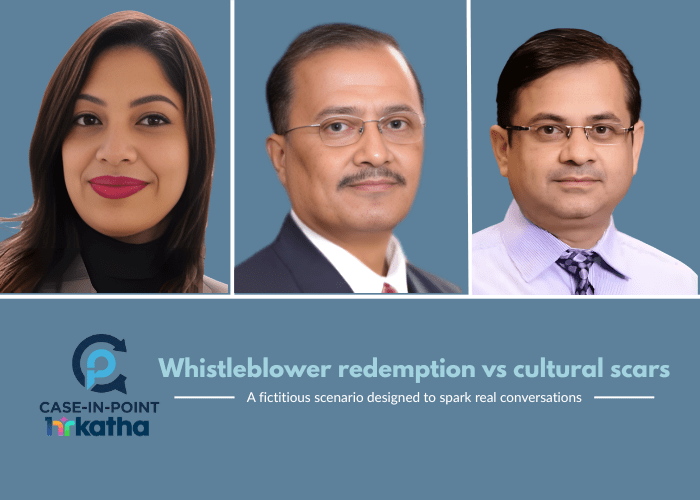
We asked three HR leaders how they would approach this dilemma.
What HR leaders said
Mousumi Roy Bose, Head–HR, The Chatterjee Group
“If I were to look at this situation, I would first anchor my decision in principles, not sentiment. For me, this cannot be about how people felt in the past or the discomfort that still lingers. It has to reflect what kind of organisation we want to be going forward.

Rehiring Vikram cannot be a symbolic act. I would not do it just to ‘send a message.’ It has to be a deliberate reinforcement of ethical behaviour and the values we claim to stand for. If we believe integrity matters, then our actions must reflect that—clearly and consciously.
But bringing him back is not enough. Reintegration has to be actively managed. I would ensure that leadership clearly communicates a zero-tolerance stance on retaliation. His return should not be framed as his personal victory—it should be positioned as alignment with organisational values.
I would also be thoughtful about where he is placed. It’s important to minimise legacy conflicts and avoid putting him in situations where past tensions could resurface. At the same time, key stakeholders must be engaged beforehand—alignment cannot be an afterthought.
To me, this is also a moment of organisational learning. We must acknowledge that we did not handle things perfectly earlier. This is an opportunity to demonstrate that we have evolved—that we are committed to creating a psychologically safe environment.
Ultimately, leadership must be willing to absorb some short-term discomfort to build long-term credibility. Decisions like these define culture more than any policy document ever will.
If we cannot stand by those who uphold integrity, we cannot claim to value it.”
Shailesh Singh, CPO, Axis Max Life Insurance
“Honestly, for me, there is no dilemma here. I would absolutely hire Vikram back—and I say that very clearly.
To me, the real issue is not Vikram. The issue is the culture of the organisation. It reminds me of a weighing scale in a shop—if the needle itself is set at minus 500 grams, everything you weigh will be off. Here, the culture needle seems to have been set below zero.

So, using that flawed system to judge Vikram is unfair. The system has to be right first. From what I see, he did exactly what he was supposed to do. Whistleblower mechanisms are designed for situations where employees may not feel safe going through regular channels. He used that process as intended.
Could he have spoken to his manager first? Maybe. But that’s not the point. The process exists precisely because sometimes you cannot trust the immediate hierarchy. So there is nothing wrong in what he did.
What went wrong is what happened after. The fact that he had to leave—that he was made uncomfortable—that reflects poorly on the organisation, not on him. In fact, whistleblowers are protectors of the company. They save the organisation from far bigger damage.
There’s a line I often recall: “Bhool chehre pe thi, aur aayina saaf karta raha”. We keep cleaning the mirror instead of addressing what’s actually wrong. That’s exactly what seems to have happened here—we blamed the individual instead of fixing the culture.
Now, of course, people may feel uncomfortable. But the answer to that is not to avoid the right decision. The answer is to educate, to communicate, to reset the narrative. The CEO must take the lead in reinforcing that what Vikram did was right.
If we don’t do that, what message are we sending? That speaking up will cost you your career? Then why would anyone ever come forward again?
To me, this is straightforward. If we want to build an organisation that stands for integrity, we must act like it—even if it’s late.
Whistleblowers are not disruptors—they are protectors. If we fail them, we fail the organisation itself.”
Praveen Purohit, CHRO, Vedanta Aluminium, Power, Port, Mines
“If I put myself in this situation, I would approach it with both pragmatism and sensitivity. I don’t think this is as binary as ‘hire’ or ‘don’t hire.’ It’s about understanding the organisational context and the readiness of the system to absorb his return.

On one hand, Vikram clearly did the right thing. There is no ambiguity there. Any organisation that wants to uphold strong governance must recognise and respect that.
But I would also not dismiss the cultural reality. The scars from such incidents run deep.
People’s reactions—whether rational or emotional—cannot be ignored. If those sentiments are not addressed, his return could create friction, not healing.
So my first step would be to assess: has the organisation truly moved on? Has leadership demonstrated, over time, that it supports ethical behaviour? Or is this still an unresolved chapter?
If I am convinced that the organisation has evolved, then yes, bringing him back can be a powerful step. But it must be done with preparation. Conversations need to happen—with leadership, with teams, and even with Vikram himself—to set expectations clearly.
I would also ensure that his role is designed in a way that allows him to succeed without being constantly pulled back into the past narrative.
At the same time, we must be honest—rehiring him will send a strong signal. It will reassure some employees, but it may unsettle others. That is the balance we have to manage.
For me, the decision is not just about Vikram. It is about whether the organisation is ready to live up to the values it claims.
Rehiring a whistleblower is not just a decision—it is a test of whether the organisation is truly ready to stand by its values.”
If you were the CHRO at Sterling
You have been asked to recommend a course of action to the leadership team.
Do you:
- Rehire Vikram and actively manage his reintegration, accepting short-term discomfort for long-term credibility?
- Decline politely, acknowledging that whilst he was right, the cultural scars haven’t healed and his return would do more harm than good?
- Offer an alternative, such as bringing him back in a different division or role where legacy tensions are less likely to resurface?
Or is the deeper question this:
If an organisation cannot welcome back those who protected it from wrongdoing, can it ever truly claim to value integrity?
Share your recommendation in the comments or on LinkedIn using #HRKathaCaseInPoint.