



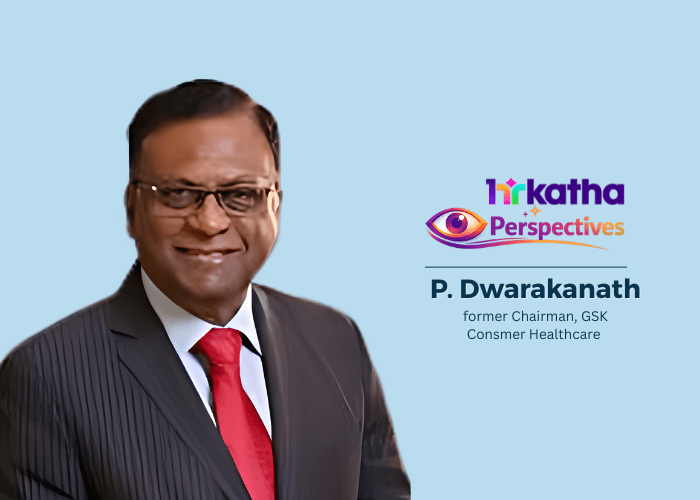
Dwarakanath has spent four decades inside organisations that kept changing around him – through mergers, restructurings, name changes and strategic pivots. What that experience produced is a clarity about people decisions that is rare – uncluttered by fashion, anchored in judgement. His focus, consistently, has been on what holds organisations together when everything else is in flux.
In conversation with HRKatha, he explains why hiring for what someone knows today is the wrong question, why the build-versus-buy debate is simpler than organisations make it, and why employee trust in AI is built through visible augmentation, not messaging.

Hire for slope, not for skills
How should organisations rethink hiring when roles are evolving faster than credentials?
The shift I see is from hiring for skills to hiring for slope. It is no longer just about what someone knows today. It is about how they will remain relevant over the next three to five years.
In that context, organisations must prioritise curiosity, learning agility and problem-solving ability over current expertise. With AI, answers are available instantly. What becomes critical is the ability to think, to apply judgement, and to work through problems that do not already have defined answers.
The mindset shift required is from know-it-all to learn-it-all. Adaptability is not a junior employee challenge. It applies at every level.
And it is not limited to technology. Geopolitical shifts, regulatory change and environmental pressures are constant. The ability to read context and respond to it is what defines long-term relevance.
“Credibility compounds slowly — but it stays.”

Build for continuity, buy for disruption
How do you balance developing leaders internally against hiring from outside?
I describe it simply: build for continuity, buy for disruption. It is not a binary choice. It is context-driven.
You build internally when culture, execution discipline and long-term orientation matter.
Internal leaders carry institutional memory, relationships and values that cannot be recreated quickly.
You hire externally when disruption demands it, when capability gaps are real, or when entering areas where the organisation does not yet have depth.
Very few organisations today rely purely on internal pipelines, and those that once did have evolved. A practical balance is roughly 70-30 in favour of internal development. Continuity and disruption are both necessary. Talent strategy must reflect that reality, not habit.
“Trust is built when employees see augmentation before elimination.”
Augmentation before elimination
How do you build genuine trust around AI rather than just managing anxiety?
AI will not replace people. But people using AI will replace those who do not.
The shift needed is from seeing AI as job replacement to seeing it as job redesign. That distinction shapes how employees respond. AI must be positioned as a co-pilot that enhances capability, not as a signal of redundancy.
We have seen this before with earlier waves of technology. Roles evolved rather than disappeared. The difference now is speed and visibility, which makes anxiety sharper and faster.
Trust is built when employees see augmentation before elimination. Re-skilling investment is the clearest signal of intent. Without it, communication alone will not hold.
“Build for continuity, buy for disruption.”
The company changed its name five times
What has shaped you most as a people leader?
I have not changed my name or profession. But the company I worked with for 41 years changed its name five times. That reflects what careers actually look like. Context changes continuously. What matters is how you respond.
The most important trade-off I have navigated is between short-term visibility and long-term credibility. Many roles I chose were not the most prominent, but they were high-impact. That builds depth over time.
The principle that has guided me is tough love. Be tough on issues, soft on people. Difficult decisions are unavoidable, but dignity in execution defines trust.
One piece of advice I would give is this: do not confuse breadth with shallowness or depth with narrowness. Early exposure to different parts of the business matters. Later, build depth in a few areas. And engage with governance and board-level thinking earlier than most HR professionals do.
Careers are not linear. Credibility, resilience and consistency are what compound over time.
“Adaptability is not a junior employee challenge. It applies at every level.”