


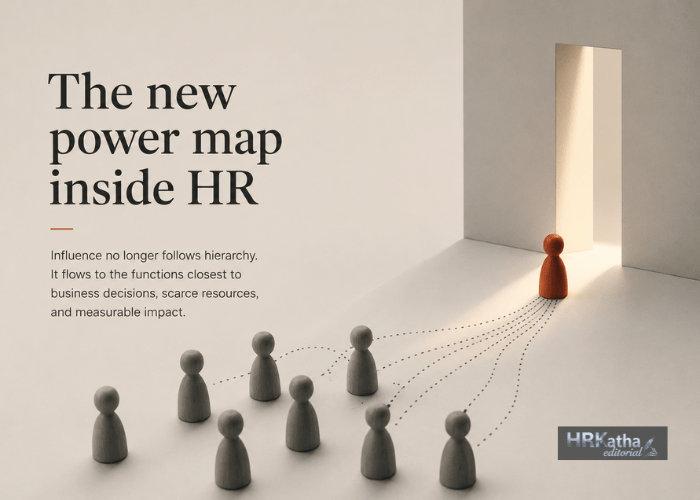
The org chart did not predict this shift. Business urgency did.
Corporate HR structures still suggest a clear hierarchy. The Chief Human Resources Officer at the top. Layers of Vice Presidents, Directors, and specialists underneath: talent acquisition, learning and development, compensation, employee relations, workforce planning, diversity, analytics.
The structure implies that power flows downward through reporting lines.
It rarely does.
Inside HR, influence sits with people closest to business priorities, scarce organisational resources, and leadership access.
Titles often predict very little.
A Head of Executive Compensation with a small team may wield more influence than a Vice President overseeing a large learning function. An HR Business Partner supporting a revenue-critical business unit may shape more decisions than someone senior to them in the hierarchy.
Over the last five years, the distribution of power inside HR has changed dramatically.
“Just as HR finally became central to business strategy, influence inside the function began shifting away from the parts most associated with humans and toward the parts easiest to model like finance.”
What actually determines HR power
Three things consistently shape influence inside HR.
The first is proximity to business decisions. HR leaders who participate in strategy discussions, restructuring conversations, acquisitions, or workforce redesign hold real power regardless of title. Those brought in afterward to “manage the people implications” usually do not.
The second is control over scarce organisational resources. During expansion phases, hiring authority creates leverage. During downturns, workforce planning and restructuring do. During retention crises, compensation teams gain influence because they control the one thing leadership suddenly cares about: preventing exits.
The third is access to information before others have it. Knowing about layoffs, succession plans, operating-model changes, or strategic pivots before they become public creates structural advantage.
This is why formal hierarchy often explains less than access.
In many promoter-led companies, HR influence still depends heavily on personal access to leadership rather than formal structure. The most senior HR title does not always belong to the person with the most influence.
The CHRO paradox
The Chief Human Resources Officer sits in the C-suite, suggesting significant organisational power. Some CHROs genuinely possess it. Many do not.
The difference is rarely competence. It is positioning.
A CHRO who participates in commercial strategy, expansion planning, or operating decisions before they are finalised operates with real authority.
A CHRO informed after major decisions are made and then asked to “manage the transition” holds a senior title but limited influence.
The distinction becomes visible during expansions, restructurings, acquisitions, and workforce redesign.
“The org chart still says ‘Human Resources’. Increasingly, the power sits with those managing the resources more than the humans.”
Is the CHRO shaping the decision or managing its consequences afterward?
At one large Indian IT services company, the CHRO reports to the COO and is excluded from commercial strategy discussions. When the organisation entered a new market last year, the CHRO learned about the decision after it was finalised and was asked to build the people plan around it.
The role has a C-suite title. The influence is operational, not strategic.
At another technology company of similar scale, the CHRO reports directly to the CEO and participates in major business decisions from the beginning.
The distinction is not seniority. It is access.
When interviewing CHROs across industries, the difference becomes evident quickly. Some discuss business challenges, competitive positioning, margins, and growth strategy with the fluency of a business leader. Others frame their role primarily through HR programmes, engagement initiatives, and policy implementation.
Both are competent professionals. But only one is operating at the level the title implies.
“In many companies today, the recruiter who once hired 200 people a quarter sits in a smaller team with less influence, while the workforce-planning manager now joins finance reviews with the CFO.”
The functions that gained influence
The last five years fundamentally reordered which HR roles matter most.
During the pandemic, HR gained unusual strategic visibility because business continuity depended on workforce continuity. Remote work, crisis communication, health protocols, and employee support suddenly became operational priorities.
Many believed this marked HR’s permanent strategic elevation.
It did not.
The next phase shifted influence again. During the hiring frenzy and attrition crisis of 2021 and 2022, Talent Acquisition and Compensation became unusually powerful.
In Indian IT services firms and startups, recruiters often had more internal leverage than L&D leaders simply because delivery teams could not grow without rapid hiring. Compensation teams approved off-cycle corrections, retention bonuses, and salary revisions at unprecedented speed because attrition had become a business risk rather than merely an HR metric.
But that influence was tied to labour-market conditions, not permanently embedded authority.
When hiring slowed and layoffs began, the power map shifted again.
Workforce Planning, HR Analytics, and restructuring teams moved closer to leadership because organisations no longer needed aggressive hiring. They needed cost models, productivity analysis, headcount scenarios, and workforce-reduction strategies.
Functions rise when the business urgently needs what they control. They decline when that urgency disappears.
“For years, HR argued it deserved a seat at the strategy table. Ironically, the functions now gaining those seats are often the least human-facing parts of HR.”
Why analytics keeps rising
Among all HR functions, one area has steadily accumulated influence: People Analytics and Strategic Workforce Planning.
Modern organisations increasingly demand quantitative justification for workforce decisions.
Leadership wants attrition forecasts, skills-gap analysis, productivity models, compensation benchmarks, and headcount scenarios before approving strategy. The functions producing those insights now sit closer to business planning because the business cannot operate without them.
In some organisations, People Analytics teams now report directly to the CFO rather than the CHRO. Workforce planning is treated as financial planning. The person modelling headcount costs sits in budget discussions. The person managing employee experience does not.
Large consulting and professional services firms have hired hundreds of data scientists into HR over the last three years, not to improve culture but to quantify workforce decisions.
Large GCCs expanding in India have also accelerated investment in workforce analytics and centralised HR operations because talent planning is increasingly treated as an operating-cost discipline.
HR influence is increasingly moving toward those who can translate people into financial variables.
For years, HR argued it deserved a seat at the strategy table. Ironically, the functions now gaining those seats are often the least human-facing parts of HR.
The functions losing ground
Other functions have steadily lost influence.
Traditional Talent Acquisition, once central during hiring booms, is now vulnerable to automation and hiring volatility. AI tools increasingly handle sourcing, screening, scheduling, and early candidate interaction at scale.
The scale of reduction is visible in headcount. Several technology companies that employed 70-80 recruiters in 2021 now operate with 20-25. The difference is not lower hiring volume.
It is automation.
AI tools now handle sourcing, screening, initial engagement, and scheduling. What once required a team now requires software and a handful of people managing exceptions.
At one company, the Head of Talent Acquisition who reported directly to the CHRO in 2021 now reports to a Director of HR Operations two levels down.
The demotion followed the downsizing. When hiring stopped being urgent, the role stopped being strategic.
Learning and Development continues to struggle unless capability-building is directly championed by the CEO or tied tightly to revenue outcomes. The challenge is not philosophical support. It is measurability.
Employee Experience and Engagement teams face similar pressure. During labour shortages, engagement mattered because retention mattered. In weaker labour markets, those functions often become harder to defend financially.
Diversity, Equity, and Inclusion perhaps illustrates the volatility of HR influence most clearly. Between 2020 and 2021, DEI functions expanded rapidly across many organisations. Dedicated leadership roles emerged, budgets grew, and public commitments intensified.
Within a few years, much of that momentum reversed. Budgets narrowed, mandates contracted, and roles disappeared.
The speed of both the rise and decline revealed how contingent the function’s influence had been.
The middle layer is thinning
Automation is now reshaping HR structurally, not just operationally.
AI tools increasingly handle policy queries, onboarding workflows, interview scheduling, resume screening, reporting, and employee-service interactions. Shared-service models continue absorbing transactional work that once justified large HR teams.
This is thinning the middle layer of HR.
Traditional HR Generalist roles, coordinators, and process-heavy administrative functions are gradually shrinking. In their place, organisations are concentrating investment in fewer specialist areas tied directly to business priorities: analytics, workforce planning, compensation strategy, HR technology, AI implementation, and organisational design.
Spans of control inside HR have widened noticeably. Organisations that maintained ratios of one HR person for every 50 employees in 2020 now operate at 1:80 or 1:100.
The difference is not just efficiency. It is automation and structural redesign.
Local HR presence is disappearing. Roles that existed at every location are being consolidated into regional hubs or replaced by shared services and self-service platforms.
The HR person employees could walk to is increasingly a chatbot or a ticket in a queue.
HR is becoming smaller, more technical, and more financially accountable to the business than it was five years ago.
What this reveals about HR’s future
The pattern across the last five years is not random fluctuation. It reflects a structural shift in how organisations value HR.
The functions gaining influence are those easiest to connect to measurable business outcomes. The functions losing influence are those harder to quantify, more cyclical, or increasingly automatable.
For decades, HR tried to position itself as more strategic, more influential, and more central to business decision-making. Yet the roles accumulating influence today are often not the ones most closely associated with people.
They are the ones most closely associated with measurement.
People Analytics. Workforce Planning. Compensation Strategy. HR Technology. AI-enabled workforce optimisation.
The irony is difficult to miss.
Just as HR finally became central to business strategy, influence inside the function began shifting away from the parts most associated with humans and toward the parts easiest to model like finance.
The org chart still says “Human Resources”.
Increasingly, the power sits with those managing the resources more than the humans.
And inside many modern organisations, the HR executive closest to the CEO is no longer necessarily the one responsible for culture, engagement, or learning.
It is increasingly the person modelling workforce costs.
2 Comments
Dr Prajjal, I rarely read every word of an article but yours I did . It was capturing my attention like nothing else in the morning. Well said and all points are like firing gun at HR and they should be worried for their survival.. Are they ? NO ..
I keep hinting at solutions in my short scripts with the hope that some one will follow it to the implementation and ….. +++.. Keep writing
Thank you so much, Dr Ritu. Coming from someone who has helped shape the HR profession at scale, that means a great deal.
As a journalist and editor covering the world of work and HR, my role is often to identify and articulate the structural shifts and uncomfortable realities emerging inside organisations. The solutions, evolution, and reinvention of the function will ultimately come from leaders and practitioners like you who have built and transformed institutions from within.
I do hope more conversations now move from acknowledging these shifts to actively responding to them.