


Technology is no longer HR’s competitive advantage. In 2026, most organisations will have access to AI, predictive analytics and digital HR platforms. What will distinguish them is how intelligently they use those tools.
Will AI become another mechanism to monitor employees, or will it free managers to become better coaches? Will predictive analytics replace judgement, or strengthen it? Will compliance create bureaucracy, or enable faster decisions? And as people become the biggest determinant of business performance, will HR finally move beyond being a support function to become a genuine business leader?

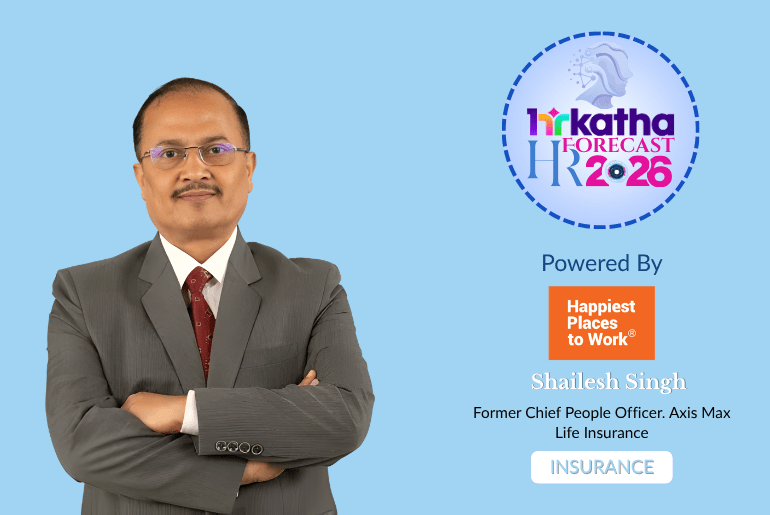
For Shailesh Singh, former, Chief People Officer at Axis Max Life Insurance, the answer lies in striking the right balance between technology and humanity.
“AI in everything, but not everything in AI.”
That philosophy runs through every aspect of how he sees HR evolving in 2026.
Signal 1: AI will become a coach, not a controller
The debate around AI and employee monitoring is already shifting. Singh believes organisations are asking the wrong question.
“The conversation shouldn’t be about whether AI tracks performance or not. That is already a reality. The real question is whether we use this data as a monitor or a mentor.”
At Axis Max Life, AI already analyses hiring patterns across more than 5,000 annual hires each year, helping improve speed and consistency. Yet Singh is equally clear that algorithms should never define organisational culture.
AI can measure productivity. It cannot measure judgement, empathy or the emotional effort that often determines how customers experience a service.
“If an employee feels like a mere data point in an Excel sheet, then we have failed them. Dignity is non-negotiable.”
The best organisations will use AI to remove routine reporting and administrative work, giving managers more time to coach, listen and develop people. Data should trigger conversations, not reprimands.
Technology works best when it expands human capability rather than replacing it.
Signal 2: HR will become a business leadership function
Singh believes the question is no longer whether HR deserves a seat at the leadership table, but how much influence it has on business decisions.
“Today, the CHRO is a strategic co-pilot to the CEO.”
In a business built on trust, culture and talent directly influence commercial performance. Leadership capability, succession planning and workforce productivity have therefore become business conversations rather than HR processes.
At Axis Max Life, Organisation and Talent Reviews are treated as business reviews, reflecting the belief that human capital is the leading indicator of financial performance.
This also explains why Singh expects more CHROs to move into CEO and COO roles over the coming years. HR leaders have a unique enterprise-wide view, connecting people, culture and business strategy in ways few other functions can.
“We are no longer just people managers. We are architects of business sustainability.”
Boards increasingly expect HR leaders to speak about investment and returns as fluently as engagement, capability and retention. The future CHRO will be judged not only by culture, but by the business outcomes it enables.
Signal 3: Compliance will become invisible, but more powerful
As regulations around data privacy, employment law and governance continue to expand, HR teams face a growing compliance burden. Singh believes the answer is not more controls but better design.
“The compliance burden will certainly be heavier, but it should never make us slower.”
His solution is what he calls Compliance by Design.
At Axis Max Life, employees access instant policy guidance through Ely, the organisation’s chatbot on the employee app. Instead of searching policy manuals or waiting for HR support, they receive guidance while they work, reducing uncertainty without slowing decisions.
Singh compares compliance to the brakes on a car.
“We treat compliance as hygiene, like the brakes on a car that allow it to go faster safely.”
The best organisations will build systems that make the right decision the easiest decision. Compliance shifts from policing behaviour to enabling it.
For Singh, regulation should strengthen trust rather than create bureaucracy.
“The most successful organisations will view regulation not as a hurdle, but as a framework for building deeper trust with customers.”
Signal 4: Predictive analytics will sharpen judgement, not replace it
People analytics has spent years explaining the past. Singh believes its real value now lies in helping organisations prepare for the future.
“We are moving from ‘What happened?’ to ‘What will happen?’“
At Axis Max Life, predictive models already help identify “Best Bets”, employees with the potential to move across functions and take on larger responsibilities. Analytics also supports workforce planning by identifying attrition risks and capability gaps before they become business problems.
Yet Singh is careful not to place blind faith in data.
“I always caution against the skills-first delusion.”
Analytics can predict who may leave, who learns fastest or where capability may emerge. It cannot measure judgement, resilience or the intuition that experienced leaders develop over time.
“Predictive analytics is our compass, but the heart and mind of the leader is the captain.”
Analytics should sharpen judgement, not replace it. Data may guide decisions, but leadership still requires context, intuition and experience. HR must become data-driven, while remaining data-informed and human-led.
The Human Shift
Taken together, these signals point to a larger transformation.
AI will become more capable. Analytics will become more predictive. Compliance will become increasingly automated. HR will continue moving closer to the centre of business strategy.
Yet none of these developments reduce the importance of human leadership. They make it even more valuable.
Technology can process information faster than people ever will. It cannot replace empathy, judgement or the trust leaders build through everyday interactions.
That is why Singh’s final wish for the profession is perhaps his most significant prediction.
“I want HR to be perceived as a belief system owned by every supervisor, not just the people in the HR wing.”
The future of HR will not be defined by how much technology it adopts.
It will be defined by how effectively technology helps people lead.
Three Strategic Imperatives
Use AI to enable better leadership: Let AI automate routine work and generate actionable insights, while giving managers more time to coach, listen and develop people.
Position HR as a business driver: Integrate talent, culture and leadership decisions with business strategy, ensuring HR contributes directly to long-term organisational performance.
Balance analytics with judgement: Use predictive intelligence to improve workforce planning and identify emerging talent, while keeping human judgement at the centre of every critical people decision.
The Human Test
The question in 2026 is not whether organisations have AI platforms or predictive analytics.
Most already do.
The real differentiator is whether technology makes work more human or simply more measurable.
Does AI create better coaching or better surveillance?
Does predictive analytics strengthen judgement or encourage leaders to outsource it?
Does compliance empower employees to act confidently or burden them with more process?
The organisations that will pull ahead are those where AI removes routine work without removing humanity, analytics informs better judgement rather than replacing it, and compliance becomes effortless because it is built into the way people work.
As Singh says, HR should become “a belief system owned by every supervisor, not just the people in the HR wing.”
Technology will never be the competitive advantage.
The organisations that succeed will be those whose leaders know how to use it without losing sight of the people behind the data.
1 Comment
Extremely relevant topic in today’s HR scenario – technology dovetailed with human intervention