


Stumbling upon HR
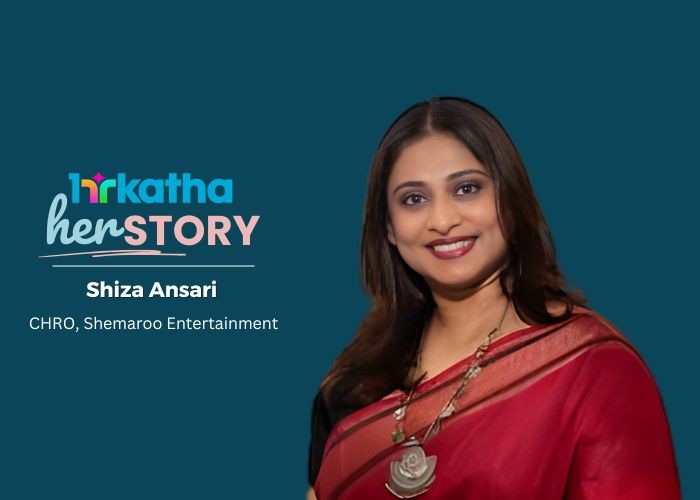
Shiza Ansari admits to stumbling upon HR whilst pursuing a business/commerce degree when she had to opt for an elective subject, which happened to be Industrial Psychology. That’s when curiosity about the role played by people in making businesses successful or otherwise got the better of her. It intrigued her and got her interested in understanding how people contribute, what motivates them, and how workplaces function. After that it did not take much effort to decide on her domain of specialisation.
Today, as chief human resources officer at Shemaroo Entertainment, Ansari leads with a philosophy forged through experiences with bias—and the determination to overcome it through extraordinary performance.
Having to overachieve to negate bias
In the very early days of her career, gender bias wasn’t even a topic of concern. There were just norms, “some very stereotypical and one had to just live with them,” recalls Ansari. It wasn’t discussed the way it is today. Biases always existed and still do, and we continue to face them.
One remark about her, however, has stayed with her forever, and now it’s something that she always shares in all her sessions on DEI or sensitisation workshops. She discovered that in a conversation she was referred to as ‘that Muslim girl’ within the organisation. “That one term was loaded with more than one bias: gender and religious belief,” recalls Ansari. Whilst it was generally used in her absence and never directly, she could sense the bias easily.
Though there wasn’t any formal mechanism to raise this as an issue in those days, Ansari was “fortunate to have very understanding and empathetic managers” who heard her and convinced her that they would never let this come in the way of opportunities for her growth. They assured her that if her performance was extraordinary, it would change the way people perceived her.
Forever glad to have such managers on her side, Ansari does admit that she “had to overachieve to negate the bias.” So, it was not equitable.
Thanks to her performance, over time, “my work became my identity, and people began to remember my name.”
“My work became my identity, and people began to remember my name instead of referring to me as ‘that Muslim girl’”
Choosing between being liked and being respected
Ansari’s career has seen several organisational transformation journeys. These have included diversification, business expansion, integration post M&As, restructuring, and so on. All of this required balancing commercial sustainability with human impact, knowing that short-term discomfort was necessary for long-term organisational health.
“At senior levels, one often has to choose between being liked and being respected, and I have learnt that credibility comes from principled consistency, transparent communication and visible fairness in decision-making,” states Ansari.
Respect, in her experience, “is built not by avoiding difficult calls but by handling them with integrity and empathy.”
“Respect is built not by avoiding difficult calls but by handling them with integrity and empathy”
Quick fire round
If not HR, what career path would you have pursued?
Probably Psychology, or perhaps teaching or maybe even law.
What energises you most about your work?
The endless possibilities of creating a positive impact on people and their work lives.
Best investment you’ve made in yourself?
I think I still continue to invest in being a business-aligned leader rather than only a functional expert. I am also committed to continuous self-reflection and learning which helps me be more grounded and empathetic.
One skill you’re currently working on developing?
Adoption of new-gen technologies.
Your definition of success today versus 10 years ago?
Ten years ago, success meant growth, titles, and visible milestones. Today, success means meaningful impact, balance, and knowing that I am growing whilst helping others grow too.
Shaping organisational direction
Strategic HR, to Ansari, is about shaping organisational direction. For her, it means partnering in business resource allocation conversations, managing succession risks, reviewing productivity metrics, and strengthening governance as a co-owner of business outcomes.
At Shemaroo Entertainment, she is preparing for the future of work by building agile teams, strengthening digital capabilities, and creating a strong learning culture. HR is driving this shift by enabling effective work designs, creating opportunities for upskilling, embedding wellness into workflows and aligning talent strategy closely with evolving business needs.
Supporting women
At Shemaroo Entertainment, supporting women isn’t just a policy, it is something they practise every day.
“We regularly organise simple, practical workshops that help women build confidence and guide their growth into larger or leadership roles with continuous support through policies and initiatives,” she shares. Alongside this, there is an internal group Sisters in Shemaroo, where women come together to speak openly, learn from one another and support each other, whether it is about mental wellbeing, physical health, or stepping up professionally.
The goal is to create an environment where every woman feels seen, heard and encouraged to grow—not just participate. The DEI programme ‘Confluence’—where diversity becomes strength—focuses on continuously improving representation of diverse groups whilst also making Shemaroo sensitive to the needs of all and inclusive.
Ten years ago, success meant growth, titles, and visible milestones. Today, success means meaningful impact, balance, and knowing that she is growing whilst helping others grow too.