

Close Menu
    Facebook X (Twitter) Instagram
    • Our Story
    • Partner with us
    • Reach Us
    • Career
    Subscribe Newsletter
    HR KathaHR Katha
    • Exclusive
      • Exclusive Features
      • Perspectives
      • Friday Features
      • herSTORY
      • Rising Stars
      • Case-In-Point
      • Point Of View
      • Research
      • HR Pops
      • Dialogue
      • Movement
      • Profile
      • Beyond Work
      • By Invitation
    • Brief News
      • Global HR News
      • Compensation & Benefits
      • Diversity
      • Events
      • Gen Y
      • Hiring & Firing
      • HR & Labour Laws
      • Learning & Development
      • Merger & Acquisition
      • Performance Management & Productivity
      • Talent Management
      • Tools & Technology
      • Work-Life Balance
    • Special
      • Editorial
      • HR Forecast 2026
      • Cover Story
      • HR Forecast 2024
      • HR Forecast 2023
      • HR Forecast 2022
      • HR Forecast 2021
      • HR Forecast 2020
      • HR Forecast 2019
      • New Age Learning
      • Coaching and Training
      • Learn-Engage-Transform
    • Studio
      • The CHRO Playbook
      • Quick HR Insights
      • The Corner Office
    • Reports
      • Whitepaper
        • HR Forecast 2024 e-mag
        • Future-proofing Manufacturing Through Digital Transformation
        • Employee Healthcare & Wellness Benefits: A Guide for Indian MSMEs
        • Build a Future Ready Organisation For The Road Ahead
        • Employee Experience Strategy
        • HRKatha 2019 Forecast
        • Decoding and Driving Employee Engagement
        • One Platform, Infinite Possibilities
      • Survey Reports
        • Happiness at Work
        • Upskilling for Jobs of the Future
        • The Labour Code 2020
    • Forums
      • HRKatha Inner Circle
      • HRKatha Futurecast
      • Leadership Summit 2025
      • Rising Star Leadership Awards
      • HRKatha Futurecast 2025
      • Automation.NXT
      • The Great HR Debate
    WhatsApp LinkedIn X (Twitter) Facebook Instagram
    HR KathaHR Katha
    Home»Exclusive Features»HR Pops»The halo-horn effect: When one impression hijacks every judgement
    HR Pops

    The halo-horn effect: When one impression hijacks every judgement

    How a bias identified over a century ago still shapes hiring, promotions, and leadership decisions, often without organisations realising it
    mmBy Liji Narayan | HRKathaAugust 4, 2026Updated:August 4, 20264 Mins Read10638 Views
    Share LinkedIn Twitter Facebook WhatsApp
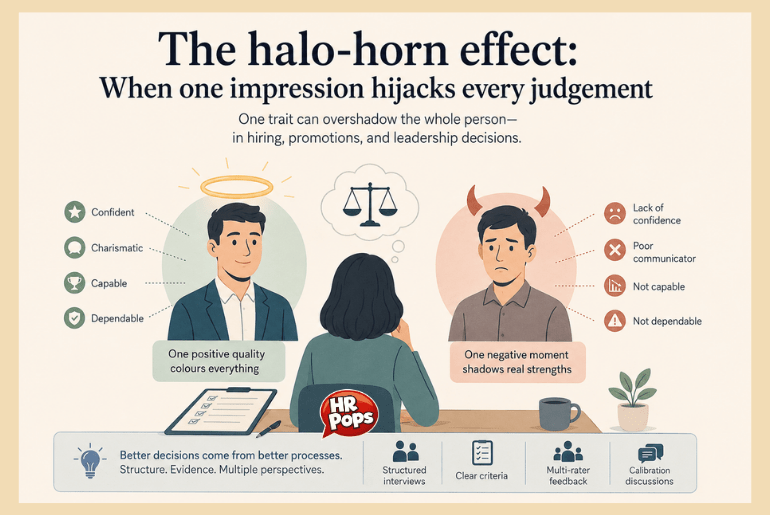
    The halo-horn effect (HR Pops)
    Image Source: AI generated
    Share
    LinkedIn Twitter Facebook WhatsApp

    What does halo-horn effect  mean?

    The halo effect occurs when one positive quality influences how we judge everything else about a person. Confidence, charisma, fluency, or even appearance creates such a favourable first impression that other strengths are simply assumed.

    The horn effect works in the opposite direction. One visible weakness, an awkward interview, a presentation that goes badly, or a single mistake, colours every subsequent judgement, making genuine strengths harder to recognise.

    The names come from familiar imagery. A halo symbolises virtue. Horns suggest the opposite. In psychology, both describe the tendency to let one characteristic dominate our overall assessment.

    These shortcuts are part of normal human thinking. They help people make quick decisions in everyday life. In organisations, however, quick judgements often become career decisions.

    Where did the idea come from?

    The concept dates back to 1920, when American psychologist Edward Thorndike studied how military officers evaluated soldiers.

    He found that one strong impression consistently influenced ratings across completely unrelated qualities. A soldier viewed as physically impressive was also more likely to be rated intelligent, capable, and dependable, regardless of evidence.

    Thorndike described it as a “constant error in psychological ratings.”

    A century later, the error remains remarkably constant. Only the setting has changed.

    Instead of military barracks, it now appears in interview rooms, calibration meetings, succession discussions, and performance reviews.

    Why is it relevant for HR?

    Few business functions depend on judgement as heavily as HR.

    Hiring managers often mistake confidence for competence. Employees with one exceptional achievement receive stronger overall ratings than their broader performance justifies. Others carry the weight of a single mistake long after it should have lost relevance.

    Leadership decisions are equally vulnerable. Charismatic individuals frequently receive greater visibility, whilst quieter contributors struggle to be recognised despite consistently delivering results.

    The effect is particularly significant in diversity and inclusion. People who resemble existing leadership norms often accumulate halos more easily. Those who communicate differently, come from unfamiliar backgrounds, or challenge conventional expectations are more likely to encounter horns.

    Over time, these individual judgements become organisational patterns.

    The hybrid workplace complication

    Hybrid work has changed how impressions form.

    In physical workplaces, managers observe employees across hundreds of interactions. In hybrid environments, judgements are often built on far fewer signals, a video call, response time to emails, camera confidence, or visibility during virtual meetings.

    The smaller the sample, the greater the influence of first impressions.

    Employees who are naturally reserved online may quietly lose visibility, whilst those comfortable performing in digital environments accumulate disproportionate influence.

    Technology has not removed the halo effect.

    In many cases, it has amplified it.

    The uncomfortable reality

    Most organisations respond by training managers to recognise unconscious bias.

    That is necessary.

    It is rarely sufficient.

    Knowing that the halo effect exists does not prevent it from influencing decisions. Under time pressure, managers continue relying on mental shortcuts because shortcuts are precisely how the human brain conserves effort.

    The bigger issue lies elsewhere.

    Many HR systems actually encourage the bias.

    Performance reviews that reduce an entire year to a single rating invite overall impressions instead of evidence. Unstructured interviews reward confidence over competence. Promotion decisions built largely on manager advocacy often reinforce existing perceptions rather than challenge them.

    The problem is not simply biased managers.

    It is systems that make biased decisions easier.

    What HR can do

    The most effective response is not asking people to become perfectly objective. It is designing processes that depend less on subjective impressions.

    Structured interviews, behaviour-based assessments, multi-rater feedback, calibration discussions, and clearly defined evaluation criteria all reduce the influence of first impressions. None removes bias entirely, but each makes it harder for one characteristic to dominate every decision.

    Good HR systems do not eliminate human judgement.

    They prevent one impression from becoming the only judgement that matters.

    The takeaway

    The halo and horn effects remind us that organisations rarely judge people as objectively as they imagine.

    A single moment, positive or negative, can quietly influence hiring, promotions, leadership opportunities, and careers for years.

    For HR, the challenge is not removing judgement from people decisions.

    It is ensuring that judgement is built on evidence rather than impressions.

    Because talent is often overlooked not through lack of ability, but because someone formed an opinion before the evidence had a chance to speak.

    bias Edward Thorndike Employee employer evaluating soldiers first impression halo effect halo is virtue halo-horn effect horn effect horns devilish HR HR Pops HRKatha pops HRPops Human Resources human thinking LEAD military evaluation one quality influences judgement psychological ratings When one impression hijacks every judgement Workforce
    Share. LinkedIn Twitter Facebook WhatsApp
    mm
    Liji Narayan | HRKatha

    HRKatha prides itself in being a good journalistic product and Liji deserves all the credit for it. Thanks to her, our readers get clean copies to read every morning while our writers are kept on their toes.

    Leave A Reply Cancel Reply

    Related Posts

    Andhra Pradesh clears promotion pathways for ward secretariat staff after six-year wait

    September 28, 2026

    IndiGo brings in Deloitte’s Sudeep Anurag to lead HR analytics

    September 28, 2026

    Priyanka Nayak takes on enterprise talent mandate at HDFC ERGO

    September 28, 2026

    Punjab raises DA to 50% for government employees, pensioners

    September 28, 2026
    zoha
    Editorial

    GCCs are not shrinking, the jobs that made them are

    The numbers that describe India’s GCC story in 2026 are impressive. More than 2,100 centres.…

    The Tata tussle: why employees are distant but not indifferent

    In the space of five weeks, the chairman of one of India’s most storied conglomerates…

    EDITOR'S PICKS

    GCCs are not shrinking, the jobs that made them are

    September 28, 2026

    POV: Is work-life balance becoming another work target?

    September 28, 2026

    The small things employees remember

    September 25, 2026

    herSTORY: Ina Bajwa, Chief People Officer, Tilaknagar Industries

    September 24, 2026
    Latest Post

    Andhra Pradesh clears promotion pathways for ward secretariat staff after six-year wait

    Brief News September 28, 2026

    Andhra Pradesh has operationalised long-pending promotion pathways for four categories of Swarna Ward Secretariat employees,…

    IndiGo brings in Deloitte’s Sudeep Anurag to lead HR analytics

    Movement September 28, 2026

    Sudeep Anurag has moved from Deloitte to IndiGo as director-HR analytics and transformation, taking his…

    Priyanka Nayak takes on enterprise talent mandate at HDFC ERGO

    Movement September 28, 2026

    vPriyanka Nayak has moved from Bain & Company to HDFC ERGO General Insurance as vice…

    Punjab raises DA to 50% for government employees, pensioners

    Brief News September 28, 2026

    Punjab government employees and pensioners will receive dearness allowance and dearness relief at 50 per…

    Asia's No.1 HR Platform

    Facebook X (Twitter) Instagram LinkedIn WhatsApp Bluesky
    • Our Story
    • Partner with us
    • Career
    • Reach Us
    • Exclusive Features
    • Cover Story
    • Editorial
    • Dive into the Future of Work: Download HRForecast 2024 Now!
    © 2026 HRKatha.com
    • Disclaimer
    • Refunds & Cancellation Policy
    • Terms of Service

    Type above and press Enter to search. Press Esc to cancel.