



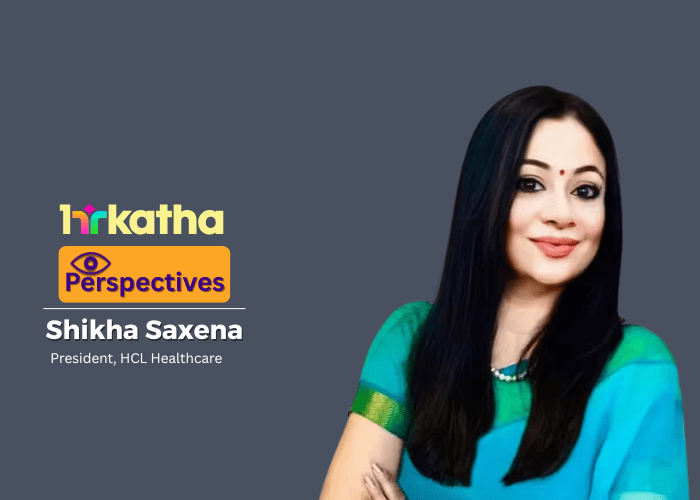
Healthcare sits at an unusual intersection. The sector is driven by purpose, yet it generates some of the highest rates of workforce burnout. It deals in human well-being, yet its own employees are often the last to receive the care the organisation promises others. And it is being reshaped by technology faster than most HR frameworks can keep pace with.
Shikha Saxena has spent her career navigating that tension. In conversation with HRKatha, she explains why future-ready talent is defined more by adaptability than by expertise, why psychological safety in Indian workplaces requires redefining hierarchy rather than dismantling it, and why the organisations that get AI right are the ones that treat it as a people challenge before a technology one.

Hire for what does not yet exist
Are you hiring for skills that exist today, or the capacity to learn what does not yet exist?
The definition of future-ready talent is shifting. It is no longer about what someone knows when they walk in the door—it is about how quickly and consistently they can learn once they are inside.
At HCL Healthcare, we hire with that lens. Learning agility, curiosity and resilience matter more than technical credentials that may be obsolete within the year. The ability to perform under conditions of continuous change is itself the skill.
There is also a dimension that often gets overlooked: well-being. The capacity to keep learning depends on physical, mental and emotional reserves. An organisation that invests in capability without investing in the conditions that make learning possible will find the two working against each other.
Future-ready talent, in that sense, is as much about mindset as it is about skill.
“Future-ready talent is as much about mindset as it is about skill.”
Data without judgement
Is people analytics genuinely transforming decisions, or just making the same biased decisions faster?
Data has unquestionably strengthened HR decision-making. But its value depends entirely on how it is interpreted—and who interprets it.
The real risk is not that data misleads us. It is that we use it to confirm what we already believe. Aggregated patterns can highlight trends; they cannot replace the contextual judgement required to act on them responsibly.
The organisations that get this right treat data as a starting point, not a verdict. They combine analytics with human insight, and they are transparent about how data informs decisions. That transparency builds trust.
Data strengthens decisions—but only when combined with context and judgement. The balance between the two is what separates meaningful change from the acceleration of existing assumptions.
“The future CHRO must be as comfortable with data and finance as with emotion and behaviour.”
AI as colleague, not threat
How do you help employees see AI as something that amplifies their work rather than threatens it?
The technology itself is rarely the obstacle. The real challenge with AI adoption is perception—and that perception is shaped long before any tool is rolled out.
When employees hear that AI is being introduced, many hear something else entirely: that their role is being evaluated for redundancy.
Countering that requires more than communication. It requires transparency on how roles will evolve—and support to get there.
Resistance, in my experience, is almost always rooted in uncertainty rather than opposition. People are not resistant to change—they are resistant to change they do not understand and have no agency in.
The organisations that navigate AI adoption well are the ones that bring employees into the process early, invest in reskilling meaningfully, and make it visible that the goal is to free up human capacity for more valuable work—not to eliminate it.
In that sense, AI adoption is less a technology rollout and more a trust exercise.
“Well-being is not an intervention. It has to become part of the daily routine.”
Psychological safety within hierarchy
Can Indian organisations build cultures where junior employees genuinely challenge senior leaders?
Building psychological safety in a hierarchical environment is not about dismantling hierarchy—it is about redefining how that hierarchy is experienced.
The shift is from authority-driven leadership to trust-driven leadership. You do not need to flatten a structure to make it safe. You need leaders who model openness, invite dissent, and respond constructively when they receive it.
Structured channels help—forums, anonymous feedback mechanisms, skip-level conversations. But the most powerful signal is what happens after someone speaks up.
If the response is punitive, no policy will compensate for it. If the response is engaged and appreciative, culture shifts faster than any programme can achieve.
Respect and candour can coexist. That is the goal worth pursuing.
“Psychological safety is not about dismantling hierarchy—it is about redefining how it is experienced.”
One culture, different experiences
Can a single culture genuinely serve five generations simultaneously?
I believe it can—but only if we stop conflating culture with uniformity. A strong culture is not one in which everyone has the same experience. It is one in which everyone shares the same underlying values, even while their day-to-day experience differs.
The values that cut across generations—inclusion, recognition and the opportunity to grow—are more consistent than the generational conversation often suggests. What differs is how those values are expressed: the degree of flexibility, the channels of communication, and the role of technology in working life.
The shift organisations need to make is from listening periodically to listening continuously. Personalisation, when done thoughtfully, does not fragment culture. It deepens it. In healthcare, where employees are under constant pressure, that responsiveness is not a nicety—it is a retention strategy.
“Data is a powerful enabler—but not a substitute for empathy and judgement.”
Well-being as strategy
How do you move well-being from a benefits line item to a genuine business priority?
The shift I am most committed to is moving away from a reactive, illness-driven model towards something genuinely preventive. In most organisations, employee health is addressed at the point of crisis rather than before it. That is the gap.
What matters is not which platform you deploy. It is whether well-being becomes part of how people work each day, or remains something they access occasionally when they are already struggling. Gamified habits, daily nudges, personalised health journeys—these only work if they are embedded in the rhythm of work rather than bolted onto it.
When well-being is designed into the employee experience rather than added to it, something changes. Employees take ownership of their health. Organisations gain early visibility into workforce trends. And culture shifts from talking about care to practising it.
Well-being is not an intervention. It has to become part of the daily routine.
“Future-ready talent is defined more by adaptability than by expertise.”
The CHRO of tomorrow
What should someone entering HR today be learning that is not in any traditional curriculum?
The role is changing faster than the training for it. Financial acumen, data literacy and design thinking are no longer optional—they are foundational.
But the most overlooked capability is behavioural science. Understanding how people respond to stress, motivation and uncertainty transforms how interventions are designed. The difference between a well-being programme that changes behaviour and one that does not is usually not the content—it is the understanding of human psychology behind the design.
In healthcare particularly, the future CHRO needs to be as comfortable interpreting health data and financial metrics as they are in reading a room. These are not competing capabilities—they are complementary.
If I could tell my younger self one thing, it would be this: do not wait to be given commercial exposure. Seek it out. The HR leaders who will matter in the next decade are the ones who understand the business as deeply as they understand people.
1 Comment
Very clearly outlined