


Corporate diversity initiatives often announce ambitious targets and publish progress reports. Actual workplace change tends to lag behind. Women return from maternity leave to find projects reassigned, manager relationships weakened, and career trajectories quietly altered.
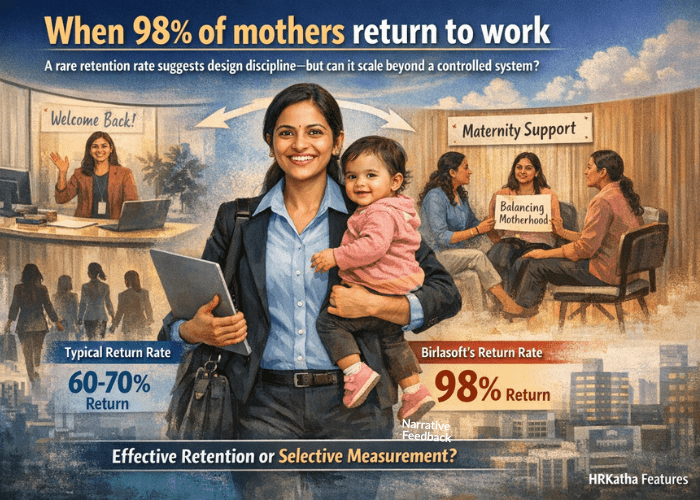
Birlasoft, an IT services firm employing thousands across India and globally, reports something unusual: a 98 per cent maternity return rate, with 177 out of 180 women coming back to work. According to Sarika Saini, senior director, HR and DE&I, this stems from structured intervention rather than policy alone.
“DEI is deeply embedded in how we build our culture, develop our talent, and make everyday decisions. It’s not a separate stream of work, but it’s part of how we operates.”
Sarika Saini, senior director – HR & DEI, Birlasoft

“We connect with women even during their break—not to disturb them, but to ensure they remain connected,” she says. “We run balancing motherhood sessions, provide buddies, and sensitise managers for smoother reintegration.”
The approach targets a well-known problem. Indian IT services firms typically see 30–40 per cent of women not returning after maternity leave—a significant loss of trained talent. If Taken at face value, the figure suggests that maternity retention can be engineered.
The representation pattern
Birlasoft reports 26 per cent overall gender diversity and a 23 per cent hiring mix. More strikingly, it says 67 per cent of key managerial personnel (KMP) roles are held by women.
The contrast is encouraging. Overall representation aligns well with industry benchmarks, while senior representation reflects a strong and progressive leadership presence.
This points to a healthy organisational dynamic—one that not only builds talent at scale but also successfully advances it into leadership roles. It signals a focus on creating meaningful growth pathways and sustaining leadership diversity over time.
Saini attributes senior representation to structured interventions—mentorship, leadership programmes, and sponsorship. The BEmpowered Women’s Leadership Programme recently included 34 participants, with 26 moving into mentoring roles. The Each One Teach One initiative has supported over 100 women across cohorts.
Leadership programmes across corporate India are evolving, and here, the emphasis on outcomes is evident. The focus remains on enabling faster career progression, increasing visibility, and preparing talent for roles with significant decision-making responsibility—ensuring that these initiatives translate into tangible, long-term impact.
Governance versus theatre
Birlasoft has built a multi-tiered DE&I governance structure: a council of senior leaders, supported by 25 ambassadors across functions and geographies.
Such structures, while increasingly common, become truly impactful when they are closely integrated with core business decisions—shaping hiring, promotion, and resource allocation. Birlasoft’s evolving framework appears aligned with this direction, positioning DE&I as a strategic priority rather than a standalone initiative.
The company tracks multiple indicators: diversity ratios, hiring mix, leadership composition, training coverage, and engagement scores. Over 6,500 employees have undergone inclusion training, with coverage exceeding 80 per cent.
While training is an important starting point, its real strength lies in how it translates into everyday behaviours and cultural shifts. Birlasoft’s continued focus on expanding coverage creates a strong foundation for deeper, long-term impact.
Saini points to engagement surveys and focus groups as evidence of improved psychological safety and collaboration. Without baseline comparisons or external benchmarks, these indicators remain difficult to validate independently.
Targets and trade-offs
Birlasoft has committed to ensuring one-third of candidates for managerial and leadership roles are women, alongside a 50 per cent target in campus hiring.
This approach reflects a familiar debate. Critics argue targets risk tokenism; supporters argue they correct structural exclusion.
“We do not compromise on meritocracy. What we do is expand access,” Saini says.
The emphasis on expanding access is increasingly recognised as a meaningful way to unlock diverse talent pools and strengthen organisational capability over time. By creating more inclusive entry points, Birlasoft is positioning itself to benefit from a broader range of perspectives and experiences.
Complementing these targets are a set of structural interventions, including diverse sourcing channels, balanced interview panels, and hiring manager sensitisation. Together, these measures create a more inclusive and enabling hiring ecosystem—one that supports fair evaluation and consistent decision-making.
Beyond gender
The company’s diversity efforts extend meaningfully beyond gender. It currently employs 22 persons with disabilities and five veterans, with clear plans to expand further while exploring areas such as neurodiversity and generational inclusion.
As Saini notes, “Inclusion cannot stop at hiring. It must extend to infrastructure, digital accessibility, and managerial capability.” This reflects a holistic and evolving understanding of inclusion—one that goes beyond representation to focus on enablement and long-term success.
Broadening the scope of diversity initiatives signals a maturing and forward-thinking approach. It demonstrates the organisation’s intent to build an inclusive ecosystem that supports varied talent segments in a comprehensive manner.
As these efforts scale, continued investment in infrastructure, capability building, and execution will play a key role in sustaining impact.
The maturity question
Birlasoft reports its Inclusive Business Maturity Score improved from 7.1 to 7.8 in FY 2024–25.
Such scores typically rely on self-assessment frameworks that reward policy presence and programme deployment. They offer useful signals of organisational intent.
While these frameworks primarily capture structural and programmatic advancement, they serve as an important foundation for deeper cultural transformation. The upward movement in Birlasoft’s score signals consistent effort and a clear trajectory towards building a more inclusive workplace.
Scaling the model
The returning mothers programme remains Birlasoft’s most distinctive intervention. It combines ongoing engagement during leave, manager sensitisation, buddy systems, and structured reintegration.
This suggests that maternity retention can be addressed through sustained, high-touch design rather than policy alone.
As the organisation grows, the opportunity lies in scaling this model while preserving its effectiveness. With the right systems, processes, and managerial alignment, such programmes can evolve into replicable frameworks that continue to deliver value at scale.
More broadly, Birlasoft’s efforts—reflected in strong return rates, leadership representation, and expanding programmes—point to a consistent and structured approach to inclusion. As these initiatives mature, continued tracking of long-term career progression, performance, and retention will further strengthen the organisation’s ability to demonstrate sustained impact and build on its momentum.
The longer view
For now, Birlasoft demonstrates that maternity return need not be left to chance. With deliberate design and sustained support, organisations can significantly strengthen retention at a critical career juncture.
What stands out is the potential of this approach to evolve into a scalable and replicable model. As the organisation grows, continued focus on consistency, efficiency, and leadership alignment will further enable it to embed these practices seamlessly across the business.
In many ways, Birlasoft’s experience offers a strong blueprint—showing how thoughtful design, when backed by intent and execution, can translate into meaningful and lasting impact.