



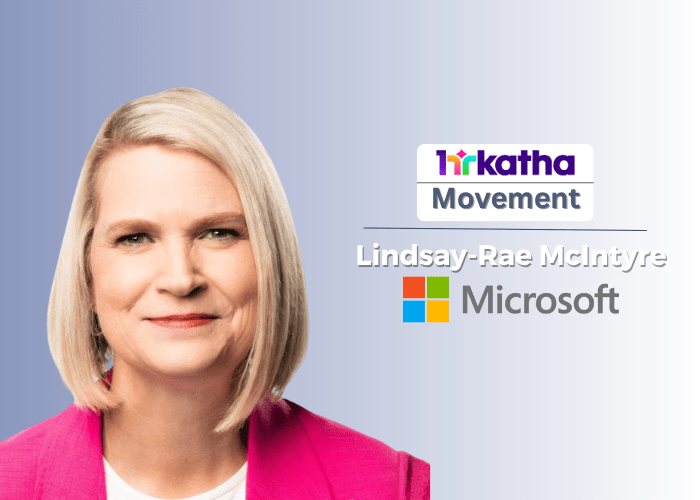
Leadership changes at Microsoft are unfolding alongside a significant reset of its people strategy, as the company aligns its human- resources function with the demands of an AI-driven future. Lindsay-Rae McIntyre, chief diversity officer and corporate vice president-talent and learning, will step down at the end of March, marking the end of an eight-year tenure with the tech giant.
McIntyre is set to move on to a chief people officer (CPO) role elsewhere, according to internal communication cited in media reports.

During her time at Microsoft, she played a central role in shaping the company’s approach to inclusive leadership, talent development, and learning at scale.
With over two decades of experience in human resources, McIntyre has built her career at the intersection of talent strategy and business growth. Prior to joining Microsoft, she spent nearly 18 years at IBM, where she held multiple senior HR- leadership roles across global markets, including Asia Pacific, Latin America, and the Middle East. Her experience spans executive succession planning, leadership development, and large-scale HR transformation—capabilities that have shaped Microsoft’s evolving people agenda in recent years. Academically, she holds an MBA in International Business from Duke University – The Fuqua School of Business and a Bachelor’s degree with highest honours from University of North Carolina at Chapel Hill.
Her departure comes at a time when Microsoft is undertaking a broader restructuring of its HR organisation to support what it describes as the next phase of “AI-powered transformation.” As part of this shift, the company is consolidating key HR functions, merging its HR4HR and culture and inclusion teams into a unified people and culture unit led by Leslie Lawson Sims. The move reflects a more integrated approach to managing culture, inclusion, and workforce strategy under a single leadership structure.
In parallel, Microsoft is reorganising its engineering HR teams into a single structure and repositioning its people analytics function closer to employee experience teams. This signals a stronger emphasis on using data to drive real-time workforce decisions and enhance employee outcomes. The restructuring also introduces new organisational priorities, including the creation of a dedicated talent- development team that brings together leadership development, succession planning, and manager capability initiatives, with Wyatt Cutler set to lead the function upon his return.
Additionally, a Workforce Acceleration team is being introduced to focus on skilling, redeployment, and workforce planning, particularly as organisations navigate increasing collaboration between humans and AI systems. Coleman highlighted that the pace of change now demands a different HR operating model, noting that the focus is shifting from scaling for stability to scaling for adaptability.
