
Close Menu
    Facebook X (Twitter) Instagram
    • Our Story
    • Partner with us
    • Reach Us
    • Career
    Subscribe Newsletter
    HR KathaHR Katha
    • Exclusive
      • Exclusive Features
      • Perspectives
      • Friday Features
      • herSTORY
      • Case-In-Point
      • Point Of View
      • Research
      • HR Pops
      • Dialogue
      • Movement
      • Profile
      • Beyond Work
      • Rising Star
      • By Invitation
    • News
      • Global HR News
      • Compensation & Benefits
      • Diversity
      • Events
      • Gen Y
      • Hiring & Firing
      • HR & Labour Laws
      • Learning & Development
      • Merger & Acquisition
      • Performance Management & Productivity
      • Talent Management
      • Tools & Technology
      • Work-Life Balance
    • Special
      • HR Forecast 2026
      • Cover Story
      • Editorial
      • HR Forecast 2024
      • HR Forecast 2023
      • HR Forecast 2022
      • HR Forecast 2021
      • HR Forecast 2020
      • HR Forecast 2019
      • New Age Learning
      • Coaching and Training
      • Learn-Engage-Transform
    • Magazine
    • Reports
      • Whitepaper
        • HR Forecast 2024 e-mag
        • Future-proofing Manufacturing Through Digital Transformation
        • Employee Healthcare & Wellness Benefits: A Guide for Indian MSMEs
        • Build a Future Ready Organisation For The Road Ahead
        • Employee Experience Strategy
        • HRKatha 2019 Forecast
        • Decoding and Driving Employee Engagement
        • One Platform, Infinite Possibilities
      • Survey Reports
        • Happiness at Work
        • Upskilling for Jobs of the Future
        • The Labour Code 2020
    • Conferences
      • Leadership Summit 2025
      • Rising Star Leadership Awards
      • HRKatha Futurecast
      • Automation.NXT
      • The Great HR Debate
    • HR Jobs
    WhatsApp LinkedIn X (Twitter) Facebook Instagram
    HR KathaHR Katha
    Home»Exclusive Features»Newgen’s AI strategy starts with people, not technology  
    Exclusive Features

    Newgen’s AI strategy starts with people, not technology  

    The software firm is redesigning how work, learning and leadership fit together rather than simply training employees to use new tools
    mmBy Radhika Sharma | HRKathaJuly 21, 2026Updated:July 21, 20264 Mins Read1179 Views
    Share LinkedIn Twitter Facebook WhatsApp
    Newgen
    Share
    LinkedIn Twitter Facebook WhatsApp

    Corporate AI strategies often begin the same way. Buy the tools. Train employees. Measure adoption. Hope productivity follows.

    Newgen Software believes the sequence is backwards.

    “We don’t measure AI success by the number of employees trained,” says Kashish Kapoor, the company’s global chief human resources officer. “We measure it by how naturally AI becomes part of everyday work.”

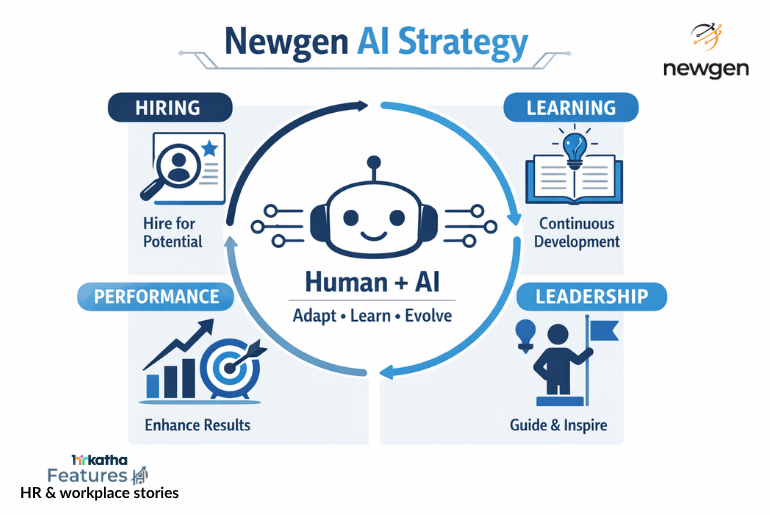
    The distinction is important. Teaching employees how to use AI is relatively easy. Redesigning work so that people and AI genuinely complement one another is much harder. It requires organisations to rethink hiring, learning, performance management and leadership together rather than treating them as separate initiatives.

    The company argues that AI creates value only when people, processes and technology evolve in parallel. Whether that integrated approach delivers a lasting advantage remains to be seen. But it moves the conversation beyond AI literacy towards organisational redesign.

    Hiring for adaptability

    Newgen has shifted its hiring philosophy away from recruiting people with narrowly defined technical expertise.

    “Today, we hire less for what someone knows and more for how quickly they can learn, adapt and create value,” Kapoor says

    “We don’t measure AI success by the number of employees trained. We measure it by how naturally AI becomes part of everyday work.”

    Kashish Kapoor, Global CHRO, Newgen Software

    That philosophy has become increasingly common across the technology sector. The real challenge lies in supporting it after recruitment.

    Hiring for potential works only if organisations invest continuously in developing that potential.

    Newgen attempts to do that through personalised learning journeys, AI labs, hackathons and cross-functional mobility. It is also placing greater emphasis on business understanding alongside technical capability. As the company increasingly positions itself as an enterprise performance partner rather than simply a software provider, employees are expected to understand customer problems as well as technology.

    The objective is no longer to produce better engineers alone, but professionals capable of connecting technology with business outcomes.

    Learning through work

    Many AI learning programmes still rely on classroom sessions and mandatory certification.

    Newgen has chosen a different route.

    Instead of treating AI as another subject employees need to study, it encourages them to use AI while building products, solving customer problems, improving internal operations and supporting sales teams.

    “The biggest shift is moving from a change programme to a learning culture,” Kapoor says.

    The distinction matters because change programmes eventually end. Learning cultures do not.

    The company points to growing cross-functional collaboration, wider AI adoption and increased employee mobility as indicators that the approach is gaining traction. While those outcomes are difficult to verify independently, the underlying philosophy is clear: employees learn AI fastest when it becomes part of their everyday work rather than an occasional training exercise.

    Redefining performance

    Newgen is also changing how performance is evaluated.

    Alongside traditional business outcomes, the company increasingly rewards behaviours such as collaboration, innovation, continuous learning and responsible AI use.

    The last element reflects the company’s customer base. Banks, insurers and government agencies operate in highly regulated environments where AI decisions often carry legal, financial and ethical consequences.

    Employees are therefore encouraged to ask not only whether AI can perform a task, but whether it should.

    As AI capabilities become easier to access, judgement may become a greater competitive advantage than technical proficiency alone.

    Managing human-AI teams

    Kapoor believes leadership expectations are changing just as quickly.

    Managers increasingly need to decide which work belongs with people, which belongs with AI, and which requires both.

    That demands different capabilities from traditional people management.

    Accordingly, Newgen measures AI readiness less through training completion and more through business outcomes. It looks at how employees apply AI in customer engagements, how quickly they acquire new capabilities, productivity improvements and the value delivered to clients.

    Measuring outcomes instead of activity is a more demanding approach. It also avoids a common trap where organisations confuse course completion with genuine capability.

    Beyond AI training

    Newgen’s approach is notable because it treats AI as an organisational challenge rather than a technology initiative.

    Hiring, learning, leadership and performance are designed to reinforce one another instead of evolving independently.

    That is considerably harder than launching an AI training programme. It requires sustained changes across multiple people systems at the same time.

    That integration is also the hardest part to sustain. Competing priorities, budget cycles and leadership changes all create pressure to revert to simpler, more measurable interventions.

    As AI tools become widely available, access to technology is unlikely to distinguish one software company from another. The bigger differentiator may be how effectively organisations redesign themselves around it.

    Culture diversity Employee Employee Benefits Employee Engagement employees employer Employment Engagement HR Human Resources Kashish Kapoor Newgen Software Productivity Recruitment Skill Development Training Workforce Workplace
    Share. LinkedIn Twitter Facebook WhatsApp
    mm
    Radhika Sharma | HRKatha

    Radhika is a commerce graduate with a curious mind and an adaptable spirit. A quick learner by nature, she thrives on exploring new ideas and embracing challenges. When she’s not chasing the latest news or trends, you’ll likely find her lost in a book or discovering a new favourite at her go-to Asian eatery. She also have a soft spot for Asian dramas—they’re her perfect escape after a busy day.

    Leave A Reply Cancel Reply

    Related Posts

    Accenture taps Pradeep Prabhala to head India market unit

    July 21, 2026

    8th Pay Commission nears halfway mark; pension framework review remains key focus

    July 21, 2026

    ASML to offer €20,000 retention bonus to employees staying through 2030

    July 21, 2026

    LatentView appoints Sonal Ramrakhiani as CEO to drive next phase of AI-led growth

    July 21, 2026
    zoha
    Editorial

    India’s IT services industry built the talent. Its biggest clients are now hiring it directly through GCCs

    Something significant is happening to India’s technology workforce in 2026. Most people are describing the…

    The interview was never measuring what we thought it was

    I was speaking recently to the HR Head of a mid-sized IT company about hiring.…

    EDITOR'S PICKS

    Newgen’s AI strategy starts with people, not technology  

    July 21, 2026

    Ghost jobs: The phantom listings that haunt modern hiring

    July 21, 2026

    India’s IT services industry built the talent. Its biggest clients are now hiring it directly through GCCs

    July 20, 2026

    POV: Should organisations hire for adaptability over expertise?

    July 20, 2026
    Latest Post

    8th Pay Commission nears halfway mark; pension framework review remains key focus

    News July 21, 2026

    The 8th Central Pay Commission is nearing the halfway point of its 18-month tenure as…

    ASML to offer €20,000 retention bonus to employees staying through 2030

    News July 21, 2026

    ASML, the world’s largest manufacturer of semiconductor chipmaking equipment, is planning to introduce a retention…

    Amazon sued over alleged FMLA violations after employee’s dismissal

    News July 21, 2026

    Amazon is facing a lawsuit in the US after a former employee alleged that the…

    Intel plans fresh layoffs in data centre business amid ongoing restructuring

    News July 21, 2026

    Intel is preparing another round of job cuts, this time in its Data Centre Group…

    Asia's No.1 HR Platform

    Facebook X (Twitter) Instagram LinkedIn WhatsApp Bluesky
    • Our Story
    • Partner with us
    • Career
    • Reach Us
    • Exclusive Features
    • Cover Story
    • Editorial
    • Dive into the Future of Work: Download HRForecast 2024 Now!
    © 2026 HRKatha.com
    • Disclaimer
    • Refunds & Cancellation Policy
    • Terms of Service

    Type above and press Enter to search. Press Esc to cancel.