



There’s a persistent myth in corporate leadership: the higher you climb, the more you’re supposed to know. The corner office comes with a mahogany desk, a better view, and apparently, omniscience.
Yogesh Misra wasn’t buying it. As chief business officer at Thomas Assessments, he posed a question that made the second panel discussion at HRKatha’s Rising Star Leadership Awards 2025 uncomfortable in all the right ways: Is there a need for us to learn from frontliners in the service industry, or do we still have a class hierarchy and continue to claim that we know best?

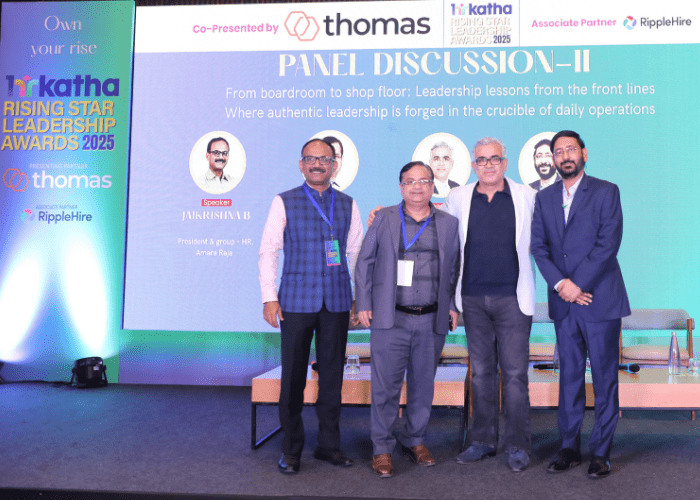
The question hung in the air like a challenge. And three panellists—Jaikrishna B (president, group HR, Amara Raja Group), Praveen Purohit (CHRO, Vedanta Aluminium), and Sandeep Girotra (ED & CHRO, DCM Shriram)—took it head-on with stories that were refreshingly honest about the messiness of real leadership.
The union negotiator who learned humility
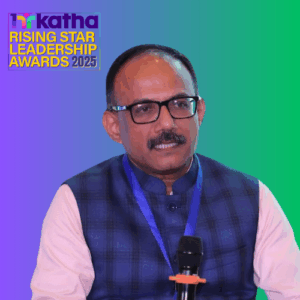
JK’s story began exactly where most leadership nightmares do: in the middle of a labour dispute.
He was promoted to management trainee and found himself mediating an ongoing labour conflict before the conciliation officer. A second notice had been issued, which ordinarily would trigger alarm bells. But JK, fresh and confident, thought the Union was simply posturing. Being second in command gave him a certain swagger. He was thrilled, thinking adjournment would be a formality. Everything went smoothly and the adjournment happened, signed by those present.
Victory, right? Not quite.
When he returned to the office, the inevitable question came: why had he agreed to withdraw the notice? His reaction was textbook defensiveness—he realised his boss hadn’t read the adjournment before putting his signature to it. A scared JK thought his career was over. He waited, trembling, for his boss to reprimand him.
But what happened was rather unusual and unexpected. His boss simply hugged him and asked how he had managed to create a great experience for himself. Just when he was bracing for a strong reprimand, he was simply told how it is normal for mistakes to happen. A senior had simply considered his mistake as a learning.
It’s a story about ego, fear, and the rarest thing in corporate life: grace. JK learned something more valuable than negotiation tactics that day. He learned that authentic leadership doesn’t mean never making mistakes. It means creating a culture where mistakes become lessons, not career death sentences.
“Authentic leadership isn’t about never making mistakes—it’s about turning mistakes into lessons”
Jaikrishna B, president – group HR, Amara Raja Group
The salary cut that nobody wanted
JK had another story from darker times—the pandemic, when companies were haemorrhaging money and leaders were making impossible choices.
There was tremendous pressure to cut salaries. But JK was not in favour of cuts across all levels. He wanted the cuts to happen only at the management level, GM and above. With personal face-to-face meetings not happening amidst the pandemic restrictions, he was worried about how he would convince the seniors about his take on a virtual call, especially since the management had already made up its mind about salary deductions across all levels.
He wasn’t even sure whether his suggestion was feasible and feared reprimand. Overwhelmed and emotional, he called his boss and put his thoughts forward.
That day, JK learnt that communication is important and that unnecessary worrying leads nowhere, especially if you are trying to be an authentic leader. His boss agreed. The vulnerable phone call—the willingness to speak truth to power even when you’re uncertain—turned policy.
It’s a reminder that authentic leadership often feels uncomfortable in the moment. The sweaty palms. The fear of being told no. The risk of looking naive. But that discomfort is often the price of doing the right thing.
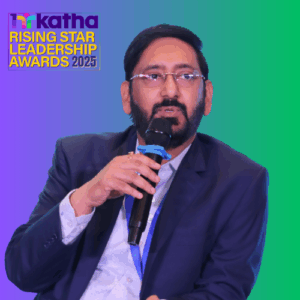
“Eighty per cent of our workforce is on the shop floor—they know what’s best for the company”
Praveen Purohit, CHRO, Vedanta Aluminium

The man who never forgot the shop floor
Praveen Purohit’s insight began with a memory, but it ended with a philosophy that challenges everything we think we know about where real power lies in an organisation.
He recalled his early days as a professional in the critical minerals, energy and tech space. “A hand on your head gives so much confidence,” he said. From his own experience, he shared how nervousness vanishes if a senior appreciates you in a meeting.
It’s easy to forget, once you’re the one with the corner office, how much a small gesture of recognition means. How a public acknowledgment can change someone’s entire week. How being seen and valued isn’t just nice—it’s essential.
But Purohit didn’t stop at nostalgia. He went somewhere more radical.
Eighty per cent of Vedanta’s workforce is on the shop floor, he explained. After all, the company is driven from the shop floor. Hiring 2000 people annually is not easy and no joke. Giving confidence to these 2000 people who will grow up to be leaders one day requires authentic leadership.
Think about that for a moment. Two thousand people every year. Not executives. Not MBAs from top schools. Shop floor workers. Science graduates who are actually running the company. They know what is best for the company, Purohit insisted, and HR is accountable for them.
It’s a perspective that inverts the usual corporate hierarchy. The shop floor isn’t where you start before moving up to “real” work. The shop floor is the bedrock. It’s where the company actually happens.
At the end of the day, business is business, Purohit acknowledged. Profits have to be made. But he never forgets that one lakh people across 75 global locations need to be touched. Those in the middle layers need to be given the energy to climb up to the senior level.
“We need to do what is justifiable and touches everyone profoundly,” he said. The HR needs to ensure they have a career.
Working with 500 HR people, Purohit re-emphasised their mission with startling clarity: their “single point agenda is to help our people grow.”
Not to manage headcount. Not to process paperwork. Not to implement policies. To help people grow.
It’s authentic leadership distilled to its essence. And it starts with remembering what it felt like to need a hand on your head—and then making sure you never stop offering that to others.
“It’s time to choose Toyotism over Fordism: empower, don’t control.”
Yogesh Misra, CBO, Thomas Assessments
The leader who learned to look in the mirror
Sandeep Girotra had a confession that cut to the heart of what authentic leadership actually means.
He recalled how despite not having worked with P Dwarakanath—the former chairman of GSK and one of India’s most respected HR leaders, who was present in the audience — he had always turned to Dwaraka whenever he needed serious career advice. And what did Dwarakanath do? He would always throw the question back at Girotra and make him think.
What Girotra tried to drive home was that leadership is about showing the mirror and not herding.
It’s a profound shift in thinking. Most leaders see their job as having answers. Girotra’s story suggests the opposite: a leader’s job is to help people find their own answers. Not by abandoning them, but by reflecting their questions back in ways that spark insight.
Delving into the epic Mahabharata, he cited the example of Lord Krishna as a leader. Krishna showed everyone the mirror, and that was enough to set everyone thinking and ensure each individual played their part just as they were supposed to. Leadership has nothing to do with designation, Girotra emphasised, but with the very action of leading.
Then came his advice for emerging CHROs—a perspective that’s rare in its clarity and courage.
CHROs should maintain a good relationship with the chief financial officers, he said. Yes, numbers are important and so is the heart, that is, the front line. Numbers need to grow for the general good of the society and the employees, including the frontline. But there has to be a balance between money making and benefitting people. Therefore, the CFO and CHRO should work in tandem, each bringing their expertise to create value that’s both profitable and human.
It’s not a call to choose between business and people. It’s a recognition that the best businesses do both—and that HR leaders need to be comfortable in the language of finance as much as they are in the language of empathy.
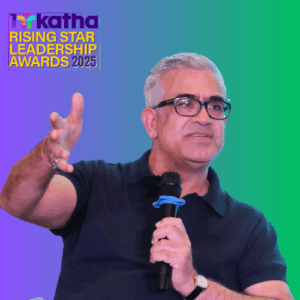
“Like Krishna in the Mahabharata, true leaders hold up the mirror that awakens everyone to their role”
Sandeep Girotra, ED & CHRO, DCM Shriram
What the front lines teach
The thread running through these stories was remarkably consistent: real leadership happens when you stop pretending to have all the answers.
JK learned it from a boss who chose teaching over punishment—and then proved it again by standing up for his junior colleagues during a crisis. Purohit learned it from the simple human need to be valued and never forgot what that felt like. Girotra learned it from Dwarakanath, who taught him that the best leaders don’t give answers—they help people discover their own.
Misra’s original question—do we need to learn from frontliners?—was answered not with theory but with lived experience. The front lines aren’t just where work happens. They’re where reality lives. Where policies meet people. Where leadership theories get stress-tested by actual human beings with actual problems.
The executives in corner offices might have the org charts and P&L statements, but the people doing the work have something more valuable: they know what’s actually happening.
The hierarchy trap
The problem with hierarchies isn’t that they exist—it’s that they create the dangerous illusion that wisdom flows in only one direction. Down. From senior to junior. From experienced to inexperienced. From boardroom to shop floor.
But as these stories demonstrate, that’s not how real learning works. JK’s boss taught him that mistakes are learning opportunities—but only after JK had made the mistake. JK’s idea to protect junior employees came from understanding their reality, not from some management textbook. Purohit’s appreciation for recognition came from having been there himself. And Girotra learned from Dwarakanath that real leadership is about reflection, not direction.
Leadership, it turns out, isn’t about knowing more than everyone else. It’s about being willing to learn from everyone else.
The uncomfortable truth
Here’s what makes authentic leadership so difficult: it requires admitting you don’t have all the answers. It means being vulnerable. It means asking for help, accepting feedback, and occasionally looking foolish.
In a corporate culture that rewards confidence and punishes uncertainty, that’s a tough sell. We promote people who project certainty, who make decisive calls, who “take charge.” But as JK, Purohit, and Girotra showed, the best leaders are often the ones who are brave enough to say “I don’t know” or “I was wrong” or “Help me understand” or even “What do you think?”
That’s not weakness. That’s wisdom.
Establishing that connect
To learn from the frontliners one has to spend time with them and earn their trust. Here, Yogesh Mishra had tips to offer on how to really connect with them first. Discard that business suit and tie. Let go of the corporate formality. Be like one of them. Eat with those on the shop floor so that they see you as one of them.
A very timely question from the audience then veered the discussion towards how the best ideas come from the shop floor but they rarely get a chance to reach the top. They meet the leadership only occasionally. When asked how it can be ensured that the ideas born on the shop floor can be heard, weighed and integrated with business decisions, Praveen Purohit promptly suggested relying on technology.
Admitting to being a big fan of technology, he thought it the best way to escalate matters and even ideas. Any idea that is good and offers profit or ESG value will never be ignored by the management. The owner of an idea, if truly convinced about it, should not let it be killed. It is the organisation’s responsibility too to ensure that ideas are not snuffed out.
Jaikrishna B drew attention to the significance of psychological safety in ensuring that the ideas travel from the shop floor to the board room. Involving the shop floor, the frontline, in any large exercise is the key. He suggested getting those on the shop floor to use apps to share their ideas and feedback. In his opinion, “frontline people are more authentic and in control than those sitting in the boardrooms”, as the plant is as good as the mother of the organisation.
It is a question of choosing Toyotism over Fordism summed up Misra referring to the practice of empowering workers vs controlling them. While Toyota follows the practice of letting workers find solutions to their own issues, entrusting power in the hands of the workers, Ford is known to be more controlling. Ultimately, achieving a balance is the key with the best interest of the business in mind.
The way forward
If there’s a lesson from this panel, it’s this: stop treating the front lines as a training ground to escape from and start treating them as a classroom to return to.
The best ideas won’t come from strategy decks or consultant presentations. They’ll come from the people closest to the actual work. The service staff. The factory floor. The customer-facing teams. The people who know what actually works because they’re doing it every day.
Authentic leadership isn’t about having the answers. It’s about asking the right questions—and actually listening to the responses.
Misra asked whether we need to learn from frontliners or whether we can keep clinging to class hierarchy. The panel answered with their lives: learn, or become irrelevant.
The choice has never been clearer.