


If someone had told senior HR leaders 20 years ago that their sharpest management lessons would one day come from people who think voicemail is a relic, use ‘GM’ for good morning, and can build a dashboard while you’re still looking for the Wi-Fi password… well, most would’ve smiled politely and gone back to their performance appraisal forms.
But here we are.
Gen Z has arrived at the workplace—not quietly, not gradually, but with the energy of a group that believes work should fit into life, not the other way around. They speak while thinking, draw boundaries without guilt, question systems older than them, and say “I don’t agree” to people who once carried the weight of hierarchy with a single raised eyebrow.
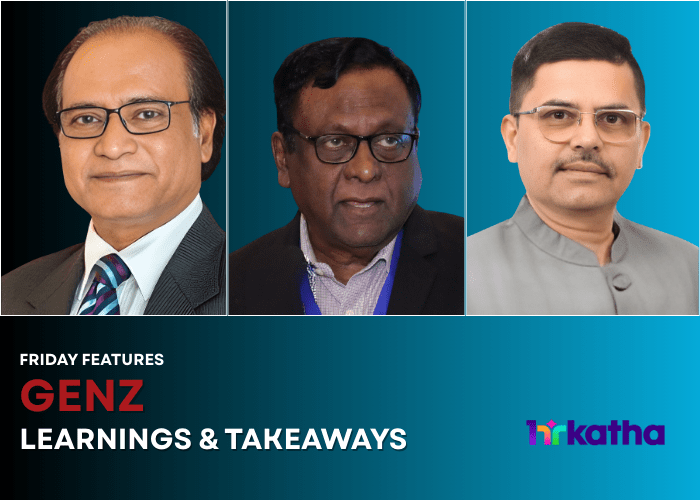
Some seasoned HR leaders have genuinely learnt from India’s youngest workforce. Not theories or stereotypes—just real interactions that made them pause, rethink, unlearn, and even laugh.
Lesson 1: They don’t do shortcuts in life—only in language
P Dwarakanath, former chairman of GSK, begins with a confession: he didn’t know what “GM” meant. Not the car company. Not ‘general manager’. Not the stock market term. Just… Good Morning.
“They want to enjoy life in this fashion. Purpose is not laminated—it has to be lived.”
P Dwarakanath, former chairman, GSK
He still remembers the first time someone replied to his carefully typed “Good Morning” with “GM”. At first, he thought it was rude. Then he realised it wasn’t rudeness—it was Gen Z’s shorthand for efficiency.
“And this is the way they live,” he says. “They want to enjoy life in this fashion. Purpose is not laminated—it has to be lived.”
Before long, he understood that this wasn’t about language. It was about philosophy. Gen Z values time, clarity, and directness over ceremony.
This is why they don’t wait for feedback cycles. Why annual appraisals feel prehistoric. For them, ‘I’ll tell you at year end’ sounds like a broken dial-up connection.
“They will ask you, ‘If I did well that day, why didn’t you appreciate me that day?’ Instant feedback is a lifestyle,” explains Dwarakanath.
For HR veterans raised on half-yearly reviews, Gen Z’s demand for instant feedback can feel impatient. But look closely, and it’s actually a high-trust, transparency-first mindset. They don’t want praise—they want clarity. They don’t want hierarchy—they want honesty.
As Dwarakanath puts it: “For them, transparency determines trust.”
Takeaway: Real-time feedback isn’t indiscipline—it’s their default mode.
Lesson 2: Why stretch if the elastic will snap?
Meanwhile in Bangalore, Sriharsha Achar, former CHRO of Star Health & Allied Insurance, was facing a different kind of reckoning—in his classroom.
“Boundaries are not rebellion. This is a generation that sets limits without guilt.”
Sriharsha Achar, former CHRO, Star Health & Allied Insurance
He was explaining “stretch roles” to his class. A student shot back: “Sir, why stretch if the elastic will snap?”
He ended the class early. Lesson learnt.
“Boundaries are not rebellion,” he says. “This is a generation that sets limits without guilt.”
These limits aren’t about entitlement—they’re about emotional sustainability. Unlike previous generations, Gen Z isn’t shy about saying: “I have an appointment.” “I’m stressed.” “I need a break.” They don’t whisper their exhaustion—they voice it.
Strangely, as Achar feels, “Once leaders accept that, the workplace becomes more humane.”
Takeaway: Boundaries aren’t a threat—they’re a form of self-respect.
Lesson 3: Their skills are their livelihood—your job is just the buyer
When Nihar Ghosh, former CHRO of Emami, started engaging with Gen Z, he quickly realised he was dealing with an entirely different psychology.
“Our generation looked at jobs as livelihood,” he says. “This generation looks at their skills as livelihood.”
They aren’t grateful for a job—they believe the job should be grateful to have them. Not arrogantly. Just matter-of-factly.
“Our generation looked at jobs as livelihood. This generation looks at their skills as livelihood.”
Nihar Ghosh, former CHRO, Emami
This shift flips the power equation, demanding organisations rethink everything—from how they design roles to how they offer growth.
Ghosh also highlights the generational leap in assertiveness. Gen Z wants to be heard. They don’t whisper concerns; they articulate them. They don’t wait years for a promotion; they expect visible pathways. And they’re fearless in asking “why”—about policies, work hours, organisational design.
“If you don’t value my skills,” they think, “someone else will.”
This shift is seismic. It’s not job-hopping, Ghosh argues—it’s skill fluidity. Gen Z treats employment like a partnership, not a debt. Employers who recognise this—and don’t complain that “kids these days lack loyalty”—create better engagement.
For Ghosh, Gen Z is a signal: it’s time to recalibrate, re-examine, and rebuild people practices for a world where talent chooses you, not the other way round.
Takeaway: They don’t work for companies. They work with companies.
Lesson 4: Wellbeing Is non-negotiable
Ask Dwarakanath about mental health, and he’ll tell you how different things were earlier. “In our times,” he says, “even if you weren’t well, you wouldn’t tell your boss.”
Today’s workforce? “Sir, I’m stressed. I need a change. I’ll go to the Himalayas for six months.”
They’re not being dramatic. They just refuse to collapse in silence the way older generations did. Furthermore, they don’t fear career breaks. Stability is secondary to meaning.
Gen Z expects psychological safety the way older generations expected pensions. And they’re right. Without emotional wellbeing, productivity is cosmetic.
Takeaway: Mental health isn’t a taboo—it’s a leadership responsibility.
Lesson 5: Linear careers are dead—Gen Z will restart whenever they want
Ghosh says the biggest shift he’s seen is the fearlessness with which Gen Z abandons the traditional idea of a one-path career.
“Earlier, once you entered a profession, you stuck to it for 30 or 40 years,” he recalls. “Stability mattered more than anything else.”
But this generation? Completely different.
They treat careers like operating systems—they update, reboot, uninstall, and reinstall without guilt.
Gen Z isn’t emotionally attached to a job title or the comfort of a predictable trajectory. “They don’t hesitate to start from scratch,” he says. “For them, learning something new is not a step back—it’s simply step next.”
The most interesting part is why they do it. “Their goals are very clear. The moment they achieve what they came for—experience, skill, exposure—they are ready for their next chapter.”
Older generations were conditioned to stay, endure, and progress slowly. Gen Z simply doesn’t subscribe to that timeline.
Takeaway: Careers are now fluid, and HR must stop expecting long-term loyalty.
Lesson 6: You walk in to teach—Gen Z walks in ready to upgrade you
Back in Achar’s class, honesty flows like Wi-Fi—fast, glitch-free, and occasionally brutal.
Once, his outfit was mismatched. A student stood up and announced: “Sir, creative look—very start-up CEO type.”
He calls it kind, honest, direct, and devastatingly observant.
Their confidence isn’t limited to commentary. During one session on HR analytics, as Achar was explaining the basics of building a dashboard, one student built a dashboard in real time, another optimised it, and a third asked for Wi-Fi so he could show something better.
Achar deadpans: “Technology is their superpower.”
What he’s really pointing to is a shift: this generation isn’t intimidated by expertise, hierarchy, or the fear of making mistakes in front of senior professionals. In their world, knowledge moves in every direction—not top-down, but in loops, bursts, and downloads.
Takeaway: Reverse mentoring isn’t optional—it’s a superpower.
Lesson 7: Respect isn’t silence—sometimes it sounds like “I disagree”
Dwarakanath recalls a young employee who told him “I don’t agree with you” in a group meeting. Everyone around her panicked.
“You will lose your job,” they warned.
But she didn’t.
He actually appreciated her honesty. “I could never have said that to my boss,” he admits. “But this generation isn’t afraid to challenge. And that’s a good thing.”
Gen Z questioning you doesn’t mean they disrespect you. It means they’re engaged, curious, and unwilling to accept outdated logic.
This is how systems evolve.
Takeaway: Questions aren’t defiance—they’re invitations to think.
Lesson 8: Efficiency is their work ethic—and AI is their secret weapon
While leaders once proved loyalty through late nights and “stretching,” Gen Z proves loyalty by not burning out—and somehow still delivering.
Achar assigned a major project, assuming the deadline was the end of the month. Then a circular announced that vivas were the very next day.
He emailed them on the 19th: “If you want to do it tomorrow, then do it.”
He expected excuses.
They came with completed presentations.
“Whatever AI they used,” he laughs, “I have no complaints.”
Gen Z knows burnout isn’t a badge of honour. They optimise, prioritise, and use tools (including AI) smartly. The output stays high; the drama stays low.
Takeaway: Productivity doesn’t look like pain anymore.
The real lesson
Gen Z hasn’t just entered the workforce—they’ve entered our assumptions, our routines, and sometimes, our comfort zones.
For HR leaders, the biggest takeaway isn’t just learning new tools, understanding flexible schedules, or tolerating a little blunt feedback. It’s recognising that these young professionals are rewriting the rules—and teaching us, sometimes uncomfortably, how to keep up.
And maybe the most important lesson of all? The smartest leaders aren’t the ones who know everything—they’re the ones willing to learn, unlearn, and relearn, sometimes from employees half their age.
1 Comment
“Gen Z is redefining the way we approach personal and professional growth. Their self-awareness, confidence, and willingness to express themselves authentically is truly inspiring. It’s a reminder that learning is a two-way street, and we can all benefit from their fresh perspectives. Kudos to HR Katha for highlighting this important conversation! ?”
?