



Higher education presents its own particular version of the HR challenge. The workforce is highly credentialled and professionally mobile. The institution’s identity is tied to intellectual rigour, which makes culture both powerful and resistant to change. And the expectations of a 25-year-old joining a research campus today are almost entirely unlike those of the senior faculty member they will eventually work alongside.
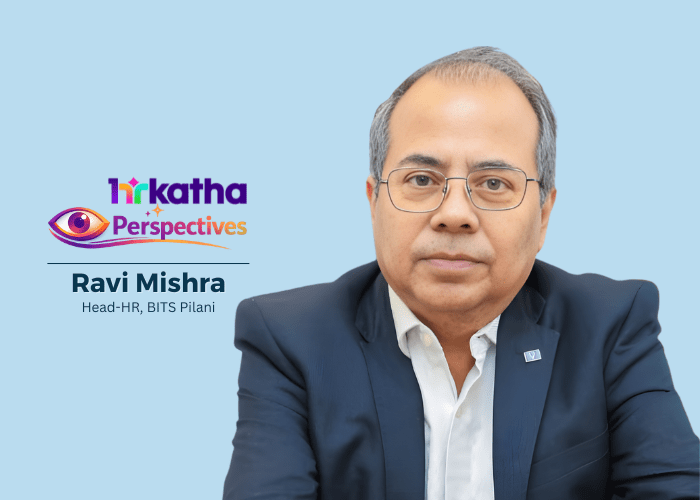
Ravi Mishra, Head–HR at BITS Pilani, navigates those contradictions at BITS Pilani. In conversation with HRKatha, he argues that culture is losing its grip as the organising principle of work, that the old saying about people leaving managers rather than companies no longer holds, and that the HR leaders who will matter in the next decade are those who can read people, not just processes.

Three to four years, not five
Are you hiring for skills that exist today, or capabilities that do not yet exist?
Honestly, even five years is generous. From what I see, the life cycle of technical skills is closer to three to four years—possibly less. Technology is evolving fast enough that what someone learns today can be redundant before they have had the chance to master it.
We talk about AI and generative tools now, but the next disruption could be quantum computing. And this is not limited to new-age industries. In traditional manufacturing, plant operators who once manually controlled valves and pressure systems now work entirely through dashboards. The technical skill has migrated into the machine. What remains with the human is the capacity to adapt.
That is why, when we hire at BITS Pilani, behavioural qualities matter far more than current technical knowledge. I have seen people move from ocean engineering or ceramics into leadership roles in global technology companies. The domain expertise was largely irrelevant. The learning agility was everything.
We hire for how quickly people can learn what does not yet exist. That, for me, is what future-ready talent actually means.
“We hire less for what people know today and more for how quickly they can learn what does not yet exist.”

Systems, not culture
Can one culture genuinely serve five generations simultaneously?
To be direct: the idea of a single organisational culture is becoming outdated. When you have five generations working together—each with different expectations, life stages and motivations—one uniform culture is simply not practical.
What I observe is that people are no longer asking “what is your culture?” They are asking “what is your system?” Do you offer hybrid work? How transparent are your processes? How much autonomy will I have? They are evaluating whether the organisation’s ways of working suit their life at this particular stage of it.
A 25-year-old and a 55-year-old will look for entirely different things—and neither is wrong. The organisation that tries to speak to both through a single cultural narrative will fail to convince either. The one that builds flexible systems—and lets people find their own alignment with those systems—has a better chance.
Culture, as we knew it, is losing relevance. What is replacing it is something more structural—and, in a way, more honest.
“HR is less about processes now. It is about understanding people.”
Systems drive retention
The cliché says people leave managers, not companies. Does that still hold?
No. That framing made sense in an era when the manager was the primary interface between an employee and the organisation. That is no longer true.
Today, an employee might have an excellent manager and still leave – because the commute is unsustainable, because there is no hybrid option, or because a policy conflicts with a personal priority. The system is what they experience every day. The manager is just one variable within it.
Younger employees in particular are clear-eyed and direct about this. They are not leaving because they dislike their manager. They are leaving because the system does not work for them at this point in their lives. There is nothing disloyal about that—it is simply rational.
The organisations that understand this are the ones redesigning their systems rather than running manager training programmes and wondering why retention does not improve.
“The manager’s role has shifted from directing to enabling—and that shift is permanent.”
Build, buy, or borrow
Is it still realistic to develop senior leaders internally, or has that model broken down?
It is not an either-or question, but the balance has shifted considerably. The pace of business change means organisations often cannot afford the two or three years a traditional development cycle requires. By the time someone is ready, the role they were being developed for may look entirely different.
What I see in practice is closer to a 30–70 split. Roughly 30 per cent of leadership is developed internally—typically in roles where organisational context and continuity genuinely matter. The remaining 70 per cent is sourced externally or through flexible talent arrangements. That is not a failure of commitment to people development. It is a pragmatic response to the speed at which markets move.
There is also a risk in development that organisations rarely acknowledge openly: you invest time and resources, and there is no guarantee the person will stay. That is not an argument against development. It is an argument for being honest about what internal pipelines can and cannot deliver.
“You don’t develop 70 per cent of your leadership pipeline—you source it.”
Enabling, not directing
How do you identify and develop great people managers in this environment?
The role itself has changed. Earlier, managers had genuine control—over information, over access, over career progression. That control has eroded. Employees, particularly younger ones, have more information, more options and less tolerance for authority exercised without justification.
The manager’s role today is less about directing and more about enabling—removing friction, creating conditions for good work, and having the kind of conversations that keep people connected to what they are doing and why.
But even strong managers cannot compensate for weak systems. A brilliant manager inside a rigid, inflexible system will still struggle to retain talent. Organisations have spent decades focusing on managers while under-investing in the systems those managers operate within.
“People don’t leave managers—they leave systems that don’t work for them.”
The breadth imperative
What should someone entering HR today be doing differently?
The most important thing is to avoid a linear career path. Move across sectors, geographies and roles. Each environment shapes how people behave differently, and HR is ultimately about understanding that variation.
I made a deliberate decision early in my career not to stay anywhere for more than three and a half years. It was sometimes uncomfortable, but it built a breadth of perspective that a narrower path would never have given me.
HR also needs to move beyond psychology into neuroscience. People respond differently to stress, motivation and uncertainty, shaped by biology as much as experience.
Processes are increasingly automated. What cannot be automated is the ability to understand people in context and respond with judgement.
“Culture, as we knew it, is losing relevance.”
The future CHRO
What should aspiring CHROs learn beyond traditional HR?
The role is no longer about managing HR processes. It is about driving business through people.
Alongside fundamentals such as finance and design thinking, two capabilities stand out: strong business acumen and a deep understanding of human behaviour.
The real test of a CHRO is simple: can you make people a competitive advantage?
That requires designing systems—not just cultures—that are adaptive, equitable and aligned with diverse needs.
That is where the future of HR lies.