


Kyndryl emerged from IBM’s infrastructure services business in 2021 with deep technical capability, but also the task of building a distinct identity in a technology-services market where client expectations and skills are changing quickly. In such a business, the people agenda is inseparable from the commercial one. The capabilities inside the organisation increasingly determine not only whether work can be delivered, but whether it can be won in the first place.
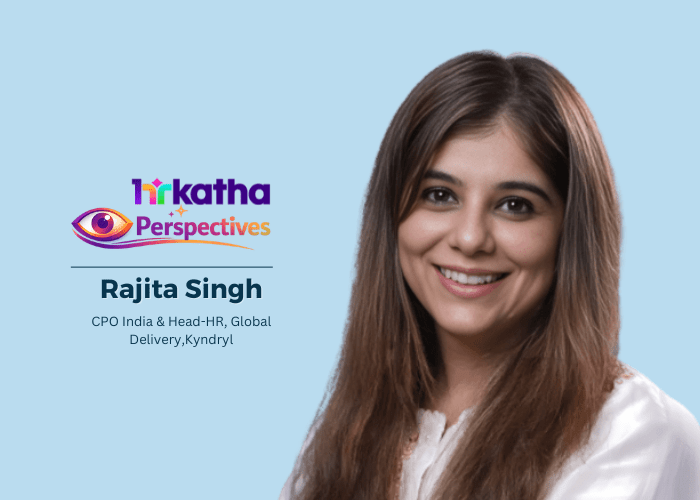
Rajita Singh leads people strategy across India and global delivery. In conversation with HRKatha, she explains why internal mobility needs the same rigour as external hiring, why simplicity has become an underrated part of the employee proposition, and why the HR leader who matters in the next decade will be the one who can connect workforce decisions to revenue, margin and competitive advantage.
The same thinking, applied inward
Organisations routinely say they prefer internal mobility, yet external candidates often appear to have an advantage. What has to change for internal talent to become a genuine first choice rather than an alternative to external hiring?
The challenge is making mobility possible when the skills required for a role have already changed. People may have been doing the same work for years, but the requirements have evolved. So the approach to the work has to evolve too.
Let me give you an analogy. Imagine a five-storey building with stairs to the fifth floor. One approach is to bring someone from outside to advise on where to install a lift. Now consider that most buildings today are not five storeys. They start at ten floors or more. When you think about the lift in that context, you may have to redesign the entire building. How the lift operates and how you achieve efficiency are entirely different.
That fits precisely with how I think about internal mobility: anticipate where the business is heading, take stock of where skills currently sit, reskill deliberately and then redeploy.
Giving internal employees opportunities requires the same kind of thinking as hiring externally. The rigour, intentionality and honest assessment of gaps all have to be the same.
The approach needs to be mixed depending on how the organisation is evolving. But organisations that treat internal mobility as a secondary option, something to be tried before going outside, will always underinvest in the preparation that makes it work.
The HR leader of the future is someone who can connect AI, the business model, workforce strategy and leadership effectiveness.
Business athletes, not training completions
If clients increasingly want to see the people who will actually deliver the work, does that change how you judge whether reskilling investments are working?
The question we start with is not whether a learning investment makes sense. We start with where the business is changing, what new capabilities need to be developed and where to invest accordingly. The value of learning is ultimately reflected in whether we build a workforce that can respond to changing client needs.
Here is what has changed in the industry. When we go for a pitch today, clients do not always want to discuss a proof of concept or how we will solve the business problem first. They say: show me the people who are going to work with me.
They want to meet the delivery team, brainstorm and collaborate before the pitch is even finished, rather than have someone make the sale and then hand the project over for execution.
That shift tells you what capability-building actually needs to produce. It is not training completion rates. It is whether your people can walk into a client room, think on their feet, engage meaningfully and create in real time.
The metaphor I use is the baseball card. On the front is the person’s profile. On the back is what they have actually done and can do. That is what matters. That is what capability-building should be oriented towards.
Workplace design will not be defined by a policy. It will be defined by choice, clarity and community.
Make life simple
When compensation is increasingly transparent and easier to compare, what makes an employee proposition genuinely difficult for competitors to replicate?
I think the question itself is the right starting point: are we listening to what employees actually want rather than assuming we know?
For any organisation to hold people, they need a sense of belonging. They need to trust that the organisation will help them grow alongside it and give them an opportunity to make a meaningful difference.
But the element I would place highest, and which organisations consistently underestimate, is simplicity. People appreciate simplicity. If there is a ten-step process for something, employees will ask why it cannot be five.
Let me give you an analogy. When I was growing up, my parents told me you could not cut your nails at night. My grandmother had told them the same. When I asked why, she explained that after sunset there was no light and you did not want to hurt yourself.
Today, we have electricity. But many organisations are still operating by rules whose original rationale no longer exists. Processes that complicate life. Onboarding that takes too long. Performance documentation that nobody reads.
Our performance appraisal process is extremely simple. Every person knows where they stand throughout the year. There is nothing to wait until December to find out. That is one of the most meaningful things we offer: clarity about where your career is heading.
Beyond simplicity, flexibility matters in terms of how people can perform and the kind of environment that enables that. Recognition matters through peer acknowledgement, manager recognition and senior visibility, not just formal awards cycles. Meaningful work, career growth and internal opportunity matter enormously too.
People entering the market may prioritise compensation. But the broader ask from employees today is: help me grow, give me access to opportunities, provide flexibility, recognise my contribution and let me work for someone who cares about me.
The element organisations consistently underestimate is simplicity.
Choice, clarity and community
After several years of hybrid work, has the question of how many days people spend in the office become the wrong question?
Three years in, I am less interested in where people are sitting and more interested in whether teams are collaborating effectively, innovating and delivering for clients.
Different roles, teams and client environments have different needs. That is a fact, and flexibility has to accommodate it rather than paper over those differences with a fixed number of office days.
What we have learned is that productivity, collaboration and employee experience do not have to be competing priorities. The right balance depends on the work that needs to be done.
Technology has made distributed work more feasible than ever, but the sense of learning and
belonging still comes through human connection. That is why the manager’s ability to build trust and enable local decision-making remains critical, regardless of where the work happens.
The best outcomes come when leaders are clear about what is expected while giving their teams flexibility in how those outcomes are achieved. Going forward, I do not think workplace design will be defined by a policy. It will be defined by choice, clarity and community.
Community matters because every team develops its own identity and sense of belonging. That is what gives flexibility its meaning. Flexibility without community is just remote work. Flexibility within a team that knows itself, trusts one another and has a shared sense of purpose is something different.
It is whether your people can walk into a client room, think on their feet, engage meaningfully and create in real time.
Understanding how talent creates revenue
What does an HR professional need to understand about the economics of a technology-services business before they can genuinely influence it?
I would say there are five things that matter enormously and are not as common as they should be.
The first is discipline. Whatever you take on, see it through. People get distracted quickly, and the temptation to use AI to shortcut completion is real. That is fine up to a point, but the ability to finish something in totality is becoming rarer and more valuable.
The second is respect. We operate in a multi-generational workforce, and it is easy to take experience for granted or dismiss a new idea because of who it comes from. Both the experience of someone who has seen something before and the instinct of someone entering the field for the first time deserve genuine engagement.
The third is the ability to synthesise. I use AI extensively, not just for routine tasks but for brainstorming, generating insight and validation. The difference between HR professionals who use it well and those who do not is not the tool. It is whether they understand the insight rather than simply reproduce the output.
The fourth is creation. Engagement surveys are important, but the question is whether HR is building something that makes people say this function is actually adding value to the conversation. Otherwise, the work HR does can be replaced by a workflow tool or a chatbot.
The fifth, and the one I think about most, is that very few people in HR understand how talent creates revenue, margin, growth and competitive advantage.
Which talent segments are driving growth internally and externally? How much work can AI realistically absorb within the current setup? Which leaders produce the best commercial outcomes, and why? How do you reskill faster than your competitors.
The HR leader who will matter in the next decade is the one who can connect workforce decisions to the business model, understand where AI changes the calculus and make those connections visible to the people who run the business.
That is not a soft capability. It is a commercial one.
Giving internal employees opportunities requires the same kind of thinking as hiring externally.