


Collecting employee feedback has become relatively easy. The more difficult question is what happens after somebody speaks up.
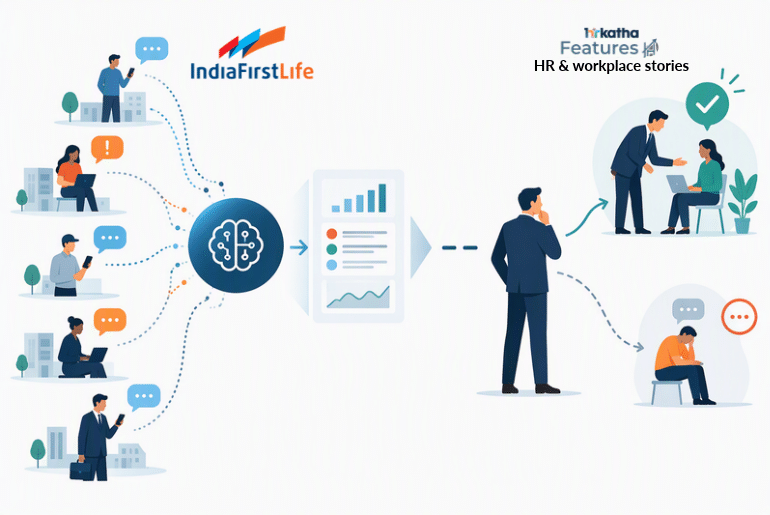
At IndiaFirst Life, an AI-enabled engagement system follows up with employees 15 days after they raise a workplace concern, asking whether the issue has been resolved. The mechanism introduces an element of accountability into a process that can otherwise end once feedback has been collected.
“An AI system can surface concerns across a dispersed workforce, identify patterns in employee sentiment and make information accessible to leaders,” says Sunder Natarajan, chief human resources officer. “It cannot, by itself, ensure that a manager intervenes, a grievance is resolved or an employee feels safe enough to speak again.”
That distinction shapes IndiaFirst Life’s approach to AI. Technology can make problems visible across a large organisation. Responding to them remains a management responsibility.
Scale created the listening problem
IndiaFirst Life has nearly 5,000 employees, around 82 per cent of whom work in sales. Over two years, its branch network expanded from 28 to more than 100 locations.
The workforce also includes operations staff, security personnel, housekeeping employees and corporate functions. Maintaining regular contact with employees across such a dispersed network becomes more complicated as the organisation grows.
The AI-enabled feedback system provides one way of narrowing that distance. Leaders can examine employee sentiment at the team level. Natarajan says that when visiting a city without time for a detailed briefing, he can review feedback from the local team before arriving.
“An AI system can surface concerns across a dispersed workforce, identify patterns in employee sentiment and make information accessible to leaders. It cannot, by itself, ensure that a manager intervenes, a grievance is resolved or an employee feels safe enough to speak again.”
Sunder Natarajan, CHRO, IndiaFirst Life

The rollout produced an unexpected operational lesson.
Initially, employees accessed the system through a corporate messaging platform. Participation was limited. When IndiaFirst Life moved access to WhatsApp, responses increased sharply.
That solved one problem and created another. The HR business partnering team found itself managing a much larger volume of feedback than before. Additional capacity-building was needed to handle the increase.
It illustrates a consequence of making employee feedback more accessible. The easier it becomes to speak, the more the organisation must be prepared to listen and act. Higher participation is not necessarily the same as a better listening system. It may simply mean that more concerns are now visible.
Natarajan has also used the system to seek direct employee views on subjects such as performance management, allowing responses to reach leadership without being filtered through reporting managers.
Not every suggestion can be implemented. Employee expectations still have to be considered alongside business requirements. But the organisation now has another way of understanding where those expectations differ.
Apprehension one level below
IndiaFirst Life is encountering another challenge in its adoption of AI: enthusiasm is not evenly distributed through the hierarchy.
Natarajan describes his direct reports as enthusiastic about the technology. Employees one or two levels below them, he acknowledges, may be less informed about its implications or more apprehensive about how it could affect their roles.
The company is responding through practical exposure.
Sales training includes AI-enabled role-play simulations, allowing employees to practise conversations rather than simply attend sessions explaining the technology. Managers are expected to use AI tools themselves before introducing them to their teams.
The intention is to make AI part of actual work rather than something employees encounter only through announcements and training presentations.
Natarajan also says IndiaFirst Life does not intend to dismiss employees simply because AI makes their roles redundant. The preference is to educate and redeploy people into other responsibilities.
That position is relevant because employees are being asked to adopt technology that could change the nature of their jobs. The organisation is attempting to connect AI adoption with capability development rather than treating the two as separate exercises.
As AI becomes more deeply embedded in everyday processes, redeployment and reskilling will become increasingly important parts of that approach.
Making culture visible across branches
AI-enabled listening is part of a wider effort to maintain organisational consistency as IndiaFirst Life expands.
The company’s HDFC project, now in its third iteration, brings second-level leaders from different functions together to examine employee feedback and identify priorities for action.
The inputs come from three sources: Workplace Ranking scores, insights from its employee-feedback system and internally developed Milap, an initiative through which leaders visit branches and gather feedback directly from employees.
The exercise produces four or five broad areas for action, ranging from workplace facilities to product propositions and customer acquisition.
That breadth is relevant. Employee feedback is not confined to conventional HR subjects. Some concerns require decisions by business leaders and other functions.
Bringing those leaders into the process is intended to create broader ownership of the resulting actions.
IndiaFirst Life has also defined ten behavioural rituals intended to make its culture more consistent across locations. These include encouraging direct conversations rather than excessive email exchanges and placing collective outcomes ahead of individual interests in decisions about recognition and rewards.
For an organisation whose branch network has more than tripled in two years, the challenge is to maintain a shared understanding of how the company operates while recognising that employee experiences can differ considerably between locations.
Career movement as a retention lever
Listening to employees is one part of the engagement equation. Giving them reasons to see a future in the organisation is another.
IndiaFirst Life uses a process called Career Kundali to map employee aspirations against the competencies required for different roles and identify opportunities for development and cross-functional movement.
Natarajan makes an observation about employees who have spent many years in an organisation. Experience can make them increasingly productive, but it does not automatically keep their careers moving.
Someone who has spent a decade in a role may understand the business exceptionally well while finding that opportunities for further growth have narrowed.
Career mapping is intended to make those possibilities more visible rather than assuming that tenure itself will produce progression.
The company’s Lead First programme works with first-time and next-level managers over an extended period, using technology-enabled nudges to reinforce learning beyond individual workshops.
Manager capability connects several strands of IndiaFirst Life’s people strategy. Managers are expected to respond to employee concerns, support career development, help teams adopt AI and maintain engagement across a largely sales-driven workforce.
The technology can support each of those responsibilities. It cannot perform them on the manager’s behalf.
The productivity question
Natarajan’s broader observation about AI brings the discussion back to leadership.
“It is the organisational will and leadership which will make a big difference on what prevails,” he says.
AI can help employees complete tasks more efficiently and allow organisations to operate at greater scale. But productivity gains also create choices about how the time and capacity released by technology will be used.
They can create room for more valuable work, better customer engagement and employee development. They can also result in higher expectations without corresponding changes in how work is organised.
For IndiaFirst Life, that makes AI adoption as much a managerial question as a technological one.
The same applies to employee listening.
The feedback system can collect concerns from a workforce spread across more than 100 locations, identify patterns and put information before leaders. The move to WhatsApp has made that process more accessible, while the resulting increase in feedback has shown that HR needs the capacity to respond.
The 15-day follow-up introduces another step. It asks employees whether anything has changed since they first raised a concern.
That does not guarantee resolution. Nor does it mean every issue can be settled within a fortnight.
But it shifts attention from what employees are saying to what the organisation has done with what it heard.
For a rapidly expanding insurer, that may be the more consequential part of AI-enabled engagement.