


Company: Halcroft Partners (fictitious), a global management consulting firm with 4,200 employees, advising clients across financial services, infrastructure and the public sector in Asia, Europe and the Middle East.
Background
Sunita Nair and Rohit Desai had both been with Halcroft Partners for seven years. Both were principal consultants, with strong performance records, comparable client portfolios and similar internal ratings across the previous three review cycles.
When a senior director position opened in the firm’s infrastructure practice, both were shortlisted.
The selection process lasted six weeks. A panel comprising the practice head, two senior partners and an external facilitator assessed both candidates through presentations and interviews covering client leadership, stakeholder management and strategic thinking.
Rohit was promoted.
Sunita learnt of the decision in a brief meeting with her manager. She was told the panel believed Rohit demonstrated stronger ‘leadership presence’ and ‘stakeholder confidence’.
When she asked what those terms meant and how they had been assessed, her manager explained that the panel had exercised holistic judgement.
Sunita filed a formal complaint the following week, alleging gender bias.
Three days later, the complaint reached the CHRO, accompanied by a note from the practice head. The decision, he maintained, was sound. The panel was experienced, and qualitative leadership criteria were entirely legitimate for a role at this level.
The difficulty was that those criteria had not been formally defined before the assessment, and the panel had provided no specific evidence explaining the difference between the candidates.
HR now had to decide whether the problem lay in the promotion decision itself, the process used to reach it, or simply the way it had been communicated.
The dilemma
Should HR uphold the promotion, accepting that senior leadership decisions require qualitative judgement and that there is no established evidence of gender bias?
Or should it reopen the process with clearly defined criteria, recognising that the original assessment may have lacked sufficient transparency even if the outcome was legitimate?
And if neither approach is satisfactory, should HR first require the panel to substantiate its judgement, examine whether the same criteria were applied consistently to both candidates, and decide whether the original outcome can withstand scrutiny?
What’s really at stake
This is a question about how far organisations can rely on subjective judgement when making decisions that shape careers.
At senior levels, performance alone rarely determines promotion. Leadership maturity, stakeholder influence and the ability to inspire confidence can legitimately distinguish candidates with otherwise comparable records. Experienced panels are expected to exercise judgement about qualities that cannot always be reduced to numerical scores.
Halcroft therefore has a reasonable argument for defending the panel’s discretion.
But discretion is not the same as an absence of accountability.
If ‘leadership presence’ influenced the decision, the panel should be able to explain what it meant, what it observed and why Rohit demonstrated it more convincingly than Sunita. The absence of a numerical measure does not make an assessment invalid. The inability to explain the assessment makes it difficult to defend.
There is also a distinction between a process that was poorly documented and one that was discriminatory. Sunita’s complaint raises the possibility of gender bias, but the available facts do not establish it. Equally, the absence of direct evidence does not automatically demonstrate that the decision was fair.
That leaves HR with a difficult responsibility. Reopening a promotion whenever an unsuccessful candidate challenges the outcome could undermine the authority of selection panels. But defending a decision solely because an experienced panel made it could leave legitimate concerns unexamined.
The consequences extend beyond Sunita and Rohit. If employees believe that promotion decisions ultimately depend on qualities that are neither clearly understood nor consistently assessed, confidence in the organisation’s career processes may weaken.
The challenge is to preserve legitimate leadership judgement while ensuring that such judgement can be explained and tested.
The deeper question is whether a decision can be considered fair simply because no one can prove that it was unfair.
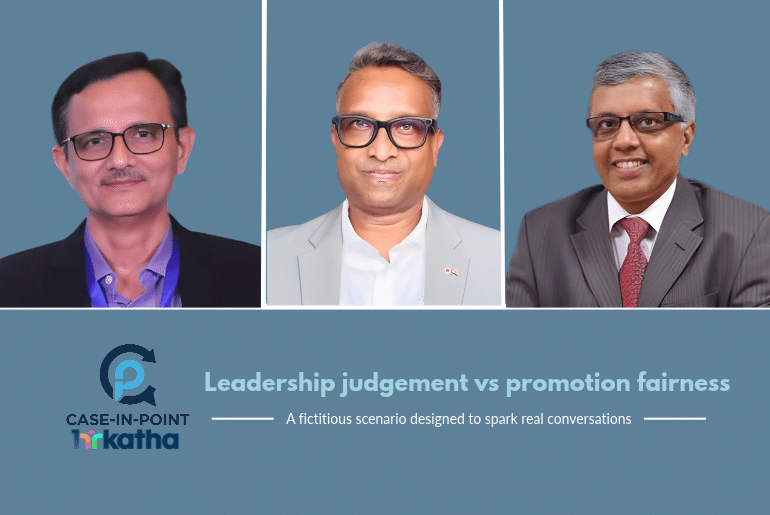
We asked three HR leaders how they would approach this dilemma.
What HR leaders said
Rajorshi Ganguli, president and global head, HR, Alkem Laboratories
“What is really at stake here is not whether ‘leadership presence’ is a legitimate differentiator, but whether it was defined, evidenced and applied consistently.

At senior levels, performance alone may not capture the full picture. Leadership maturity, stakeholder influence and the ability to lead at scale can all legitimately inform a promotion decision. However, when such criteria are undefined and introduced only after the decision has been made, they create room for unconscious bias and weaken the credibility of the process.
HR’s role is not to eliminate managerial judgement. It is to ensure that such judgement is transparent, evidence-based and consistently applied. If ‘stakeholder confidence’ is being used to distinguish between two candidates with comparable performance records, the organisation should be able to explain what that means, what evidence supports the assessment and whether the same yardstick was applied to both candidates.
Fairness does not mean removing judgement from leadership decisions. It means ensuring that the judgement can stand up to scrutiny.”
Satish Mohapatra, EVP, HR, Maruti Suzuki India
“Gender bias is not always a myth. In my career, I have seen gender bias, mostly in unconscious ways, present in people, certain roles and certain locations. It is almost pre-programmed into the frameworks we use, the belief that certain roles require a strong male candidate who can control, drive results or be more reliable in terms of reserve.
That said, I would not want to generalise it to every situation.

In this case, I would first want to speak to the panellists, particularly the hiring manager, to understand what they were looking for, what they got from the two candidates and how each performed. Process transparency cannot become an end in itself. At the end of the day, we have to make the right business decision.
For a senior position in a consulting firm, if stakeholder management is genuinely critical to the role and two candidates are otherwise equal, the organisation may choose the person who appears stronger on that dimension. What matters is whether the decision-makers can articulate why those qualities were essential and how the two candidates differed on them.
As long as there is no disconnect between what the role requires and the reasons given for the decision, I would leave the final choice to the people making it. HR cannot run the world through processes.
At the same time, I have personally been part of discussions where, when two candidates were broadly equal, we chose a woman because the percentage of women in leadership was low. Both realities can exist.
I would not intervene in this case unless it becomes clear that gender bias, rather than other legitimate factors, drove the decision. The fundamental question should be whether the organisation selected the right person between the two, regardless of gender.”
Ramesh Shankar, senior HR leader
“In a senior position, promotions are based on potential more than performance.
Performance is generally assumed to be satisfactory at that level because both candidates would not have reached the final stage otherwise. What organisations are really assessing is potential, how the person is likely to demonstrate leadership qualities at a senior level.
Gender should not be a criterion for promotion. There have been organisations that have promoted diversity very aggressively in recent years. Promoting someone simply because of their gender is not the right approach either.
In this case, both candidates have clearly performed well, otherwise they would not have been considered. Whether assessed through an assessment centre, interviews or another process, there should have been a defined set of criteria applied equally to everyone

If the process has been properly defined and the criteria have been established and applied consistently, HR has no business reviewing the case simply because one candidate was not promoted.
If I trust the process, I would trust the panel as well. The interview panel should comprise people expected to be objective and fair. Once all candidates have been evaluated on the same parameters, the panel’s recommendation should be respected.
Diversity is absolutely critical for organisations, whether in terms of gender, age, nationality or other dimensions. It brings diversity of thinking and diversity in decision-making. But promoting someone simply because they belong to a particular gender is itself a form of bias.
In this case, I would expect the organisation to stand by the decision if the panel had clearly defined the criteria beforehand and applied them equally to both candidates. A promotion decision cannot be reopened every time an unsuccessful candidate challenges the outcome.”
If you were the CHRO at Halcroft Partners
Sunita has alleged gender bias. The panel stands by its decision, but the criteria distinguishing the two candidates were never formally defined.
What would you do?
- Uphold the promotion, trusting the experienced panel’s judgement unless evidence of bias emerges?
- Reopen the process using clearly defined criteria, accepting that the original assessment lacked sufficient transparency?
- Require the panel to substantiate its judgement and examine whether the criteria were applied consistently before deciding whether the promotion should stand?
Or is the bigger question this:
If a promotion decision cannot be clearly explained, how can an organisation establish that it was fair?
Share your perspective in the comments or on LinkedIn using #HRKathaCaseInPoint.