



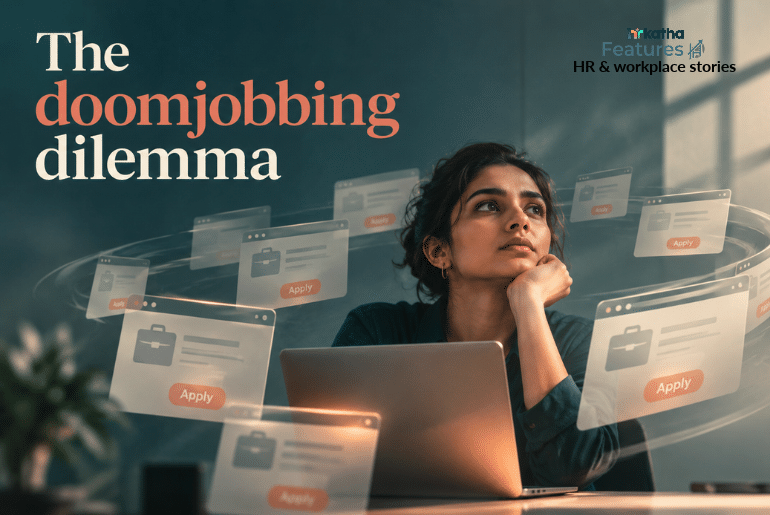
Lunch break, phone in hand, a scroll through vacancies. Another application goes out before bed. Sometimes a recruiter replies and the candidate disappears halfway through the process. The application has served its purpose long before an offer arrives.
Call it doomjobbing. The term borrows from doomscrolling, the compulsive consumption of bad news, and describes a similar loop in the job market. Professionals keep applying not because they want to leave but because searching gives them a sense of control. They fear layoffs, falling behind their peers, missing something better. A career decision becomes a way of managing uncertainty.
Some of those doing it are unhappy at work. Others are content but anxious about what comes next. The impulse to keep looking does not always come from a wish to move. Often it comes from dread of being unprepared if a move is forced.
The friction has gone
Technology removed the cost. AI-drafted CVs, one-click applications and algorithmic alerts let professionals apply to dozens of roles in minutes. A process that once meant researching an employer and tailoring an application now takes a few taps. People respond to notifications instead of asking whether a role fits their ambitions. Each submission brings a brief sense of preparedness, which lasts until rejection, silence or the next batch of alerts restarts the cycle.
The activity looks like career management. It rarely produces career progress.
Boredom or fear
Anju Jumde, Heaf-HR of Aditya Birla Money, doubts that insecurity is always the driver. In her experience, boredom is just as powerful.
“It’s not about job security, but it is about boredom. People don’t enjoy doing what they are doing, so they will keep looking for different jobs which can give them that dopamine.”
“It’s not about job security, but it is about boredom. People don’t enjoy doing what they are doing, so they will keep looking for different jobs which can give them that dopamine.”
Anju Jumde, CHRO, Aditya Birla Money

She sees the pattern in her own company, where employees apply for several internal vacancies whether or not the roles suit them. Recruiters sift through irrelevant applications while candidates collect rejections.
“It leads to fatigue on both sides,” Jumde explains. “Candidates keep getting rejected while recruiters spend unnecessary time sorting through irrelevant applications. Eventually, genuine talent risks getting missed because of the sheer volume of unsuitable applications.”
The motivations differ but the behaviour is identical, and the cures differ too. A bored employee needs a harder assignment or an internal move. A worried one needs clarity about the organisation’s future and her place in it. Treating every application as disengagement misses what is driving the search. No survey separates the two groups; the evidence so far is what HR leaders see from their desks.
Busy is not safe
Jumde links the anxiety to the pressure to stay employable as technology changes the nature of work.
“With AI coming, most people need to start reskilling. I don’t think they’re getting reskilled.
They’re only fearing job loss,” she says. “The jobs are not going to disappear. New jobs will emerge. If employees focus on upskilling and reskilling, they don’t have to keep looking for jobs out of fear. Even within their current organisations, they can move into better roles.”
It is a confident forecast, and employees whose tasks are exposed to automation will not all share it. New jobs do not appear in the same places, demand the same skills or pay the same rewards. The transition hurts even when the labour market as a whole keeps creating work.
Her larger point stands. Applying gives an immediate sense of action. Learning a skill demands sustained effort with no guaranteed return. A professional can send fifty applications in a month and be no more valuable at the end of it. One who spends that time building a relevant capability is better placed when an opening arrives.
The cost to employers
For employers, the worry is who is doing the applying. Praveen Purohit, CHRO of Vedanta Aluminium, Ports & Power, singles out high performers.
“When high-potential employees start forcing themselves into this kind of engagement because of insecurity and anxiety, it is not desirable,” he says. “Sometimes they accept opportunities without evaluating them properly simply because they want to move out of uncertainty.”
“When high-potential employees start forcing themselves into this kind of engagement because of insecurity and anxiety, it is not desirable.”
Praveen Purohit, CHRO, Vedanta Aluminium, Ports, Mines & Power,

The risk is capable people moving early, not because the company failed them but because uncertainty makes staying feel less safe than leaving. “The high-quality people move faster.
That is not good for the company,” Purohit observes. Standard engagement measures miss this. An employee can hit targets and look committed while quietly testing the market, and a manager has little to address when the anxiety concerns future relevance, not present conditions.
Purohit’s remedy is communication. “Companies need regular town halls and conversations that explain the positive story of the business. High performers need confidence that the organisation is committed to their growth and that they should focus on their work instead of getting distracted by insecurity.”
Town halls help when staff are decoding restructuring or automation. But they explain where the business is going without showing an anxious employee where she fits. Reassurance turns credible only when it comes with visible routes to growth.
A confidence problem
Rajesh Jain, group chief people officer at Vishvaraj Environment, sees the behaviour as part of a wider anxiety about relevance.
“People today are not just worried about whether they have a job; they’re worried about whether they’ll continue to stay relevant in a rapidly changing world of work,” he says.
“People today are not just worried about whether they have a job; they’re worried about whether they’ll continue to stay relevant in a rapidly changing world of work.”
Rajesh Jain, CPO, Vishvaraj Environment

“When organisations actively invest in learning, internal career mobility and transparent communication, employees begin to see a future within the company instead of constantly searching for one outside it.”
Job security and career confidence are different things. A company can offer stability in a person’s current role and give no view of what comes next. External applications become a way of testing that gap. A recruiter’s reply is evidence the market still values her experience. An interview invitation proves alternatives exist. Even if no move follows, the process restores a sense of control over a career that otherwise depends on decisions made elsewhere.
Jain’s fix is to make progression tangible. “Growth conversations matter more than ever. If employees understand how they can evolve, acquire new skills and contribute meaningfully, they are less likely to apply impulsively to roles that don’t truly align with their aspirations.”
That exposes a weakness in how companies manage talent. They spend heavily on employer branding to convince outsiders that attractive careers await. Their own staff often cannot say what their next role could be. Internal mobility schemes exist on paper, but employees don’t know which roles they could pursue, what skills they need or whether their managers would back a move. When the internal career market is opaque, the external one wins because it is visible.
Higher pay will not calm a fear of obsolescence, and engagement events do little for someone who feels stuck. Regular growth conversations, real internal moves, relevant learning and managers who raise the future before employees start looking will do more.
Employees have their own part to play. Fifty applications feel like taking charge. A new capability, a stretch assignment or an honest talk about prospects does more for employability than another evening with the job alerts.
Employers usually ask how to stop people leaving. Doomjobbing poses a harder question: why do employees who haven’t left already behave as if they have?