


AI is taking some of the drudgery out of work, but it is also changing what organisations consider good performance. Tasks that once took hours can now be completed in minutes, research can be accelerated and presentations can be built with a few prompts. Yet as these efficiencies become part of everyday work, an important question emerges: will employees gain more time to think, learn and create, or will organisations simply expect them to deliver more within the same working hours?
The distinction matters because productivity and the quality of work are not necessarily the same thing. An employee may complete a task faster without producing a better outcome. Equally, the time saved could be invested in deeper analysis, stronger judgement and more meaningful contributions. Whether AI improves the employee experience or simply raises the performance bar will depend on how organisations interpret and use these gains.
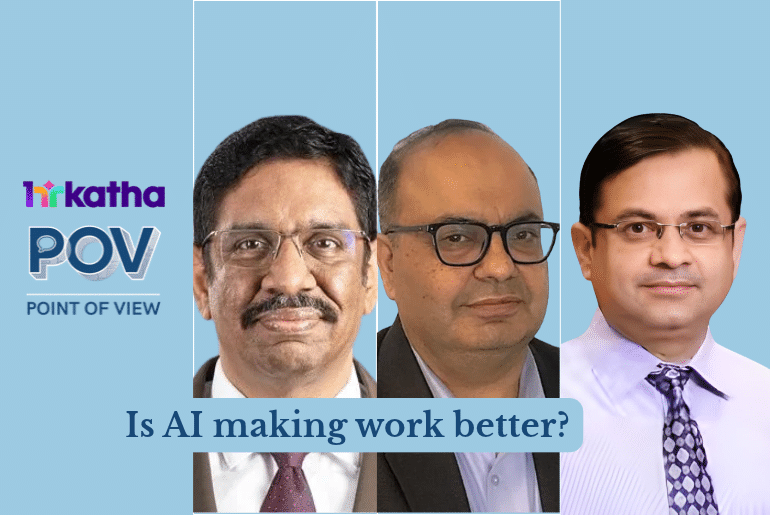
Three HR leaders offer their perspectives on what AI-enabled productivity should mean for employees.
Sunder Natarajan, chief human resources officer, IndiaFirst Life
Both outcomes are possible, and leadership intent decides which one employees get.

AI can make work better for employees, but it can also lead to higher productivity expectations. What makes the difference is the organisation’s intent and, more importantly, its leadership.
Organisations that are proactive, listen to employees, understand what is happening on the ground and respond to what they hear can make a strong case for using AI to improve both productivity and the overall employee experience. The important thing is to listen to the room, so to speak. Leaders need to understand how employees are experiencing these changes, what is working for them and where they are struggling, rather than simply introduce technology and expect people to adapt.
When employees see AI helping them work better, giving them more room to contribute and making their jobs easier, organisations have an opportunity to build a positive narrative around productivity. But if leaders do not pay attention to employee sentiment and simply keep raising expectations, those same productivity gains can become a source of resentment.
AI itself will not determine whether work becomes better or more demanding. Organisations and their leaders must decide how they want to use it and what kind of workplace they want to create.
Takeaway: AI’s impact on employee experience depends as much on leadership intent as on technological capability; organisations that listen and respond can turn productivity gains into better work rather than a reason to demand more.
Deepak Arora, vice president and head-L&D, HR technology and transformation, Birlasoft
Better, when employees use the time saved to think harder and question what AI produces.
Over the past one or two years, the way employees use AI has evolved significantly. Initially, people used it to write emails, improve presentations and complete routine tasks. There were also concerns that growing dependence on these tools could reduce cognitive ability.
However, conversations with team members revealed a different development. Employees began bringing presentations created using AI, and we questioned them about the thinking behind their work. This encouraged them to revisit their outputs, analyse them more deeply and consider what could be improved.
They had already used AI to prepare presentations or conduct research, but the time saved allowed them to go beyond the first output. They could add context from their experience, challenge what AI had generated and bring a more considered perspective. At the team level, the quality of inputs has improved because people have more time to think at a higher level.

At the same time, roles and expectations are evolving. For freshers, the expectation is shifting from being AI-fluent to becoming AI-native. A developer may now be expected to generate code using an AI tool, but generating code is only one part of the job. Equally important is the ability to validate and scrutinise the output and contextualise it to the industry or domain being served.
Even graduates who have used AI in college will find that expectations in an industry environment are different, and organisations must support them in adapting. The same shift is under way for project managers, programme managers and sales professionals.
L&D leaders therefore have a clear responsibility to enable this transition across the organisation, including at senior leadership level. These are exciting times for the function because there is work to be done across the agendas of every CXO.
Takeaway: The real opportunity is to move employees from using AI merely to finish tasks faster to using it to think more critically, which requires reskilling and the judgement to validate and contextualise AI-generated outputs.
Praveen Purohit, chief human resources officer, Vedanta Aluminium, Power, Port & Mines
AI helps people become better at what they do, not simply busier.
AI is making life more comfortable and productive for people. It helps employees become faster, smarter and more productive, which matters in a dynamic business environment where speed is essential. If you are not fast enough, you risk missing out.
I am passionate about AI myself and have explored how it can support HR across the entire value chain. Whether it is thinking through an idea, developing a concept, conducting research or bringing an initiative to life, AI makes these processes more seamless. It also provides access to qualitative insights that would otherwise require considerable time and effort to gather.

The laptop was once described as a window to the world. AI offers a similar support system, providing access to knowledge and information from across the globe.
This is not simply technology making people work more. It is technology helping them become better at what they do. When information and solutions are readily available, employees have more room to think, explore possibilities and develop better solutions for their work and their businesses.
UPI offers a useful comparison. Earlier, people struggled with carrying cash, exchanging money and finding change. Today, a transaction takes seconds. It has not made us transact more; it has made the process easier. AI can have a similar impact on work. You provide the right prompt, and you have a solution in front of you. The opportunity is to treat that solution as a starting point and think about how to make it even better.
We are still at the tip of the iceberg, and the deeper we go, the more innovative applications we will discover. Healthcare, for instance, offers considerable potential, including ways for doctors in distant locations to support patients more conveniently.
Takeaway: AI should be viewed as an enabler of better thinking and outcomes, not simply a mechanism for increasing output; the productivity gains it creates can give employees more space to explore, innovate and develop meaningful solutions.