


Around 80-90 per cent of organisations say they are confident about their succession plans. Stress-test that confidence with the sudden departure of one or two critical leaders, however, and it often begins to unravel.
That gap between paper readiness and real readiness framed a recent HRKatha Futurecast discussion, held in association with People Business Consulting, where senior HR leaders from banking, insurance and financial services examined “The Future of Succession in BFSI: Governance, Leadership Development and Future Readiness.”
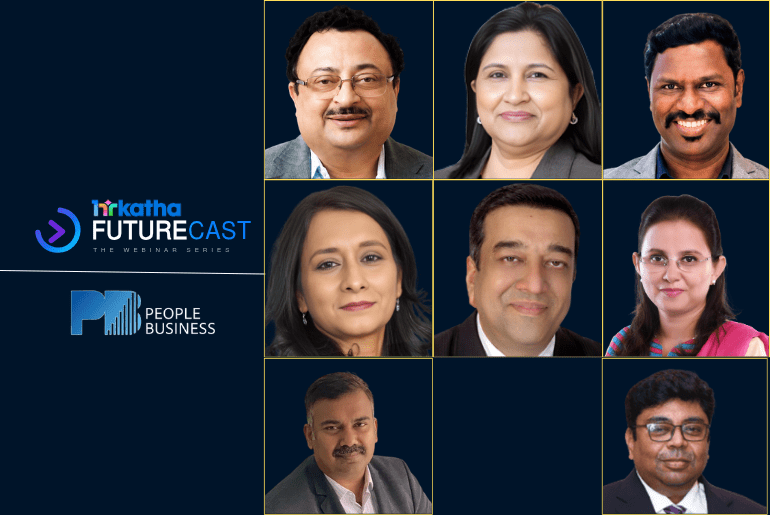
Prajjal Saha, founder and editor of HRKatha, opened the discussion, which was moderated by Dr Sandeep Krishnan, CEO and partner at People Business Consulting. The panel included Pallab Mukherji, CPO, Equitas Small Finance Bank; Priti Singh, CPO, Universal Sompo General Insurance; Saba Adil, CHRO, Edelweiss Life Insurance; Atul Mathur, EVP-HR, Aditya Birla Capital; Jeeva Balakrishnan, CHRO, Cholamandalam Investment & Finance; Anju Jumde, CHRO, Aditya Birla Money; and Kartik Kesarker, director, People Business Consulting.
“Most organisations will tell you they have a succession plan. Far fewer can tell you with real confidence that it works. A plan can sit unused for years before an unexpected exit tests it. In BFSI, where boards, regulators, investors and customers all have a stake in leadership continuity, the consequences of discovering its weaknesses too late can be considerable,” Saha said.
Confidence on paper, uncertainty in practice
Research presented by People Business Consulting during the session exposed how thin that confidence can be. Succession benches are often built for yesterday’s business rather than tomorrow’s. AI, digital technology, cybersecurity and new business models are reshaping roles faster than organisations can redraw the skills mapped against them.
The research also surfaced an internal-promotion paradox. Succession candidates are discussed in talent reviews, yet only around one-third of roles eventually get filled internally. If organisations spend years identifying and developing successors but turn outside when a vacancy actually arises, how much confidence do they really have in the benches they have built?
“While organisations may have the succession planning framework and process in place, the real question is whether we trust people to take up those roles when it comes to the rubber hitting the road. That is the important part.”
Dr Sandeep Krishnan, CEO, People Business Consulting
Data, too, plays an uneven role. “While some organisations use data in a structured manner, many continue to rely heavily on managerial judgement and fragmented information,” Kesarker said. The risk becomes greater in organisations where senior leaders have worked together for years and assume familiarity with people is the same as objective knowledge of their potential.
“While some organisations use data in a structured manner, many continue to rely heavily on managerial judgement and fragmented information.”
Kartik Kesarkar, director, People Business
Readiness itself remains a weak link. Only around 40 per cent of organisations surveyed had structured learning journeys tailored to both the target role and the individual, while success profiles for critical positions were often only partially defined.
For Krishnan, the real measure of succession depth is therefore not how many names appear on a chart. It is how little disruption occurs when leadership changes. “While organisations may have the succession planning framework and process in place, the real question is whether we trust people to take up those roles when it comes to the rubber hitting the road. That is the important part,” he added.
Succession is no longer replacement planning
These gaps point to a more fundamental change in what succession planning is expected to accomplish.
“Succession planning should not be viewed merely as a regulatory requirement,” Mukherji said. Regulators expect organisations to demonstrate preparedness at board and senior-management level, but businesses have always needed succession depth across a much wider set of critical positions. A market-risk or taxation leader, for instance, may sit outside the formal senior-management category and still be indispensable to business continuity.
“Succession planning should not be viewed merely as a regulatory requirement. Regulators expect organisations to demonstrate preparedness at board and senior-management level, but businesses have always needed succession depth across a much wider set of critical positions.”
Pallab Mukherji, CHRO, Equitas Small Finance Bank
Mathur argued that this requires a change in mindset. “Succession planning is no longer a replacement planning piece,” he said. Regulation, technology and business models are changing simultaneously, which means tomorrow’s leader may not be the person traditionally regarded as next in line. What matters increasingly is learning agility, adaptability and exposure to different business situations.
“The flavour of succession planning is changing drastically,” Mathur said. The question is shifting from who can replicate what an incumbent leader does today to who can prepare the organisation for what comes next.
That changes the definition of leadership potential as well. Adil argued that succession decisions need to look beyond current performance and examine whether leaders possess the capabilities an uncertain business environment will demand.
“Succession planning is no longer a replacement planning piece. What matters increasingly is learning agility, adaptability and exposure to different business situations.”
Atul Matur, EVP-HR, Aditya Birla Capital
“Succession planning is a lot about potential. Performance is one aspect of it,” she said. Someone being considered for a more complex role may have performed exceptionally well at the current level, but the organisation has not yet seen that person operate at the complexity of the next one. Cross-functional projects and stretch assignments therefore become more than development exercises; they are ways of testing potential before the stakes become real.
Build first, buy when necessary
That raises one of succession planning’s oldest questions: should organisations build their future leaders or buy them from outside?
“Succession planning is a lot about potential. Performance is one aspect of it. Cross-functional projects and stretch assignments therefore become more than development exercises; they are ways of testing potential before the stakes become real.”
Saba Adil, CHRO, Edelweiss Tokio Life Insurance
Balakrishnan made the case for building internally, pointing to the value of giving leaders multiple functional and geographical experiences. At Cholamandalam, several senior leaders have grown within the organisation by moving through different roles, accumulating breadth alongside experience.
Singh also favoured internal development, while acknowledging that external hiring becomes necessary when the internal pipeline is too shallow or the organisation needs capabilities it does not possess. She cited DBS Bank and ICICI Group as examples where leadership development and succession are treated as long-term strategic processes. Deliberately rotating leaders across businesses and giving them enterprise-wide exposure creates a deeper pool from which future leadership can emerge.
“If the BFSI sector is not really investing in developing some of the new-age skills that are coming up, such as digital and AI fluency, or regulatory agility, then we’ll have to look at buying the talent,”
Priti Singh, CPO, Universal Sompo General Insurance
The complication is that what counts as “future-ready” keeps changing. BFSI leaders need digital and AI fluency, regulatory agility and the ability to operate across businesses. Consistent performance within a single function may no longer be enough to establish someone as a high-potential leader.
“If the BFSI sector is not really investing in developing some of the new-age skills that are coming up, such as digital and AI fluency, or regulatory agility, then we’ll have to look at buying the talent,” Singh said.
Seen this way, external hiring is not necessarily evidence that succession planning has failed. Sometimes it is precisely what a good succession strategy should reveal: that the organisation needs a capability it cannot yet produce internally.
Suuming it up, Krishnan also added, “There needs to be a strong focus on building future skills and preparing for disruption. The real test of succession depth is whether there is minimal disruption when leadership changes happen.”
The success profile matters
Before deciding who should succeed, organisations first need to know what success in the future role will actually look like.
“We identify who is ready now, who is ready in one to two years and who is ready in three to five years. Each of these cohorts goes through different development interventions through education, experience and exposure.”
Anju Jumde, CHRO, Aditya Birla Money
Adil argued that success profiles need to capture both the outcomes expected from a role and the capabilities required to deliver them. “A success profile is very much important in terms of the leadership metrics that are there in terms of cultural fit,” she said. That means understanding what the role needs to accomplish, the leadership capabilities it requires and how the individual occupying it will influence the organisation’s culture.
Such profiles can move succession decisions away from instinct and familiarity. Once an organisation defines success clearly, candidates can be assessed against specific capabilities and given the experiences needed to close the gaps.
That becomes particularly important as BFSI roles evolve. A cybersecurity leader today has a considerably broader remit than someone holding the same title three or four years ago.
Operations leaders are expected to deliver greater scale with leaner teams and more technology. The title may survive while the job underneath it changes substantially.
As Mukherji put it, the real challenge is not deciding whether succession should be planned three or five years ahead. It is predicting what skills the organisation will require when it gets there.
Should successors know they are successors?
The discussion also challenged another assumption: that employees must always be told they are part of a succession pipeline.
“Succession is not about who built or lived the past; it is about who can reimagine the business and build the organisation for the next decade. That is why we invest in building leaders with exposure to different functions and geographies.”
Jeeva Balakrishnan, CHRO, Cholamadalam Investment & Finance
Balakrishnan argued for a more democratised approach, where organisations build capabilities broadly instead of creating a small, exclusive club of “high potentials”. Employees should have opportunities to take on different roles and develop new capabilities, while organisational needs and individual aspirations eventually determine the match.
Jumde described a more structured approach at Aditya Birla Money, where successors are categorised as ready now, ready in one to two years, or ready in three to five years. Each cohort receives different interventions through education, experience and exposure. Yet identification does not amount to entitlement. Positions are still opened up and the best-suited person selected rather than the nominated successor being appointed automatically.
At Equitas Small Finance Bank, aspiration surveys support succession conversations by helping the organisation understand what employees themselves want, Mukherji said. Potential candidates can be mapped to roles while being made aware that they are not the only people under consideration.
It is an important qualification. Succession plans tend to be drawn from the organisation’s point of view, but careers belong to individuals. A meticulously developed succession plan can still fail after years of investment if the chosen employee wants something different, or decides to leave.
From HR agenda to board agenda
Perhaps the clearest shift is in who owns succession.
The panel agreed that succession can no longer operate as an HR process detached from business strategy. It has moved “notches above” as organisations recognise its implications for continuity, talent retention and long-term growth, Adil said.
“Succession planning is one outcome of a very effective talent management and a robust talent process that goes behind it,” she added. The agenda therefore needs the involvement of the chief executive, board and NRC, while HR builds the machinery for identifying critical talent, assessing readiness and creating development opportunities.
At Equitas Small Finance Bank, the chief executive’s own KPIs include a component linked to succession planning and leadership development, with the board and NRC receiving periodic updates, Mukherji said.
“That point of it being an HR conversation is long gone.” As Krishnan also pointed out, “Succession planning is no longer just a CHRO or HR problem. It has become a business imperative, with the board, CEO, regulators, investors and other stakeholders all asking whether the organisation is prepared for leadership continuity.”
Diversity cannot stop at the entry level
The discussion also turned to gender diversity in BFSI leadership, where the numbers expose another succession problem.
Women account for around 40-50 per cent of entry-level talent in parts of the industry, Jumde pointed out, but the pipeline narrows through middle management and narrows further still at CXO level. The challenge, therefore, is not simply to hire more women at the bottom. It is to understand where the pipeline loses them on the way up.
Adil argued that diversity needs to be embedded across the talent-management journey, from recruitment and high-potential programmes through to succession planning. Gender is only one dimension. Organisations also need diversity of age, background, experience and industry exposure.
The real measure is not representation at the point of entry, but whether that representation survives the journey to leadership.
Preparing for roles that do not exist yet
The conversation kept returning to one underlying problem: succession planning cannot be future-ready if it is constructed entirely from the past.
Mathur cited industry immersion and Aditya Birla Group’s “Natural Learning Opportunity” approach, where emerging leaders observe strategic meetings and gain exposure to how decisions are made at senior levels. Adil emphasised building capability cohorts rather than merely counting successors, cultivating adaptability, AI and technology skills, and the ability to respond to changing business conditions across levels.
That may also require looking beyond traditional BFSI talent pools. Specialist capabilities such as underwriting and actuarial expertise will continue to demand industry experience, Adil noted, but newer areas such as AI, data and cybersecurity may require organisations to bring talent in from elsewhere.
For BFSI, then, the future of succession is less about finding the perfect replacement and more about building enough organisational capability that, when disruption arrives, more than one person is capable of stepping up.
A succession plan is only as good as an organisation’s willingness to test it, invest in it and change it as the business changes. The real question is no longer who is next. It is who can lead what comes next.