


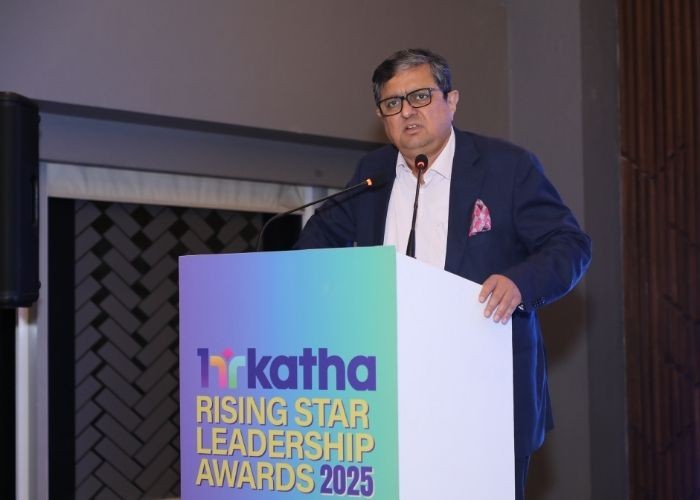
When Sandip Ghose took the stage at HRKatha’s Rising Star Leadership Awards on 31 October, the audience knew they were in for something different. As managing director and CEO of Birla Corporation, Ghose had the rare ability to make you laugh and think simultaneously—often in the same sentence.
His special address at HRKatha Rising Star Leadership Awards and Summit was part stand-up, part strategy session, and entirely a masterclass in how HR evolved from the department nobody wanted to join into the function running some of the world’s most iconic companies.
The joke that became prophecy
Ghose began with a confession wrapped in humour. In the old days, he said, HR became a dumping ground for people who didn’t fit anywhere else. “When someone couldn’t find the right job, they were pushed to HR. Made the HR head!”
He paused for effect, then delivered the punchline: “Now, they’ve gone a step further—they make her the CEO of a perfume company and send her to Chanel!”
The reference to Leena Nair—former CHRO of Unilever, now Global CEO of Chanel—drew applause and laughter. But beneath the wit was a profound observation. HR, once seen as corporate bureaucracy’s back office, is now shaping boardroom agendas and leading global enterprises.
“That shows how much things have changed,” Ghose said, “because the nature of the contract between organisations and people has changed.”
“The modern organisation is a collective intellect.”
Sandip Ghose, MD & CEO, Birla Corps
The asset myth that won’t die
Ghose then took aim at one of corporate life’s most tiresome clichés: “People are our biggest assets.”
It’s a dated notion borrowed from the industrial era, he argued, when human beings were treated as units of labour. Factories needed bodies. Assembly lines needed hands. The language of “human resources” made perfect sense when you were literally managing resources.
But today? “The modern organisation is a collective intellect,”Ghose said.
He pointed to Apple. Beyond its few showrooms, Apple’s true value lies not in physical assets or headcount but in intellectual capital—the creativity and innovation that employees bring. You can’t touch it. You can’t count it on a balance sheet. But it’s what makes Apple worth trillions.
That’s where HR’s transformation becomes most visible. The conversation used to revolve around efficiency—doing things right. Then it moved to effectiveness—doing the right things. “Now,” Ghose said, “it’s about value creation.”
HR today isn’t managing headcount. It’s co-creating business value. Shaping innovation. Nurturing creativity. Aligning human potential with strategic outcomes.
The career promise that expired
In a nostalgic reflection, Ghose recalled his early years at DCM. The promise to young recruits was simple: “We don’t have jobs to offer, only careers.”
That was a time when people aspired to retire from one company. The gold watch. The pension. The loyalty that lasted decades.
Over time, the paradigm shifted. Employees began asking different questions: “What can you offer me today?” The loyalty contract gave way to a value contract.
People no longer wanted just financial rewards. They wanted growth—personal and professional. They wanted to learn. They wanted the value they could gain in return for their time and contribution.
The younger generations have taken this evolution further. “Gen Z isn’t talking about changing three jobs—they’re talking about changing three careers,” Ghose remarked. Career paths today are non-linear, diverse, and driven by purpose and passion rather than stability and status.
The retention heresy
Here’s where Ghose said something that would have been corporate blasphemy a decade ago: retention is not an unqualified virtue.
Organisations must accept that people will move on. And that’s not just okay—it’s healthy. Renewal through fresh ideas and diverse experiences can strengthen the collective intellect.
“People will stay as long as they feel they’re learning and growing—as long as they see value,” he said. “And that’s fine. Because organisations grow the same way—through renewal and constant churn of intellect.”
The modern workplace is fluid. Companies no longer outsource outcomes; they outsource expertise and processes. In a world defined by speed and constant change, organisations need plug-and-play talent—agile contributors who can align quickly and add value immediately.
Retention is no longer the ultimate metric of HR success. The question isn’t how long people stay. It’s what value they create while they’re there—and what capability they leave behind when they go.
What “winning” actually means
As a jury member for the Rising Star Awards, Ghose shared the evaluation criteria: creativity and innovation, scalability and sustainability, and measurable business impact.
But he was quick to clarify what creativity means. It’s not digitising forms or tweaking existing systems. It’s fundamentally reimagining how HR creates value.
Scalability determines whether an idea can grow beyond a pilot stage to become sustainable practice. And measurable impact? “Not just how many people you hired or retained,”Ghose explained, “but how you’ve improved your organisation’s capability to compete and generate value.”
That’s the shift. From counting heads to building capability. From processing paperwork to powering performance.
When the advisor becomes the pilot
Ghose spoke about how business leaders now routinely take on HR responsibilities—hiring, mentoring, career planning. Meanwhile, HR professionals are becoming deeply involved in strategic and operational decision-making.
That’s why HR today isn’t just a partner. It’s a co-pilot.
“You’re no longer an advisor sitting outside the cockpit—you’re flying alongside,” he said.
This shift demands that HR professionals themselves evolve—pursuing growth not in designations but in depth. In a light-hearted callback to an earlier era, Ghose joked about how promotions used to change titles without changing responsibilities. “Someone would become Vice President, Communications—and you’d find he was actually just a telex operator.”
Today, true growth lies in transformation, not hierarchy. Leaders such as Leena Nair exemplify how HR professionals can transcend advisory roles to become enterprise leaders. From CHRO to Global CEO. From managing people to running a luxury brand.
Lean doesn’t mean less important
Concluding his address, Ghose observed that HR functions are becoming leaner—not because they matter less, but because technology and decentralisation have streamlined operations.
The goal is no longer just to “earn a seat at the table.” That battle has been won. The new challenge is to lead the table—steering organisations toward sustainable growth through human insight and strategic foresight.
“It’s always energising to meet young people buzzing with ideas,” he said, thanking HRKatha for the invitation.
The currency has changed
Ghose’s address, both reflective and forward-looking, left the audience with a message that resonates far beyond HR departments: in a world where business models evolve overnight, the organisations that win will be those that stop counting heads and start creating value.
The currency has changed. It’s no longer about headcount or retention rates or how many policies you’ve implemented. It’s about intellect. Innovation. Impact.
HR isn’t on the periphery anymore, managing administrative tasks and hoping for relevance. It’s in the cockpit, co-piloting the future.
And if you’re still thinking of HR as the place where careers go to die, you’re not paying attention. Because those “misfits”who got dumped into HR? They’re now running Chanel.
The joke, it turns out, was on everyone else.
The HRKatha Leadership Summit and Rising Star Awards ceremony took place on October 31, 2025, at Holiday Inn Aerocity, New Delhi. Nominations were open for two months, with jury evaluation conducted over two weeks by an eleven-member panel. Around 20 CHROs and CEOs participated in discussions on leadership transformation, with support from Thomas Assessments (Presenting Partner) and Ripplehire (Associate Partner).