



When Accenture announced in 2015 it would abolish performance ratings for its 300,000-strong workforce, the corporate world briefly believed performance management had been reinvented. Out with rigid rankings and bell curves. In with meaningful conversations and developmental feedback. The age of human-centred performance management had supposedly arrived.
Nearly a decade later, the revolution looks rather more modest. Accenture still evaluates its people. Adobe still differentiates performance. Microsoft still makes promotion decisions. The ratings may have disappeared from official documentation, but the underlying question remains stubbornly unchanged: how does an organisation decide who deserves what?

This tension—between the laudable desire for richer feedback and the practical necessity of making structured decisions—sits at the heart of modern performance management. The question is not whether narrative feedback is valuable. Clearly it is. The question is whether it can actually replace the numerical ratings organisations have relied upon for decades, or whether the future lies in some uncomfortable accommodation between the two.
The seductive appeal of words over numbers
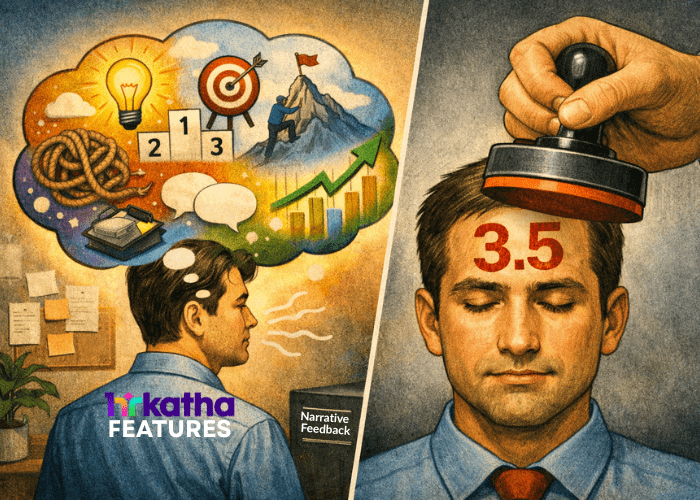
The case for narrative feedback rests on a simple observation: human performance is complicated. Numbers flatten it.
Reducing a year’s worth of work to a single score—whether 3.7 or “meets expectations”—compresses nuance into blunt categorisation. It transforms complex contributions into administrative shorthand.
Narrative feedback, by contrast, promises context. Instead of a number, employees receive descriptive evaluations highlighting specific achievements, explaining where improvement is needed, and offering guidance on development. The conversation shifts from “you scored a 3” to “here’s what you did well, here’s where you struggled, and here’s how we think you can grow.”
This matters particularly as employees increasingly expect meaningful development conversations rather than transactional performance reviews. Research consistently suggests people perceive qualitative feedback as more constructive and fair than numerical scores alone.

“It’s very important to have feedback which is qualitative, with specific examples.”
Raj Narayan, Former CHRO, Titan and Co-Founder & Lead Mentor, The CrossMentors

Raj Narayan, former CHRO, Titan and co-founder &lead mentor, The CrossMentors, articulates the problem with traditional rating-driven systems: managers fixate disproportionately on the score rather than the substance beneath it. “It’s very important to have feedback which is qualitative, with specific examples,” he argues. “That helps people understand where they’ve gone right and where they need to do better.”
When employees are slotted into categories—A, B, or C—the label can overshadow everything else. The nuance disappears. The developmental conversation gets lost. What remains is a grade that affects morale, motivation, and often the employee’s entire relationship with the organisation.
For companies seeking more transparent and empathetic cultures, narrative feedback appears to offer a more balanced approach—one that treats employees as individuals rather than data points.
The stubborn persistence of numbers
Yet for all its philosophical appeal, narrative feedback confronts an inconvenient reality: organisations need to make decisions. At scale.
Rajorshi Ganguli, president and global head of HR at Alkem Laboratories, frames the challenge clearly: “Even if I have to rate someone, the rating is an outcome of a feedback process.” In other words, narrative feedback and ratings are not competing philosophies. They are sequential steps in the same evaluation process.
“Even if I have to rate someone, the rating is an outcome of a feedback process.”
Rajorshi Ganguli, president and global head-HR, Alkem Laboratories
Typically, managers begin with qualitative assessments—describing contributions, highlighting strengths, identifying development gaps. The rating then distils this information into a form that enables organisational decision-making around rewards, promotions, and resource allocation.
The administrative challenge becomes acute in large organisations. Without structured ratings, determining increments and bonuses becomes highly discretionary. Ganguli offers a useful analogy: “If there are a hundred students, you can say one student is good and another needs improvement. But at the end of the day, how do you qualify them? That’s where marks come.”
Similarly, in corporate environments, ratings provide the standardisation needed to differentiate performance and link it transparently to compensation decisions. Remove that structure, and ambiguity often increases rather than decreases.
The problem with abolishing grades
The experience of organisations that have eliminated ratings entirely suggests the issue is more complicated than simply choosing words over numbers.
When Accenture abandoned annual ratings in favour of continuous feedback, it aimed to focus more on development and less on administrative scorekeeping. Adobe’s “Check-In” process similarly emphasised regular manager-employee conversations about expectations and growth rather than year-end assessments.
These changes addressed real problems—particularly the toxic competitiveness fostered by forced rankings and rigid bell curves. Yet eliminating formal ratings has not eliminated evaluation itself. It has merely obscured it.
According to HR leaders, removing official scores often produces what some call “shadow ratings”—informal assessments that still influence decisions but without transparency. Managers still judge performance; the difference is that the judgement becomes informal and harder to challenge.
Narayan identifies the core dilemma: “The organisation needs to have a sense of who the people are who have outdone themselves and who the stars are. Without some form of differentiation, it becomes difficult to reward performance.”
In such cases, removing ratings can paradoxically reduce clarity rather than increase it. Employees struggle to understand how decisions around compensation or promotions are being made. Trust in the appraisal process—the very thing narrative feedback is meant to strengthen—can deteriorate when the evaluation criteria become opaque.
The uncomfortable truth is that differentiation does not disappear simply because ratings do. It merely moves underground.
The hybrid compromise
Faced with these realities, many organisations are gravitating towards hybrid models that attempt to reconcile narrative richness with structural clarity.
In such systems, continuous feedback and developmental conversations occur throughout the year, providing employees with ongoing guidance. Ratings then serve as transparent mechanisms for final evaluation when reward decisions must be made.
Instead of complex numerical scales, some companies use broader descriptors—”exceeded expectations,” “met expectations,” “developing”—that maintain differentiation whilst avoiding false precision.
This approach attempts to capture the advantages from both models. Narrative feedback delivers meaningful developmental insights. Ratings ensure fairness and transparency when organisations must allocate limited resources across large populations.
The theory is elegant. Execution is far messier.
Providing thoughtful, detailed feedback requires preparation, empathy, and communication skills—skills many managers were promoted without ever being taught. Without investment in managerial capability, even the most elegantly designed hybrid system will fail in practice.
Building the muscles that matter
Improving performance conversations demands more than system redesign. It requires developing organisational capabilities that many companies have systematically neglected.
Managers need training in how to provide constructive feedback supported by concrete examples rather than vague generalisations. Equally important, employees need preparation for these discussions—documenting achievements, articulating challenges, and defining development goals.
“Managers need to prepare, but employees also need to prepare for these conversations,” Narayan emphasises. “It’s a two-way dialogue.”
Calibration processes—structured discussions across leadership levels to ensure ratings are applied consistently—become even more critical in hybrid systems. These discussions help identify and correct biases from managers who are either excessively strict or overly generous in their evaluations.
Without such infrastructure, narrative feedback risks becoming either meaningless platitudes or vehicles for unexamined bias. The quality of the conversation matters more than the format.
The real transformation
As work becomes increasingly knowledge-driven and collaborative, the limitations of purely numerical ratings grow more apparent. Employees want feedback that helps them develop, not just a number summarising their year. Research, employee surveys, and the competitive dynamics of talent markets all point in this direction.
Yet numbers continue to serve important functions in large organisations where decisions must be standardised, defensible, and transparent. The administrative reality of managing thousands of employees does not disappear simply because the HR philosophy changes.
The future of performance management, therefore, probably does not involve choosing between narrative feedback and ratings. It involves redefining how the two interact.
Narrative feedback can shape richer, more meaningful conversations about performance. Ratings can provide the structure organisations legitimately need to make fair and consistent decisions at scale.
The real transformation may not be the elimination of ratings, but the elevation of the conversation that precedes them. The discussion becomes primary; the score becomes derivative.
This is admittedly less revolutionary than abolishing ratings altogether.
But it has one considerable advantage over revolution: it might actually work.