



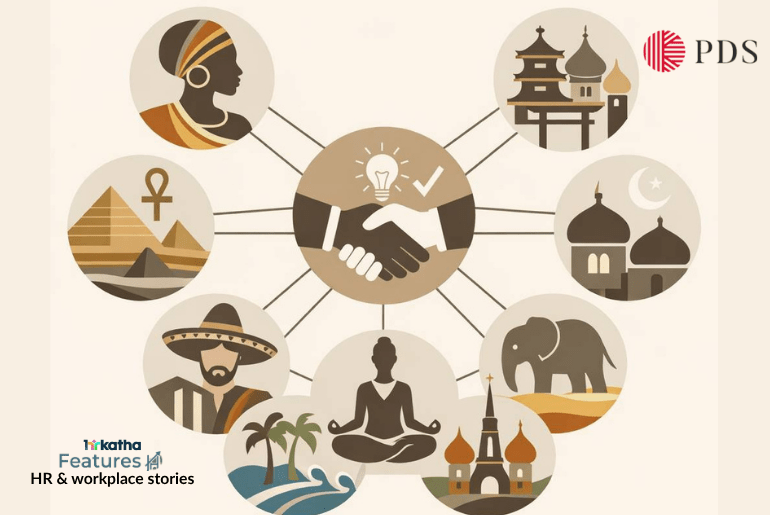
Global organisations face a familiar temptation as they grow: standardise everything. Uniform policies. Consistent behaviours. A single cultural template applied across every geography.
The logic is obvious. Consistency reduces friction, simplifies management, and creates predictability.

PDS, a fashion infrastructure company operating across more than 100 offices in 24 countries, 40 business verticals, and among employees representing over 40 nationalities, has chosen a different path.
“My job is not to have one culture, but get all these distinct country cultures remain as they are, while still threaded together with a single identity which is PDS,” says Prakhar Shrivastava, global HR lead, PDS.
The challenge, of course, is execution. Preserving local identity while maintaining global cohesion sounds attractive. Doing it across 24 countries is considerably harder.
The three Ts and the politics problem
PDS anchors its shared identity around three values: trust, transparency, and teamwork. More distinctively, the organisation explicitly seeks to minimise bureaucracy and internal politics.
“We absolutely believe in no politics, no bureaucracy, no power centres,” Shrivastava says.
The ambition is admirable. The reality is that politics and power centres tend to emerge naturally as organisations grow. The test is not whether they disappear entirely, but whether structures exist to limit their influence.
“My job is not to have one culture, but get all these distinct country cultures remain as they are, while still threaded together with a single identity which is PDS.”
Prakhar Shrivastava, global HR lead, PDS

Shrivastava describes an entrepreneurial culture where employees are expected to solve problems proactively rather than wait for instructions. In a business shaped by shifting consumer preferences, sourcing challenges, and global supply chains, that agility carries genuine commercial value.
Internal mobility as succession strategy
PDS uses a nine-box assessment framework to identify leadership potential and then develops selected employees through stretch assignments, cross-functional exposure, and mentoring.
According to Shrivastava, most leadership positions created over the past two to three years have been filled internally. If accurate, that signals a talent-development system producing visible outcomes and careers that progress within the organisation.
Internal promotion is encouraging. Whether it reflects exceptional development or simply reduced external hiring is harder to determine.
PDS also sends selected high-potential employees to programmes at Harvard, ISB, IITs, and IIMs. Such exposure broadens perspectives beyond the organisation’s own operating environment and reduces the risk of leadership becoming inward-looking.
Localised learning across 24 countries
Learning is structured through the PDS Learning Academy for middle managers and the PDS Leadership Academy for senior leaders, built around the familiar 70-20-10 framework: 70 per cent on-the-job learning, 20 per cent through interaction, and 10 per cent through formal training.
The framework is familiar. The challenge lies in execution. Delivering consistent learning quality across 24 countries, multiple time zones, and highly varied business verticals is considerably harder than designing the framework itself.
Shrivastava says capability building spans technical skills, domain expertise, and behavioural competencies. Whether all employee groups experience the same quality of development is difficult to assess externally, but the complexity of the task is undeniable.
The 58% problem
Women constitute 58 per cent of PDS’s workforce. Women occupy 30 per cent of board positions.
The gap reveals a familiar pattern. Women enter organisations in strong numbers but remain underrepresented at senior levels.
Shrivastava addresses the issue directly. “As life stages happen in the lives of women, some of the women drop out,” he says.
The candour is refreshing. Many organisations celebrate hiring numbers while paying less attention to progression challenges. Caregiving responsibilities, societal expectations, and career interruptions continue to shape leadership pipelines in ways that hiring targets alone cannot address.
PDS has introduced flexibility measures and localised interventions to support continuity through different career stages. In India, this includes menstrual leave alongside standard benefits.
“This is a long journey,” Shrivastava acknowledges.
The numbers suggest he is right. Closing the gap requires more than flexibility policies. It demands sustained attention to sponsorship, succession, and the structural factors that shape leadership progression.
Wellness without prescription
PDS approaches employee wellness much as it approaches culture: through localisation rather than central direction.
During Wellness Month and Wellness Day initiatives, employees across locations define wellness according to their own contexts. Some focus on healthier food choices. Others organise yoga sessions, sporting activities, beach walks, or hikes.
“We practically opened the canvas,” Shrivastava says.
The philosophy reflects a belief that what resonates in Bangladesh may not resonate in London or Sri Lanka. Local relevance matters more than programme uniformity.
The risk, however, is inconsistency. Open frameworks can encourage creativity, but they can also produce uneven effort across locations. The effectiveness of such an approach ultimately depends on whether local leaders treat wellness as a priority rather than an optional activity.
The standardisation pressure ahead
The real test of PDS’s philosophy lies ahead.
Most organisations celebrate cultural diversity during growth phases. As they become larger and more complex, standardisation usually follows. Investors demand comparable metrics. Compliance requirements multiply. New leaders bring familiar management models.
Shrivastava recognises the challenge. “Ensuring the belief that we have of having everyone unique and still threaded together with one idea of PDS identity will be the biggest challenge.”
PDS is attempting something different: preserving local identities while maintaining a shared organisational core.
Whether that balance survives further growth remains uncertain. But in a business spanning 24 countries and more than 40 nationalities, the challenge is not creating one culture. It is ensuring many cultures can still recognise themselves in the same organisation.