


Hero FinCorp operates in a sector where most employees serve customers directly. That changes the nature of the HR challenge. The debate is not about where work happens but about how effectively it gets done. In a fast-growing, tightly regulated NBFC, HR cannot afford to remain a process function. It has to become a business function that happens to work through people.
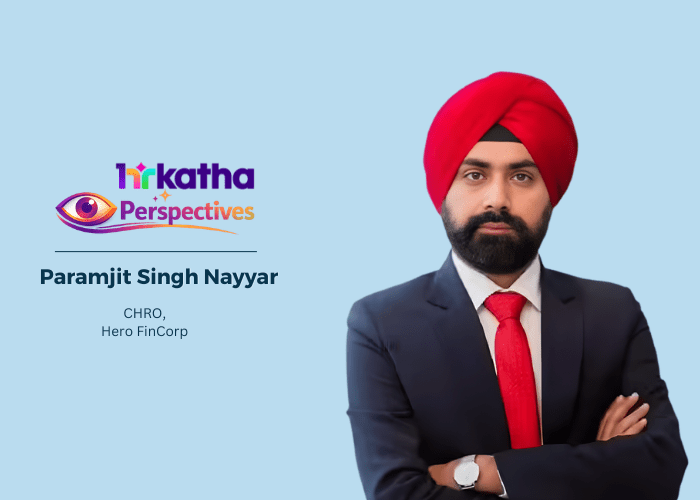
Paramjit Singh Nayyar has been driving that shift as CHRO. In conversation with HRKatha, he explains why stay interviews reveal far more than exit interviews, why the three HR metrics that matter to his board are all business metrics, and why credibility is earned by answering one question: how will this people decision improve business performance?

Designing work around the customer
Unlike many industries where hybrid work dominates the conversation, most employees in an NBFC serve customers directly. How do you design an employee experience that balances business realities with evolving workforce expectations?
The future of work in NBFCs is not about choosing between working from home and working from the office. It is about designing work around customer needs.
Nearly 80 to 85 per cent of our workforce serves customers directly, making physical presence essential. Corporate and support functions have greater flexibility. Recognising that difference is fundamental to designing the right employee experience.
Over the past few years, we have learnt that employee experience extends well beyond where people work. Our focus has been on digitising employee journeys, simplifying HR processes, strengthening manager capability, investing in continuous learning and improving employee well-being.
Flexibility matters. Purpose, opportunities for growth and strong leadership matter even more.
Being a strategic partner ultimately comes down to one question: how will this people decision improve business performance?
What stay interviews reveal
Beyond compensation, what have stay interviews taught you about why people leave, and how do you address those issues before attrition becomes inevitable?
Compensation is rarely the primary reason people leave.
Our stay interviews showed that employees were leaving because they struggled to see long-term career opportunities, experienced inconsistent manager capability, found processes cumbersome, felt insufficiently recognised or faced earnings volatility in frontline roles. Those insights rarely emerge from exit interviews, where responses are shaped by the decision to leave rather than the experience of staying.
Instead of relying solely on exit interviews, we introduced stay interviews, predictive attrition dashboards, manager effectiveness reviews, early warning indicators and structured career mobility programmes. Together, these have improved retention of critical talent while strengthening overall engagement.
I have always believed that people do not leave organisations. They leave when they no longer see a future for themselves.
The board is not interested in how many people HR hired. It wants to know whether the organisation is becoming more productive, more profitable and better prepared for future growth.
Three metrics, all business metrics
If you had to demonstrate HR’s contribution using only three metrics that matter to the CEO and the Board, what would they be?
If I had to present only three HR metrics to the board, they would all be business metrics.
The first is business productivity, measured through assets under management or sales per employee. As the business grows, productivity should improve faster than headcount.
The second is leadership pipeline strength. Today, most critical leadership roles are filled internally, reducing hiring risk while ensuring continuity.
The third is profitability per employee. Whether the intervention involves organisation design, digitalisation, capability building or workforce optimisation, the objective must ultimately be to improve business economics.
The board is not interested in how many people HR hired. It wants to know whether the organisation is becoming more productive, more profitable and better prepared for future growth.
People do not leave organisations. They leave when they no longer see a future.
Speaking the language of business
What has actually earned HR credibility with business leaders at Hero FinCorp, and what does being a strategic partner look like in practice?
HR earns credibility when it starts speaking the language of business outcomes rather than HR processes.
Conversations about assets under management, productivity, cost-to-income ratio, portfolio quality, non-performing assets and return on assets resonate far more with business leaders than discussions centred on recruitment volumes or policy compliance.
Our role has never been limited to hiring people. It is about shaping the organisation, strengthening leadership capability, improving frontline productivity and ensuring governance keeps pace with business growth.
Being a strategic partner ultimately comes down to one question: how will this people decision improve business performance?
Flexibility matters. Purpose, opportunities for growth and strong leadership matter even more.
Disclaimer: The views expressed by the interviewee are personal and do not necessarily represent the views of the organisation.