



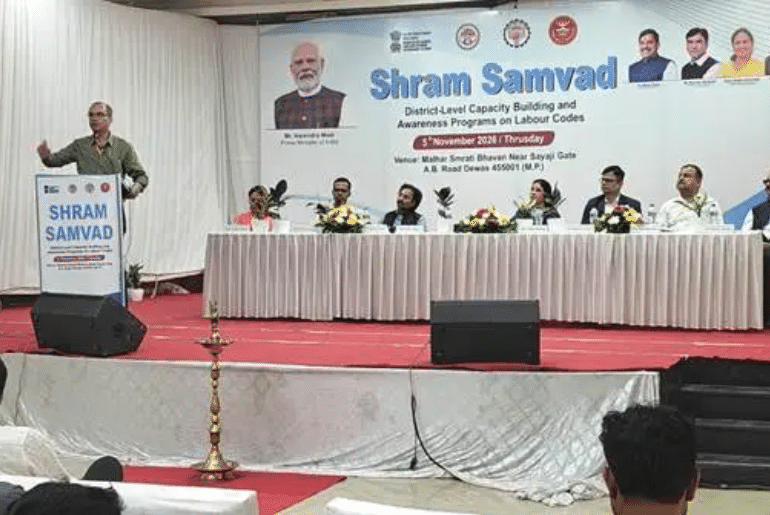
The Ministry of Labour and Employment (MoLE), Government of India, in collaboration with the Labour Department, Government of Madhya Pradesh, organised a district-level capacity-building and awareness programme, Shram Samvad, in Dewas, Madhya Pradesh, on 5 November, 2026. The programme was organised in association with the Association of Industries Madhya Pradesh and Sun Pharmaceutical Industries.
The initiative aimed to strengthen awareness among employers and HR, legal and finance professionals about the Labour Codes and the rules framed under them. It also focused on improving institutional capacity around labour reforms, welfare and social protection, while encouraging coordination between the Centre and state governments and greater engagement with industry stakeholders.
The event brought together senior officials from the Ministry of Labour and Employment, the Madhya Pradesh Labour Department, the Employees’ Provident Fund Organisation (EPFO), the Employees’ State Insurance Corporation (ESIC), the Chief Labour Commissioner (Central) and the Directorate General Labour Welfare (DGLW). More than 100 participants from industry, employers, and HR, legal and finance functions attended.
A series of technical sessions formed the core of the programme, with officials from MoLE explaining the compliance requirements under each of the four Labour Codes and the Central Rules notified under them.
The sessions focused on employers’ statutory obligations and compliance responsibilities, offering practical guidance on the operational aspects of the new labour framework. The discussions were intended to help organisations and their compliance teams better understand the requirements and prepare for effective implementation.
Representatives from EPFO and DGLW also conducted sessions on two government social-security initiatives: the Pradhan Mantri Viksit Bharat Rozgar Yojana (PMVBRY) and the Pradhan Mantri Shram Yogi Maandhan (PM-SYM) Scheme.
To support employers and compliance professionals, the Ministry also shared its ‘Handbook of Compliance for Employers’ and a ‘Compilation of Frequently Asked Questions’. These resources were developed to provide guidance on the implementation of the Labour Codes and the associated rules.
An interactive question-and-answer session gave participants an opportunity to raise queries and seek clarification on labour legislation, compliance requirements and social-security provisions.
By bringing together Central and state government representatives, statutory bodies and industry stakeholders, Shram Samvad sought to bridge the information gap around labour reforms and strengthen employers’ understanding of their responsibilities. The programme also provided a platform for direct engagement between policymakers, enforcement authorities and industry representatives on the practical aspects of labour code implementation.
